
Childminder vs Nursery in the UK
Compare childminder vs nursery care in the UK, including Ofsted rules, ratios, costs, SEND support, questions to ask and practical next steps.
You're comparing a childminder near home with a nursery that may offer longer hours, wider facilities and a more predictable structure. One parent needs wraparound care, the other works irregular shifts, and the cheapest option on paper may create an exhausting daily journey. Meanwhile, your child's age, temperament, sleep routine, SEND needs and relationship with familiar adults all matter just as much as the fee.
There's no universal winner in the childminder vs nursery decision. A childminder usually offers small-group, home-based care with strong continuity. A nursery generally provides a larger team, dedicated rooms, broader peer interaction and greater cover when staff are absent. The right choice is the setting that works on an ordinary Tuesday, not just during a friendly tour.
Table of Contents
- Choosing Between a Childminder and a Nursery
- How Childminders and Nurseries Differ
- Comparing Costs and Funded Childcare
- Which Option Suits Different Family Needs
- Inspections, Safety and Visit-Day Questions
- Using Nursery Advice to Shortlist Providers
- Making the Right Childcare Decision
Choosing Between a Childminder and a Nursery
Start with your family's week, not with the label attached to the provider. Write down the exact time your child must arrive, the latest collection time, school runs, commuting time, naps, meals and the days when work patterns change. A childminder may be able to discuss flexible drop-offs, collections, wraparound care or unusual hours, while a nursery may offer more dependable standard sessions. Neither arrangement helps if it leaves you late for work or regularly rushing your child.
Local availability can decide the issue before preference does. England had 24,700 Ofsted-registered childminders on 31 March 2026, down from the previous year, while the wider Ofsted-registered market contained 60,400 providers and 1.29 million places. The official Ofsted childcare providers and inspections findings shows why families should search widely. Childminders remain a substantial part of provision, but nurseries and other group settings account for much of the available capacity.
Set your non-negotiables first
Before contacting providers, decide which requirements cannot be compromised:
- Hours: Include commuting, school collections and occasional late finishes.
- Start date: Ask whether a place is available, rather than assuming a waiting-list position guarantees one.
- Funding: Check whether the setting accepts the entitlement you expect to use and what charges remain.
- SEND support: Ask who coordinates support and how adjustments are made in practice.
- Continuity: Decide whether one familiar adult matters more than access to a larger staff team.
- Emergency cover: Find out what happens during sickness, holidays, closures or unexpected collection problems.
A smaller setting isn't automatically more nurturing, and a larger nursery isn't automatically more educational. Judge what your child experiences, including how adults respond to distress, how routines are adapted and whether the setting can meet needs consistently.
Practical rule: Compare both providers against the same weekly routine. The setting that sounds best in general terms may be the wrong one for your actual household.
Families can also use a daily report app for daycare families to keep track of meals, naps, activities and handovers when comparing how well a setting communicates with home. That information can be useful during settling-in, particularly when your child can't yet explain how the day went.
How Childminders and Nurseries Differ
A registered childminder provides care from a domestic home and may work with assistants within the limits of their registration. A nursery operates from dedicated premises, usually with rooms or areas organised around children's ages and stages. Both can provide high-quality early education, but they deliver it through different business and staffing models.
| Feature | Childminder | Nursery |
|---|---|---|
| Setting | Domestic home, often with a home-from-home routine | Dedicated childcare premises with planned rooms and resources |
| Group format | Small, mixed-age group | Usually larger groups organised by age |
| Staffing | One childminder, sometimes with assistants | A wider team, with cover and shared responsibilities |
| Capacity | Maximum of 6 children under 8 at one time, subject to age limits, according to Ofsted guidance on staff-to-child ratios | Age-banded ratios, including 1:3 for under-twos, 1:5 for two-year-olds, and 1:8 or 1:13 for three- and four-year-olds depending on qualification conditions, as set out in the same guidance |
| Registration | Ofsted or a childminder agency, depending on the route used | Ofsted registration as a childcare setting |
| Inspection | Graded inspection and written report | Graded inspection and written report |
| Routine | Often adaptable around the children and household | Usually more structured, with planned sessions and room routines |
| Sibling care | Mixed ages can make keeping siblings together easier | Siblings may be placed in different rooms |
| Facilities | Dependent on the home, local outings and available equipment | Often includes dedicated indoor and outdoor spaces |
| Best practical strength | Continuity and flexibility | Team capacity and consistency of provision |
The childminder ratio is a genuine structural limit, not merely a description of a typical group. Under the EYFS childminder requirements, the maximum includes the childminder's own children and others they're responsible for. No more than three of the six may be young children, and only one may be under one.
Nursery ratios are more flexible because they operate through staffing and age bands. That lets a nursery expand provision across cohorts, but parents should ask how ratios work in the room their child will join. A registration is only the starting point. Visit the setting, read the report, ask about current staffing and check whether the arrangements described still reflect daily practice.
For a practical explanation of the registration route and the responsibilities involved, families can also review this guide to becoming a childminder in the UK.
Comparing Costs and Funded Childcare
There isn't a dependable single UK price for either a childminder or a nursery. Fees vary with location, the child's age, contracted hours, meals, nappies, consumables, outings, extra sessions and local demand. A childminder may quote an hourly or daily rate and negotiate a pattern that suits irregular work, while a nursery may use hourly, daily or sessional pricing tied to fixed terms.
Ask every provider for a written fee schedule. It should show:
- Core fees: The charge for the exact hours you need.
- Minimum booking: Whether you must pay for full days or fixed sessions.
- One-off charges: Registration fees, deposits and waiting-list conditions.
- Extras: Meals, nappies, consumables, outings and additional activities.
- Late collection: The charge and how the provider handles repeated lateness.
- Closures: Holiday, training and inset-day arrangements.
- Funding terms: Which hours are funded and what costs remain payable.
The correct calculation is weekly, not headline-based. Use this worksheet for each shortlisted provider:
| Calculation | Your figure |
|---|---|
| Required hours each week | |
| Funded hours available | |
| Paid top-up hours | |
| Core weekly fee | |
| Meals and consumables | |
| Registration or other recurring charges | |
| Total weekly cost |
The funded offer has strict limits. All three- and four-year-olds are entitled to 15 hours a week for 38 weeks a year, equal to 570 hours annually, and the annual total cannot exceed that amount if a child attends more than one setting. The government guidance on 15 funded hours explains why splitting care between a nursery, childminder or other setting needs careful calculation.
Eligible families may also qualify for funded provision for some two-year-olds or additional working-family hours, but don't assume every provider offers the same pattern. Tax-Free Childcare and Universal Credit childcare support can affect the final bill too. Funding may not cover meals, consumables or hours outside the funded session, so ask before accepting a place.
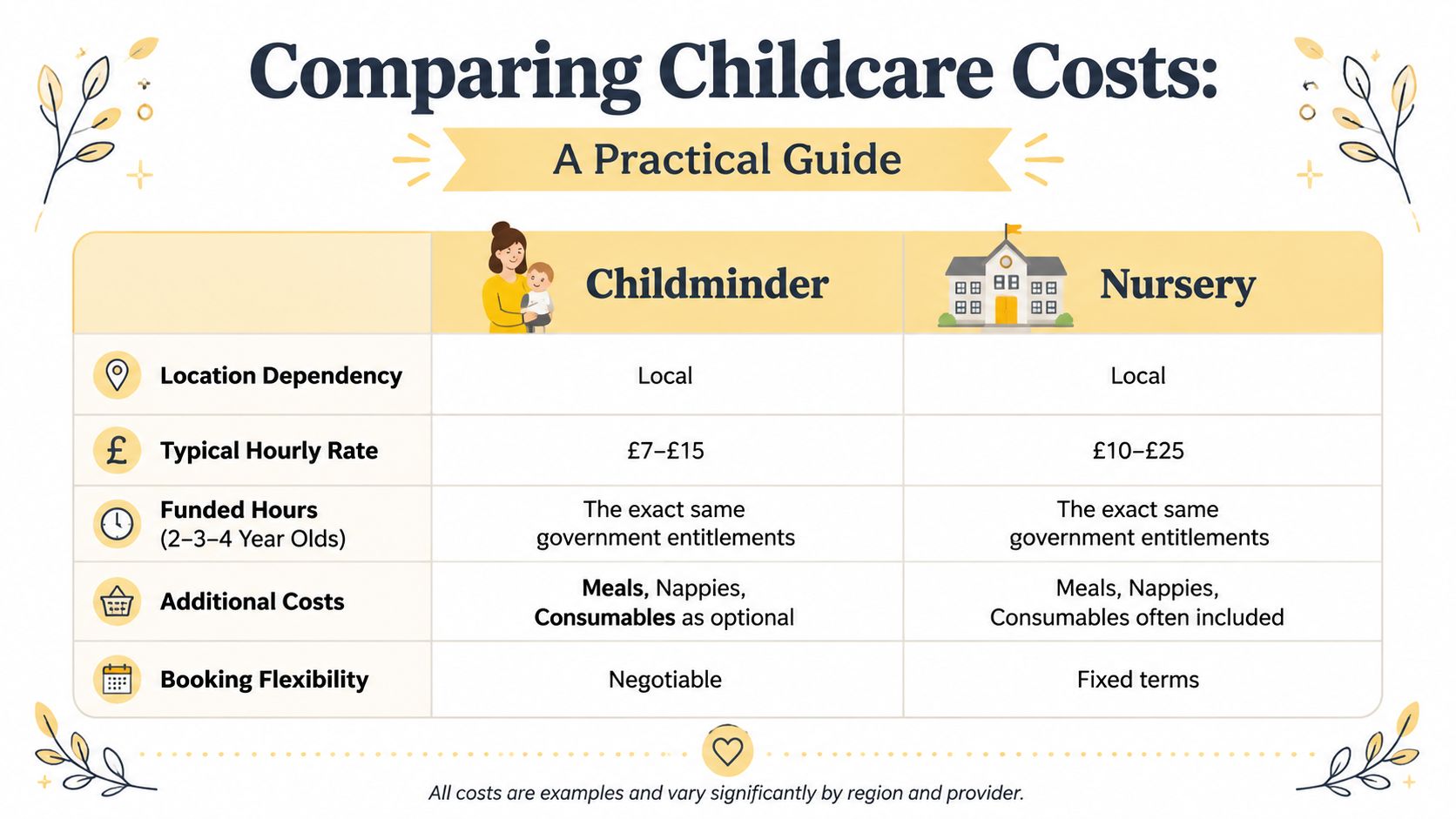
For a plain-English explanation of eligibility and application routes, use this guide to free childcare hours, then confirm the detail directly with your local authority and chosen provider.
Which Option Suits Different Family Needs
Age changes the balance. Babies often benefit from a calm routine and a small number of consistent adults, which can make a childminder attractive. A nursery may still be the better choice if you need dependable cover, a dedicated baby room or access to a larger team with staff who can share responsibility throughout the day.
Toddlers can thrive in either setting. A child who becomes overwhelmed in a busy room may settle more easily with a childminder and a mixed-age group. Another toddler may seek constant peer interaction, enjoy group activities and gain confidence from the nursery's wider social environment.
Preschool children often benefit from a nursery's structured preparation for school, group experiences and planned learning opportunities. That doesn't mean a childminder can't support development. The individual practitioner's understanding of the EYFS, communication with parents and ability to offer suitable experiences matter more than the building.
| Situation | Often better fit | Why |
|---|---|---|
| Baby needing a familiar adult | Childminder | Smaller groups can support continuity and an individual routine |
| Child who enjoys busy peer interaction | Nursery | Larger groups may offer broader social opportunities |
| Siblings needing care together | Childminder | Mixed-age care can keep siblings in one place |
| Complex SEND needs | Nursery, subject to assessment | A larger team may provide broader resources and staffing cover |
| Anxious child or difficult separation | Childminder | A consistent home setting may feel less overwhelming |
| Shift work or variable hours | Often childminder | Hours may be more negotiable, although availability varies |
| Long, predictable working days | Nursery | Fixed sessions and team cover may provide greater reliability |
| Rural location | Whichever has a suitable registered place | Local supply can outweigh theoretical advantages |
SEND provision deserves direct questioning rather than assumptions. Ask how the setting identifies needs, who acts as the Special Educational Needs Coordinator, what adaptations are available and how the provider works with parents and other professionals. A nursery may have more built-in resources and staff cover, while a childminder may offer quieter one-to-one support. Neither arrangement is sufficient unless the actual provider can meet your child's needs.
The same applies to sickness and holidays. A childminder may offer an unusually close relationship, but one practitioner's absence can affect the whole arrangement. A nursery usually has a larger team, though your child may see different adults across the week.
The individual practitioner matters as much as the setting type. Watch how adults speak to children, respond to conflict and adapt routines. That evidence is more useful than a generic promise of personalised care.
Inspections, Safety and Visit-Day Questions
Use inspection evidence as a filter, not as your final decision. Ofsted registration confirms that the provider is within the regulatory framework, while the report gives a snapshot of quality, compliance and any required action. Read the date, grade, report detail and action points. A strong grade doesn't remove the need to ask what has changed since the inspection.
Ask the same questions everywhere
Take a written list to every visit:
- Ratios in practice: How many children and adults will be present during arrivals, meals, sleep and outdoor play?
- Staffing cover: What happens when a key adult is ill, on holiday or attending training?
- Safeguarding: Who is the safeguarding lead, and how can parents raise a concern?
- Medicines: How are prescriptions stored, authorised and recorded?
- Evacuation: How are fire drills and emergency arrangements managed?
- SEND inclusion: Who coordinates support, and what adjustments can be made?
- Settling in: What does the transition plan involve, and can it be phased?
- Complaints: Who handles complaints, and what is the formal process?
A nursery should be able to explain room ratios and staff deployment. A childminder should explain how the legal total works when their own children, assistants or other responsibilities are present. If the answer is vague, ask for the arrangement in writing.
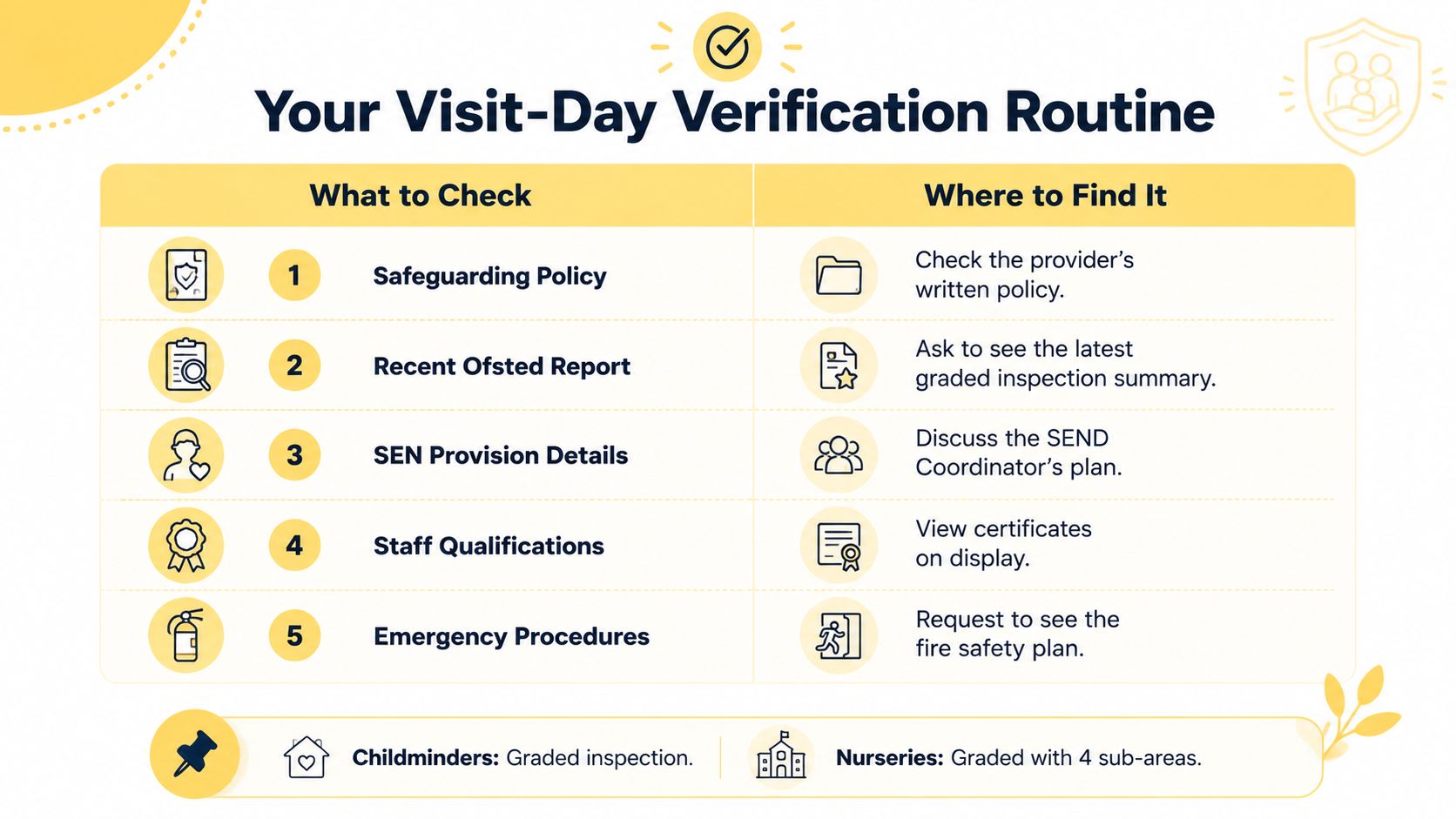
Look beyond polished rooms. Notice whether adults get down to children's level, whether children appear settled and engaged, whether the space is clean and well maintained, and whether outdoor access is practical rather than merely advertised. Ask to see the safeguarding policy, SEND information, emergency plan and latest inspection report.
The government explains that most providers caring for children under eight must register with Ofsted or a childminder agency and that EYFS-registered providers must meet statutory requirements through the official childcare registration guidance. You can also use this explanation of background checks for childcare volunteers when considering the wider safeguarding questions around helpers, students or volunteers. The provider should still explain its own recruitment and checking procedures.
Using Nursery Advice to Shortlist Providers
A sensible search begins with a postcode and a fixed list of requirements. For example, a family needing care for a toddler on working days might filter by age range, funded hours, SEND support, opening hours, inspection date and Ofsted grade. That approach removes settings that look attractive but can't meet the family's hours or start date.
Save promising providers instead of relying on browser tabs. Record the distance, opening pattern, funding position, latest report date and any unanswered questions. A childminder with an excellent personal fit may be impractical if the journey depends on a school run at the same time as your commute. A nursery farther away may offer the required hours but create pressure every morning.
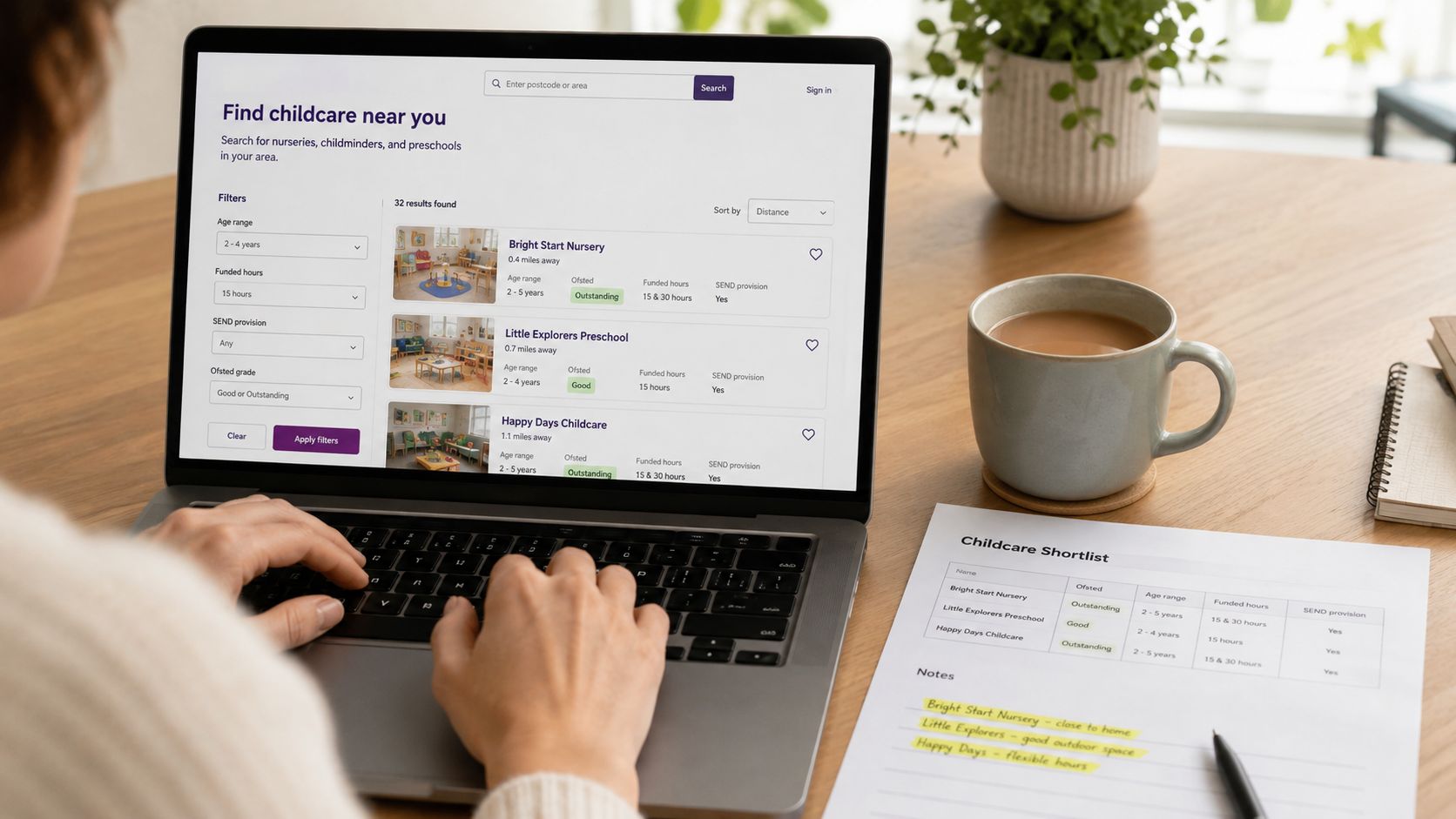
Use a side-by-side comparison to keep the evidence consistent. Put inspection findings, fees guidance, opening hours, waiting-list information and policies next to each other, then mark what's confirmed and what still needs checking. Don't treat a grade as a complete verdict. Read the substance of the inspection report, including any action points, and compare it with what you observe during a visit.
A shortlist should become smaller as evidence improves. Once you've narrowed it to around four providers, arrange visits and ask every setting the same core questions. Keep notes immediately afterwards, because a warm conversation can otherwise blur important differences in ratios, fees, travel and settling-in arrangements.
Making the Right Childcare Decision
Make the decision by weighing evidence against priorities, not by counting advantages. Start with the factors that could make a placement fail: unsuitable hours, an impossible journey, missing SEND support, unclear funding terms or no workable emergency arrangement. A setting that fails one of those tests shouldn't remain on the shortlist because its environment is appealing.
A nursery is usually the stronger recommendation when your child enjoys groups, you want structured routines and social breadth, or your household needs the resilience of a larger team. It can also be preferable when your child needs specialist input that requires several trained adults, dedicated resources or cover across the day.
A childminder is often the better recommendation for a baby who needs continuity, siblings who must attend together, a child who finds large groups stressful, or parents whose work pattern doesn't match standard nursery sessions. The small-group model can provide a home-like rhythm, but check the legal capacity, holiday arrangements and absence plan before committing.
Mixed arrangements can solve problems that neither setting can handle alone. A childminder may provide school collection or wraparound care while a nursery or preschool supplies structured sessions. Just remember that funded hours have an annual limit when care is split between settings, so calculate the combined arrangement carefully rather than assuming each provider offers a separate allowance.
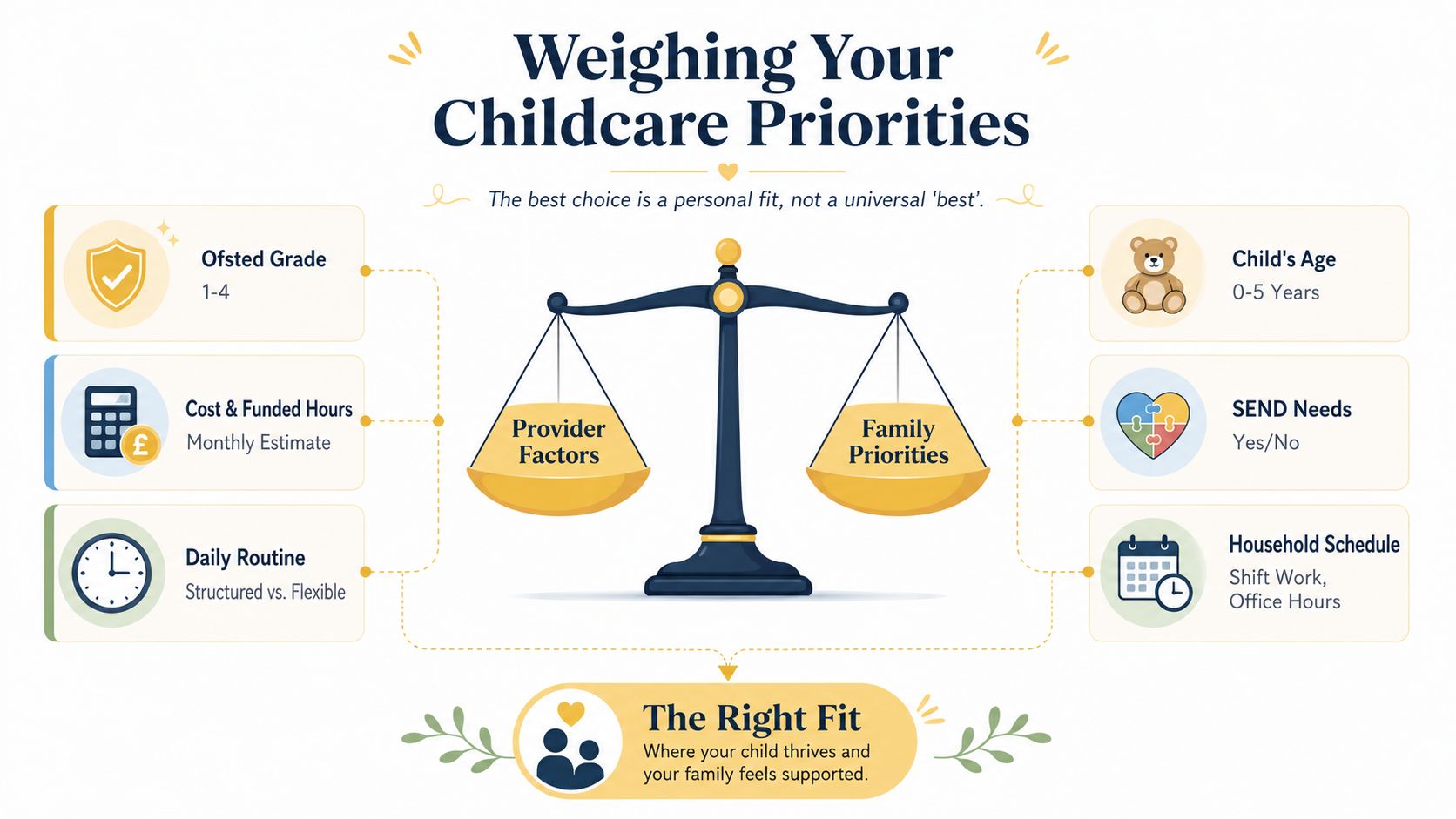
Use this final routine:
- Shortlist two or three realistic settings that meet your hours and travel limits.
- Request the latest inspection information and read the action points.
- Ask identical questions about ratios, safeguarding, SEND, sickness and settling in.
- Calculate the cost after funded hours and extras.
- Visit before signing and write down how your child responds to the environment.
- Review the choice if your child's needs, work pattern or placement quality changes.
Preparing your child and home for a new arrangement can also be easier with practical guidance on stress-free nursery preparation. Switching later isn't a failure. Children's needs change, and a different setting can build on the security, relationships and experiences they've already gained.
Use Nursery Advice to search UK childcare providers by location, compare inspection evidence, check practical details and create a focused shortlist before booking visits. Start with your postcode and essentials, save the settings that fit, then contact the strongest options directly to confirm availability, fees, funding and SEND support.