
How to Choose a Nursery in the UK Without Regret
Learn how to choose a nursery in the UK with our step-by-step parent guide. Compare Ofsted reports, fees, hours and SEND support before you decide.
The nursery search often begins with a calendar problem, not a quality problem. Maternity leave is ending, your partner is already back at work, the auntie who agreed to help is booked for two days a week, and suddenly you're trying to secure a place before the first week back becomes impossible. A beautiful setting that closes before your commute ends won't solve that problem, however impressive its playroom looks.
The sensible answer is fit first, grade second. Ofsted evidence matters, but so do opening hours, the actual route from home to work, funded-hour conditions, fees outside the entitlement and the setting's ability to support your child. This guide gives you a practical way to compare nurseries without mistaking a polished website or an old Outstanding judgement for a workable arrangement.
Table of Contents
- When Choosing a Nursery Actually Starts
- Building a Shortlist by Postcode and Filters
- Reading Ofsted Reports Beyond the Headline Grade
- Comparing Fees Funded Hours and SEND Support
- What to Ask and Watch on a Nursery Visit
- Red Flags Most Parents Miss
- Your Final Decision Checklist and Timeline
When Choosing a Nursery Actually Starts
A nursery search should begin with the month you need care, not with a favourite setting's website. Waiting-list arrangements vary between local authorities and providers, so there is no single UK-wide deadline that secures a place. Work backwards from your intended start date and contact nurseries early, particularly if you need a baby room or a limited pattern of days.
Your child's due date and your maternity-leave plan affect the timing. A setting may need to confirm availability before you are ready to enrol. Starting in the third trimester is not automatically too late, but it can leave fewer choices at popular nurseries. Use this guidance on when to start sending your child to nursery to sense-check your proposed timing, then ask local providers what their waiting lists require.
Before arranging viewings, write down the week the nursery must cover:
- What does work really involve? Include office and home-working days, compressed hours, school runs for older children and the person who can collect if a meeting overruns.
- What is the daily route? Check the journey from home to nursery and then to work at the time you will travel. A setting that looks close on a map may fail during the morning rush.
- Which requirements are required? Separate safeguarding, workable hours, dietary or SEND support and affordability from preferences such as a large garden or a particular curriculum label.
Practical rule: Choose the nursery that can reliably cover your family's week, not the one that wins a beauty contest during a twenty-minute viewing.
Use Ofsted's latest report as a screening filter, not a final verdict. Check when the inspection happened and read the context behind the judgement. New colour-coded report cards may make results easier to scan, but they cannot tell you whether the hours, fees, funded entitlement and support arrangements fit your child. Those questions belong in your shortlist and your visit notes.
If you are preparing the room at home, resources to create a nursery with That Blanket Co can help with the domestic side. Keep that project separate from choosing childcare. A well-decorated room cannot compensate for an unreliable collection plan or support the wrong setting.
Building a Shortlist by Postcode and Filters
A good shortlist starts with geography. Use your local authority's Family Information Service to identify registered childcare nearby, then check each setting through Ofsted's official childcare search. These tools serve different purposes. The local service helps you understand provision in your area, while Ofsted confirms registration details and inspection evidence.
Search by postcode first, then narrow the results according to the care you need. Don't create a list of every nursery within reach. Filter for:
- Opening pattern: Is the setting open year-round, or does it operate term time only?
- Session structure: Does it offer full days, morning or afternoon sessions, or fixed blocks that clash with work?
- Age range: Does it take babies, or does it begin at toddler or pre-school age?
- Funding: Ask whether it accepts the relevant early education entitlement and whether it supports Tax-Free Childcare.
- Availability: Record whether the provider has an immediate place, a waiting-list option or no realistic opening.
The funding filter needs care. A nursery may accept funded hours but offer them only on particular days, in term-time patterns or alongside charges for meals, nappies and additional hours. Treat “funding accepted” as an invitation to ask for the full fee schedule, not as proof that the place will fit your budget.
Plot your finalists against the route you'll drive, walk or take by public transport. A five-mile straight-line distance tells you little about an eight o'clock journey with traffic, parking problems or a nursery entrance that adds time at both ends. Test the route at the hours you'll travel, including the collection journey.
Keep the list small enough to inspect properly
Cap the shortlist at five settings. More than that usually produces shallow comparisons, rushed visits and a spreadsheet full of details you can't remember. For each provider, record the inspection date, age range, opening hours, fee information, funded-hours conditions, SEND contact and likely start date.
Parents can also use an independent directory such as Nursery Advice, which presents nursery profiles with location, opening hours, fees guidance and inspection information. Use it as a comparison aid, then verify decisive details with the provider and official sources.
The shortlist is successful when every setting is plausible on a Monday morning. If the nursery only works when your train is punctual, your manager never schedules late meetings and your child never becomes ill, it doesn't work.
Reading Ofsted Reports Beyond the Headline Grade
Ofsted should be your screening filter, not your final decision. The familiar headline judgements remain Outstanding, Good, Requires Improvement and Inadequate, but Ofsted's newer report-card format presents information in a colour-coded summary designed to make key findings easier to identify. The report still needs reading. Colour helps you locate the signal, but it doesn't replace judgement.
Start with the inspection date. A recent report gives you more relevant evidence than an old report, particularly where staffing, leadership or the early years framework has changed. Ofsted's latest childcare release records 59,676 registered childcare providers in England on 31 March 2026, a fall of 720 providers, or 1%, from the previous year, with 1.31 million places on the Early Years Register. That changing supply makes current inspection and availability information especially important for families comparing local settings. Ofsted's latest childcare statistics also report that 98% of providers were judged good or outstanding at their most recent inspection.
That high overall result is precisely why the headline grade isn't enough. Look for the detail on safeguarding, staff deployment, transitions, children's experiences and the quality of education. Ask whether the comments describe the provision your child needs, rather than just confirming that the setting met the broad inspection threshold.
What to extract from the report
Read the parent-view responses as a soft signal, not as a vote. A cluster of concerns about communication may deserve a question during your visit, but an isolated online complaint shouldn't outweigh direct evidence about safety, care and leadership.
The report should also be read alongside the statutory expectations of the Early Years Foundation Stage. For a concise explanation of the framework and its background, Kuraplan's EYFS background is a useful orientation before you compare curriculum language between settings.
| Headline Grade | Inspection Recency | Safeguarding Comment | Practical Read |
|---|---|---|---|
| Outstanding | Old or unclear | Read the full detail | Recheck current leadership, staffing and practice |
| Good | Recent | Strong, specific evidence | Often a sound shortlist choice |
| Requires Improvement | Recent | Identify the exact weakness | Ask what has changed and how it's monitored |
| Inadequate | Re-inspected | Confirm the improved position | Consider only with clear evidence and direct questioning |
Ofsted's earlier England findings reinforce the need for context. On 31 March 2025, 98% of Early Years Register providers had a good or outstanding judgement, while 91% of 5,660 full inspections since 1 September 2024 received those judgements. The same release reports that 81% of settings previously judged Requires Improvement or Inadequate improved to Good or Outstanding after inspection in the last year. The official 2025 findings support a straightforward rule: a recent Good with strong safeguarding commentary beats a five-year-old Outstanding, while a re-inspected setting that has demonstrably improved may deserve a serious second look.
Comparing Fees Funded Hours and SEND Support
The daily fee is rarely the true price. Compare the cost of usable childcare, meaning the hours you can use, the extras attached to them and the support your child may need.
Ask each nursery for a written fee sheet. Check whether it charges hourly or by fixed session, whether meals and nappies are included, how deposits work, what happens when you collect late and how much notice you must give to reduce or end sessions. A setting advertising £55 per day can cost more than one charging £65 if the first adds meal charges, consumables and expensive non-funded hours.
Funding changes the calculation. Eligible working parents can receive 30 hours for children from 9 months up to 2 years, while eligible two-year-olds receiving additional support may qualify for 15 hours, alongside the universal 15 hours for all eligible three- and four-year-olds. The Department for Education explains that funding rates are intended to cover core delivery costs such as staffing, rent, business rates and utilities, which helps explain why nurseries may charge separately for extras. These funding arrangements and their practical conditions are outlined in the UK nursery funding explainer.
Government guidance states that eligible children can receive 570 hours a year over at least 38 weeks, equivalent to 15 hours a week, with the expanded offer supporting 15 or 30 hours a week depending on eligibility. The official early education and childcare guidance explains why you must ask whether hours are term time only or stretched across the year.
SEND support needs evidence
Ask to meet the SENCO, and ask specific questions about inclusion funding, staffing support, EHCP compatibility, specialist advice and Early Years Pupil Premium. “We welcome every child” is not a support plan. You need to know who coordinates provision, how staff record progress and what happens if your child needs additional adult support.
Families comparing broader arrangements may also find this overview of childcare options for London families useful, particularly when nursery hours don't cover the full working day.
| Setting Type | Headline Daily Fee | After Funded Hours | SEND Support | Real Weekly Cost |
|---|---|---|---|---|
| Nursery | £55 | Check extras and additional sessions | Ask for SENCO arrangements | Calculate from usable hours |
| Nursery | £65 | May include more of the required day | Verify provision in writing | Compare total, not headline |
| Pre-school | Ask provider | Often session-based | Check inclusion process | Add wraparound care |
| Childminder | Ask provider | Confirm entitlement handling | Discuss individual routines | Include travel and backup |
Use the same questions for every setting. For help understanding the entitlement itself, see this guide to free childcare hours. Then write the total beside the hours you'll use.
What to Ask and Watch on a Nursery Visit
A viewing should produce evidence, not just a pleasant feeling. Visit at a normal operating time if possible, and ask the manager to describe what happens when the day becomes difficult, not only what the ideal routine looks like.
Begin with questions that expose how the setting operates:
- Staffing: How stable is the team, and who would be your child's key person?
- Settling in: How many visits are usual, and can the policy adapt to your child?
- Sleep: Where do children sleep, how are they checked and how are individual routines recorded?
- Illness: Which symptoms require exclusion, and how does the nursery contact parents?
- Accidents: How are accidents recorded and reported?
- Communication: Does the setting use an app, paper diary, email or face-to-face handover?
The legal baseline matters too. Most providers caring for children under eight must register with Ofsted unless an exemption applies. Early Years Register settings must follow the EYFS, appoint a suitable manager with at least a Level 3 childcare qualification and ensure at least one person caring for children has appropriate first aid training. Ofsted's registration guidance sets out those requirements.
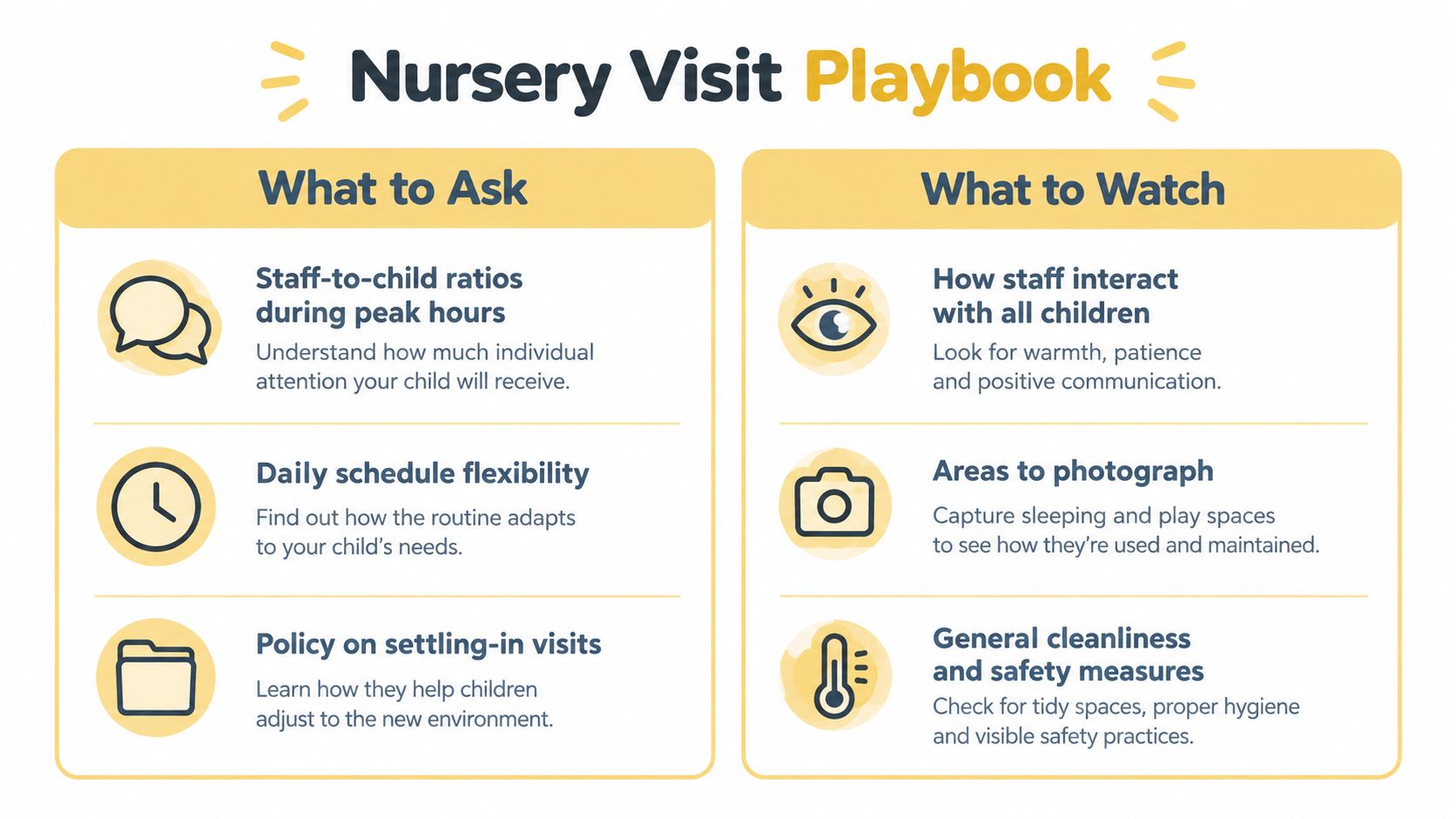
Watch the room, not the sales pitch
Observe whether staff speak to children with warmth and purpose, whether children can access play without waiting for permission and whether adults notice the quieter child. Check the noise level, outdoor access, hygiene points and the separation between babies and toddlers. Ask what the ratios are on the day, not merely what the policy says.
EYFS ratios include 1:3 for children under two and 1:4 for two-year-olds under the standard rule set. The optional arrangement for two-year-olds changed the ratio from 1:4 to 1:5 from September 2023. The Department for Education's explanation of staff-to-child ratios stresses that ratios apply across the whole provision, not room by room.
Before leaving, request or locate the safeguarding policy, EYFS curriculum overview, risk assessments, public liability insurance details, Ofsted report summary, registration certificate and complaints procedure. Ask whether you may photograph sleeping and play areas, but don't photograph children or confidential information. The best manager answers directly, welcomes sensible questions and explains how the setting would accommodate your child's temperament and routine.
Red Flags Most Parents Miss
Desperation makes parents generous. A glossy room, a convenient start date and a friendly tour can persuade you to excuse answers that should stop the process. Don't treat vagueness as harmless. It's evidence.
A manager who can't name the safeguarding lead, explain the key-person system or show you the latest Ofsted report is failing a basic test of transparency. The same applies to a setting that gives broad assurances about SEND but can't explain who the SENCO is, how support is recorded or how it would work with outside professionals.
Financial warning signs
Read the contract before paying a deposit. Be cautious if the nursery:
- Changes the price late: Fee rises should be clear before you commit.
- Hides extras: Ask directly about nappies, meals, outings, consumables and additional hours.
- Obscures notice: A vague notice period can make leaving expensive.
- Creates pressure: You shouldn't have to sign immediately to secure a place before attending a trial or resolving basic questions.
Staffing deserves equal scrutiny. Ask about agency use, turnover and who covers breaks. Look for children who spend long periods clustered around screens, locked internal doors that restrict supervision or adults who appear disengaged. A busy room is normal. A room where staff don't notice children's cues is not.
Listen carefully when you explain your child's routine. Dismissiveness about sleep, food, toileting, language, disability or sensory needs is a serious concern. A rigid settling-in policy may suit the nursery's administration while making your child's transition harder.
Triangulate before deciding. Compare what you saw, what the manager told you and what local parents report in community groups or forums. One awkward answer may reflect nerves. The same concern appearing in the report, the visit and parent feedback is a pattern.
Your Final Decision Checklist and Timeline
Give yourself a structured decision period rather than allowing the first available place to become the automatic choice. A four-to-eight-week plan is workable for many families, but the exact timing depends on your start date and local availability.
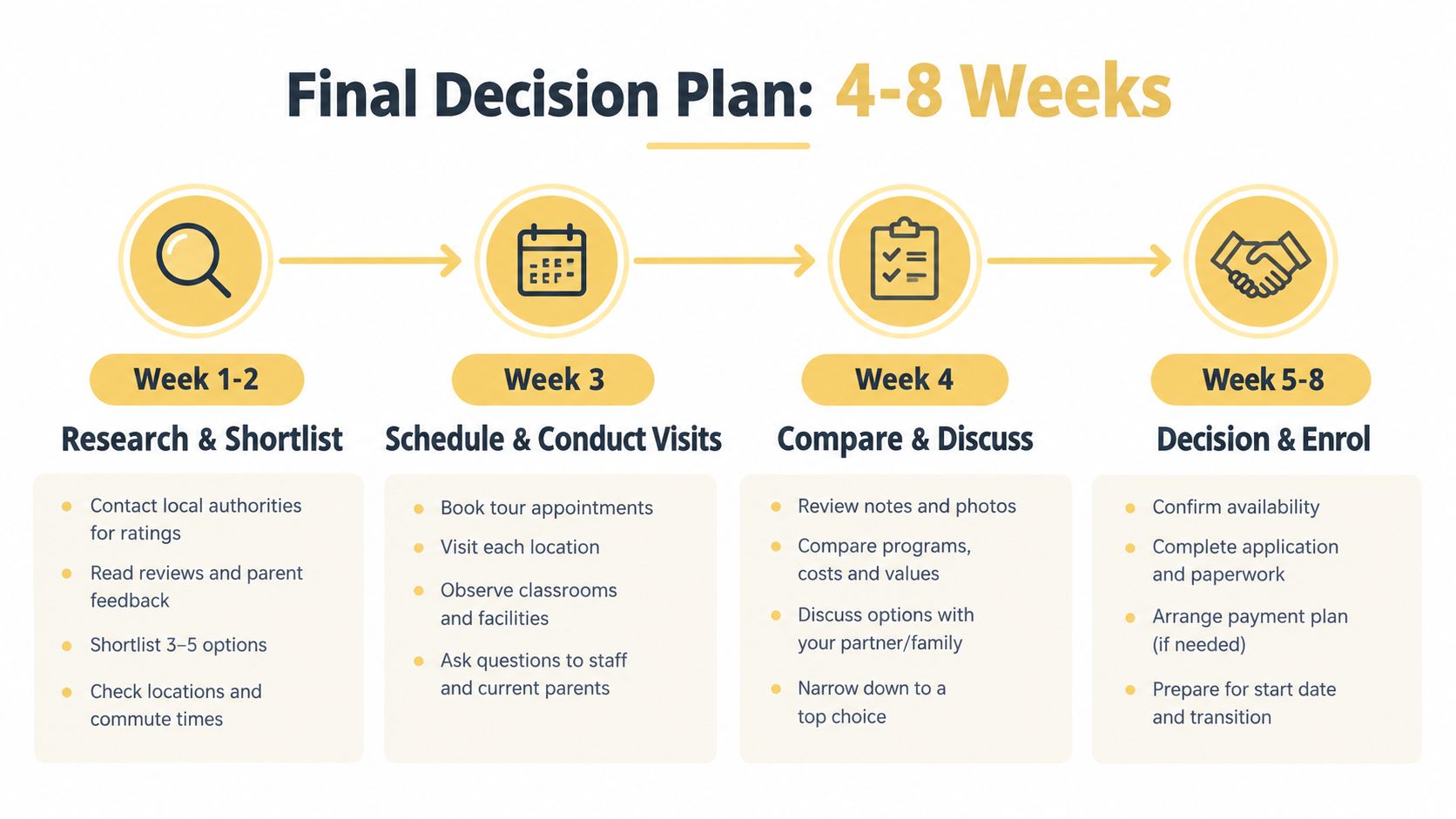
A practical decision sequence
Weeks one and two: Confirm your working pattern, search by postcode, check official registration and inspection information, and contact settings about age range and availability. Keep no more than five realistic options.
Week three: Visit the settings that pass the basic tests. Take notes immediately after each viewing, while details about staff interaction, noise, cleanliness and communication are fresh.
Week four: Compare the fee sheets, funded-hour conditions, opening times, inspection context and SEND arrangements. Ask follow-up questions in writing so the answers are recorded.
Weeks five to eight: Choose, enrol and arrange settling-in sessions. Confirm the start date, deposit terms, notice period, required documents, meals, nappies, collection permissions and your backup plan if the place falls through.
Use a simple scoring sheet, but don't let arithmetic overrule a serious safeguarding concern. Score each setting against usable hours, total cost, route, Ofsted recency and context, SEND fit, communication and your informed instinct. Weight the first four most heavily because they determine whether the arrangement can function, then use the visit evidence to separate close contenders.
Final checks before signing
- Inspection: Re-read the latest report, including safeguarding and leadership comments.
- Money: Confirm the complete fee schedule, extras, deposits, increases and notice period.
- Funding: Check eligibility, paperwork, weekly pattern and whether funded hours are stretched.
- Hours: Match opening and collection times against your real commute.
- Support: Get SEND, dietary, medication and sleep arrangements in writing.
- Settling: Agree the visits, key person and communication method.
- Contingency: Keep a second option active until the first place is formally confirmed.
England's supply can vary sharply between local areas, and Ofsted's latest release records both provider numbers and available places, so don't abandon your backup option until the contract and start date are secure. The right nursery is the one that is safe, transparent and sustainable for your family's actual week.
Use the official Ofsted search, your local Family Information Service and a written comparison sheet today. Shortlist five settings, book the visits, and ask every manager the same direct questions before you pay a deposit or sign a contract.
Your next step is simple: write down your required days, collection time, maximum realistic weekly budget and any SEND or routine needs, then contact your local settings this week. A clear brief will reveal quickly which nurseries are genuine options and which ones only look suitable from a distance.