
Tax Free Childcare Explained: The 2026 UK Parent Guide
Tax Free Childcare explained for 2026. Covers eligibility, how the government top-up works, claiming tips, and interactions with funded hours and benefits.
Tax-Free Childcare provides a 20% contribution towards registered childcare, capped at £2,000 per child each year, but only if you meet the scheme's work and income tests. It isn't an automatic discount, and the rules can be particularly confusing when funded hours or Universal Credit are also part of your family budget.
Perhaps you're looking at a nursery invoice while trying to work out whether your child's new funded-hours entitlement changes anything. Or your hours have become irregular, your partner has started parental leave, or you're wondering whether an online childcare account is worth the effort. The practical answer depends on your child's age, your household income, the provider you use and which other support you receive.
The scheme has become a substantial part of family childcare planning. Official figures show that 826,000 families used Tax-Free Childcare for 1,085,000 children in the financial year 2024 to 2025, up from 740,000 families and 966,000 children in the previous financial year, according to HMRC's Tax-Free Childcare statistics. This guide explains how the money moves, where families commonly get caught out and how to choose between overlapping forms of help.
Table of Contents
- Understanding the Government Top-Up Scheme
- Checking Your Eligibility and Income Limits
- Setting Up Your Online Childcare Account
- Navigating Funded Hours and Other Benefits
- Calculating Your Potential Savings
- Addressing Common Myths and Misunderstandings
- Using Nursery Advice Tools for Smarter Choices
- Final Checklist for Maximising Your Entitlement
Understanding the Government Top-Up Scheme
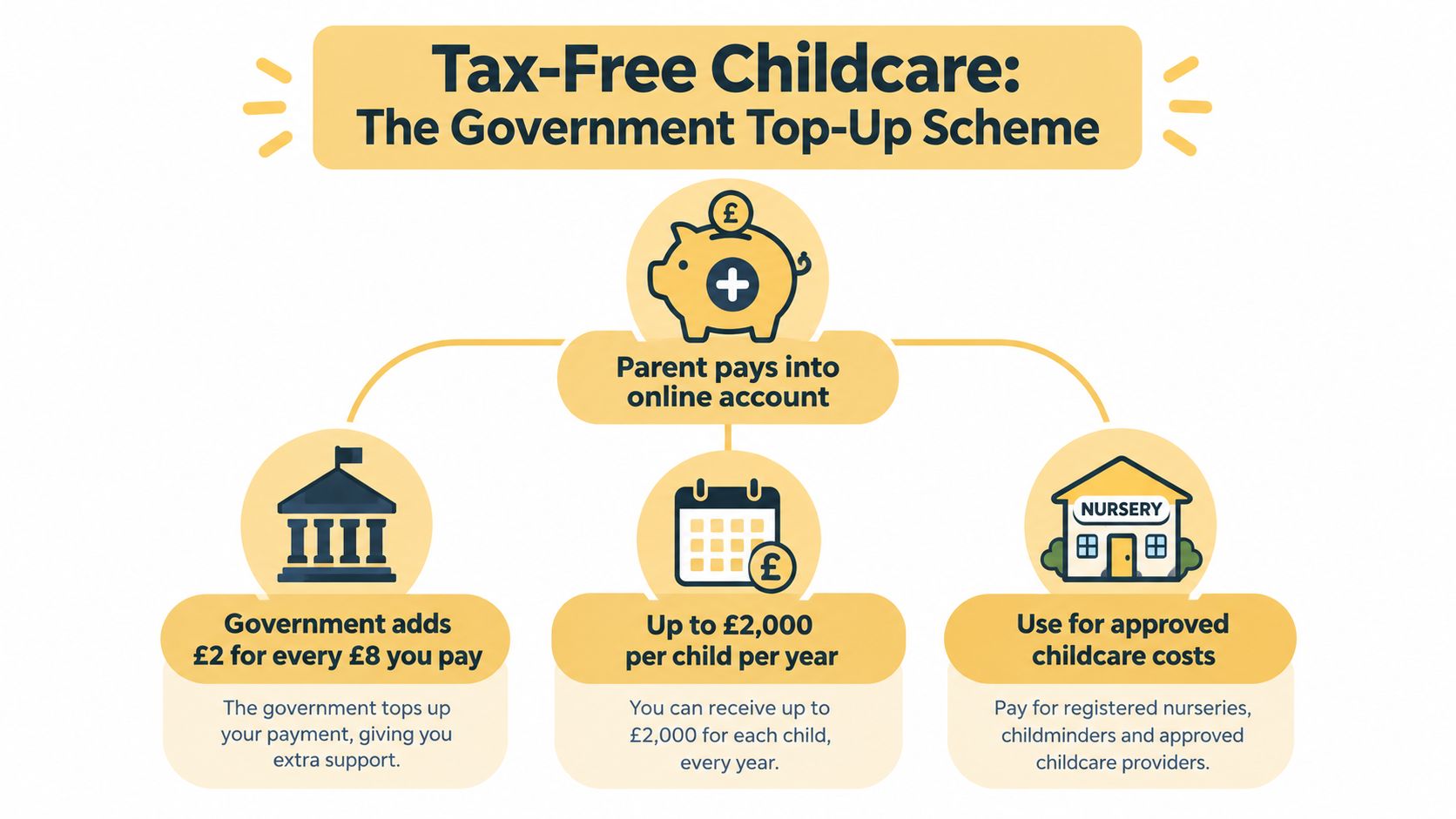
A parent checks a nursery bill, pays money into an online childcare account and sees the government add money to it. That's the basic idea behind Tax-Free Childcare. It isn't linked to the rate of tax you pay, and it doesn't reduce the nursery's invoice at the till. Instead, the government adds to your payment before you use the balance for approved childcare.
For every £8 you pay in, the government adds £2, giving an effective 20% contribution towards eligible costs. The support is limited to £2,000 per child per year, as set out in HMRC's background and guidance for Tax-Free Childcare statistics.
What the account pays for
Suppose you need to pay an approved nursery or childminder. You put money into the account, wait for the top-up to be applied, then use the account to pay the provider. If your costs are high, the scheme can still help, but it won't remove every pound of the bill because the annual limit applies per child.
A child remains eligible until 1 September after their 11th birthday, or until after their 16th birthday if they have a disability. The key point is that age eligibility doesn't guarantee an account. The adults responsible for the child must also pass the work and income rules.
Practical rule: Think of Tax-Free Childcare as a capped government contribution, not as a universal nursery discount.
The scheme was launched to the public in April 2017 and rolled out in phases by the age of the youngest child. Rollout began with children aged 0 to 3 on 21 April 2017 and was completed in February 2018, according to the official HMRC scheme guidance. For a parent applying today, the history matters less than the two filters that decide whether you can use it: work and income.
Checking Your Eligibility and Income Limits
Eligibility is where many otherwise suitable applications go wrong. The scheme generally expects each adult in the household to be working, or to expect to work, and to earn at least the equivalent of 16 hours a week at the National Living Wage or National Minimum Wage. Neither adult can have adjusted net income above £100,000, as explained by GOV.UK's Tax-Free Childcare eligibility guidance.
That test applies to each parent or partner, not just the person who normally pays the nursery. A couple can therefore be caught out by one adult's income, even if the other adult has modest earnings. A single parent is assessed on their own circumstances.
Turn the rules into a household check
Use this plain-English filter before starting an application:
- Work test: Are you and your partner working, or expecting to work, at the required level?
- Income test: Is each adult's adjusted net income below £100,000?
- Child test: Is the child within the relevant age limit?
- Provider test: Will the nursery, childminder or club accept payment through an approved childcare account?
The work test isn't a question of whether you have a full-time contract. Self-employed parents and people with variable hours should examine their expected earnings rather than assume they're excluded. A zero-hours arrangement can make the calculation feel uncertain, but uncertainty is a reason to check the rules carefully, not an automatic refusal.
Parental leave also needs careful attention. Your work status and expected earnings can change during leave, so don't rely on an old application without checking the current position. The same caution applies if one adult has recently reduced hours, started a job, stopped working or had a significant change in income.
The word adjusted matters. The relevant income figure isn't necessarily the same as the salary shown on a payslip. If your circumstances are complicated, use the official eligibility checker and keep records of the information you provide. The GOV.UK eligibility checker can help you test the basic conditions before you make childcare payment plans.
Setting Up Your Online Childcare Account
The application is easiest when you treat it as a short administrative task rather than something you'll solve while trying to settle a tired child. Have your household and childcare details available, then work through the GOV.UK application carefully.

The setup sequence
- Check eligibility online. Confirm the age, work and income conditions before relying on the support in your household budget.
- Create the childcare account. Follow the online application and complete the identity checks requested for the adults in your household.
- Add your child. Check names and dates carefully. Small errors can delay the account being ready for use.
- Find your provider. The nursery, childminder, nanny, playscheme or club must be approved for Tax-Free Childcare payments.
- Pay into the account. The government adds 20% on top, at the rate of £2 for every £8 deposited, as described by Best Start in Life's explanation of how Tax-Free Childcare works.
- Pay the provider from the account. Agree the payment process and timing with the setting, particularly if you're moving from direct debit or another payment method.
The account isn't a set-and-forget arrangement. You must reconfirm eligibility every three months. Put a reminder in your calendar for the date shown in your account, because missing the reconfirmation can interrupt future support even when your circumstances haven't changed.
Keep your provider informed if you're changing payment methods. A setting may need to identify or link its account before it can receive money from you.
Navigating Funded Hours and Other Benefits
The question many families now face isn't just whether Tax-Free Childcare works. It's whether it still earns a place in the budget after a child becomes eligible for funded hours, and whether Universal Credit would provide more help.
Tax-Free Childcare and funded hours address different parts of the bill. A funded place covers eligible hours under the relevant programme, while Tax-Free Childcare can help with eligible charges that remain, such as additional booked hours or wraparound care, provided the provider and payment arrangements meet the rules. Ask the setting how it separates funded hours, meals, extras and privately paid sessions before you decide.
HMRC's figures show why families need current guidance rather than an old rule of thumb. 556,000 families used Tax-Free Childcare for 680,000 children in September 2025, usage then dipped to 601,000 families in March 2026 after the expansion of funded hours, before rising to 602,000 families in June 2026, according to HMRC's June 2026 commentary.
Childcare support comparison
| Scheme | Key benefit | Max annual value | Income limits |
|---|---|---|---|
| Tax-Free Childcare | Government adds £2 for every £8 paid into the account | £2,000 per child per year, or £4,000 for a disabled child, according to GOV.UK guidance | Each adult must meet the work test and have adjusted net income below £100,000 |
| Funded hours | Provides funded early education hours where the child and family meet the relevant conditions | Depends on the funded-hours entitlement and the provider's billing arrangements | Depends on the applicable programme and eligibility conditions |
| Universal Credit childcare support | May contribute towards eligible childcare costs for families receiving Universal Credit | Depends on the household's Universal Credit calculation | Depends on the household's Universal Credit circumstances |
| Childcare Vouchers | May remain relevant to some families already using an employer voucher arrangement | Depends on the arrangement and household circumstances | Depends on the existing employer scheme and personal circumstances |
Use this decision matrix:
- You receive funded hours: Ask the provider what remains payable, then consider Tax-Free Childcare for eligible extra care rather than assuming the account is no longer useful.
- You receive Universal Credit: Compare the actual support available under your Universal Credit calculation with Tax-Free Childcare before switching. Don't close an existing arrangement until you understand the effect.
- You use Childcare Vouchers: Check whether your employer arrangement is still available and compare the practical value of each option. Different schemes can have different interaction rules.
- Your hours or income change: Recheck eligibility instead of assuming last term's choice still works.
For a plain-English explanation of how funded hours fit into the wider childcare picture, see this guide to free childcare hours. Your provider should also give you a written breakdown of which hours are funded and which charges remain your responsibility.
Calculating Your Potential Savings
The simplest way to understand the maths is to separate your payment, the government top-up and the total available in the account.
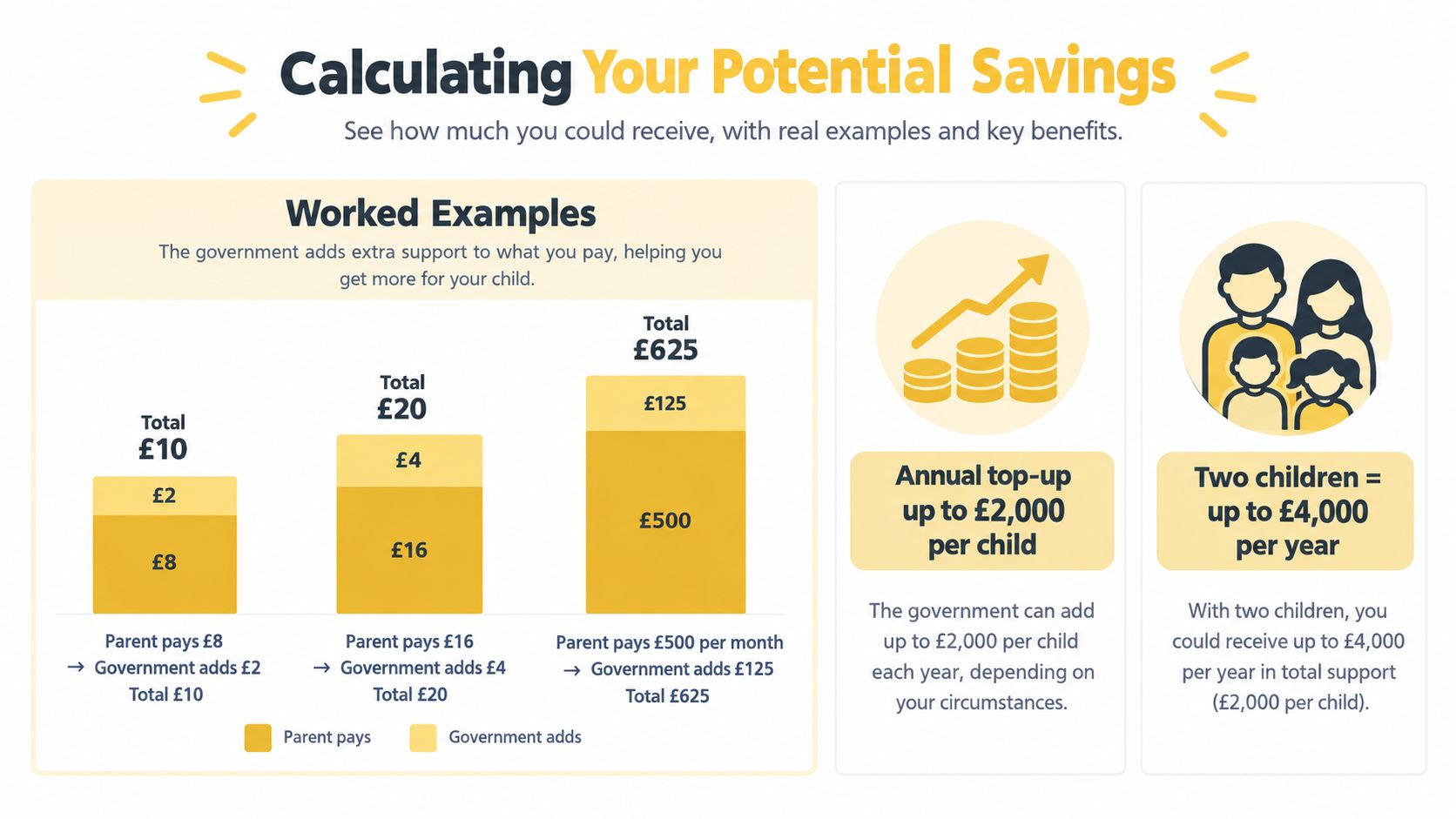
If you pay £8, the government adds £2, giving £10 to spend. If you pay £16, the top-up is £4, giving £20. The rate stays the same until you reach the cap.
A monthly example makes the limit clearer. If you pay £500 per month, the government adds £125, giving £625 in the account for that month. These worked examples reflect the £2-for-£8 mechanism described in the official scheme guidance, while the annual limit determines how far that help can continue.
Where the cap changes your budget
The maximum top-up is £2,000 per child per year. That means a family with childcare costs below the level at which the cap is reached may be able to cover 80% of the bill through the account and receive the remaining 20% from the government. Once the cap is reached, additional childcare costs must be funded privately, even if the family remains eligible.
For two children, the stated maximum is £4,000 per year, subject to the scheme's per-child limits and eligibility rules. Don't treat that figure as a cash payment you receive in advance. It accumulates through deposits and top-ups linked to childcare spending.
Before committing to a nursery place, use a UK nursery fee guide to understand the likely cost structure, then calculate the balance you'd still need to pay. Families also planning longer-term goals may find it useful to explore college saving with life insurance as a separate financial-planning topic. It shouldn't be confused with childcare support, but it can sit alongside a wider family budget review.
Addressing Common Myths and Misunderstandings
Myth one: funded hours mean you can't use Tax-Free Childcare. The schemes can address different charges. A child may have funded hours and still need additional paid childcare, although the provider must apply its own funding and payment rules correctly. Ask for a fee statement that shows funded hours separately from extra sessions and other charges.
Myth two: self-employed parents can't claim. Self-employment doesn't automatically exclude a parent. The important question is whether the household meets the work and income conditions, including the expected earnings test.

Myth three: any childcare provider can receive the money. Tax-Free Childcare is restricted to approved providers. GOV.UK lists registered nurseries, childminders, nannies, playschemes and clubs among the approved options in its guidance on help with childcare costs. Check the provider before transferring money into the account.
Myth four: applying once is enough. You must reconfirm your eligibility every three months. A calendar reminder is a small step that can prevent an avoidable interruption.
Myth five: the name means it's a tax rebate. It's better understood as a government top-up paid through an online childcare account. That distinction matters because the account, provider approval and reconfirmation process all affect whether you can use the support.
Using Nursery Advice Tools for Smarter Choices
Choosing a provider is about more than finding a convenient postcode. You need to know whether the setting accepts Tax-Free Childcare, how its fees are structured and which sessions remain payable after funded hours are applied.
Nursery Advice is one directory option for comparing UK early years settings. Its search tools let parents look at provider information, fees guidance, opening hours and inspection details, then use the childcare cost calculator to estimate the amount left after a Tax-Free Childcare top-up. Treat the figures as planning guidance and confirm the final bill directly with the provider.
A sensible comparison routine
Start with your required days and collection times. Shortlist settings that appear suitable, then check whether they accept Tax-Free Childcare payments and whether they offer the funded-hours arrangement your child may receive. A provider's opening hours can matter as much as its headline fee if you need early starts, late collection or holiday care.
Next, compare the full payment picture. Ask about registration charges, meals, consumables, deposits, extra sessions and how the setting handles funded hours. Put those answers into the calculator rather than comparing only the advertised hourly or monthly figure.
The directory can help you organise a shortlist, but it can't replace a conversation with the nursery. Confirm availability, payment instructions and the exact amount due before you move your child or commit to a place.
If you prefer visual guidance, this video provides another way to approach childcare searching and comparison:
Final Checklist for Maximising Your Entitlement
A parent who checks the account once and then forgets about it can miss support without realising anything has changed. The safer approach is to treat Tax-Free Childcare as part of your regular childcare administration, alongside invoices, attendance dates and provider communications.
Before you apply
- Check the household: Review each adult's work expectations and adjusted net income, not just the person who usually pays the bill.
- Check the child's age: Confirm that the child falls within the relevant age limit, including the different rule for a disabled child.
- Check the provider: Ask whether the nursery, childminder, nanny, playscheme or club is approved to receive Tax-Free Childcare payments.
- Check other support: Write down your funded hours and any Universal Credit or existing voucher arrangement before choosing which support to use.
Once the account is open
- Match payments to invoices: Pay enough into the account for the childcare you intend to cover, while remembering that the government contribution is capped per child.
- Keep the fee breakdown: Ask the provider to distinguish funded hours, additional hours and other charges. This makes it much easier to see what the account is paying for.
- Set a reminder: Reconfirm eligibility every three months, even if your work and income appear unchanged.
- Review changes promptly: Recheck the position after a new job, reduced hours, parental leave, a change of partner or a significant income change.
- Compare rather than assume: If funded hours expand or your Universal Credit circumstances change, calculate the household result before switching.
The family who gets the most value isn't necessarily the one with the largest childcare bill. It's the family that knows which costs remain, uses an approved provider, keeps the account active and reviews its choice when circumstances change.
Check your eligibility on GOV.UK today, ask your childcare provider for a written breakdown of funded and paid hours, and set a three-month reminder before you finish the application. That small piece of organisation can help you use every part of the support available to your family.