
What Is EYFS Framework and How It Shapes Early Years Care
What is EYFS framework? Understand the statutory rules, learning areas, assessments and ratios that shape your child's early years care in England.
The EYFS framework is the statutory set of standards in England governing learning, development and care for children from birth to age five, and it's legally binding on all Ofsted-registered providers. It applies to nurseries, pre-schools, childminders and reception classes, so it's the common legal baseline behind every registered early years setting.
You may hear the term during a nursery tour, in an Ofsted report or on a childcare website, often alongside phrases such as “learning through play” or “school readiness”. The important point is that EYFS isn't just a teaching style. It also sets expectations for welfare, safeguarding, staffing, assessment and the way adults care for young children. Understanding that wider role helps you ask better questions and look beyond attractive rooms or confident marketing.
Table of Contents
- Understanding the EYFS Framework as a Legal Standard
- The Seven Areas of Learning and Development
- Statutory Ratios and What They Mean for Your Child
- How EYFS Assessment and the Profile Work
- Safeguarding and Workforce Compliance Beyond the Curriculum
- Using a Directory to Compare Settings and Ofsted Evidence
- Key Takeaways and Next Steps for Parents
Understanding the EYFS Framework as a Legal Standard
Suppose you're visiting two nurseries. One talks about phonics and numbers, while the other focuses on outdoor play, relationships and routines. You might wonder whether they're following completely different systems. In England, both should be working within the Early Years Foundation Stage, usually shortened to EYFS.
The framework sets standards for learning, development and care from birth to age five. Its legal force comes from the Childcare Act 2006, and the unified EYFS system was introduced in 2008 after the relevant Order came into force on 1 September 2008. The current framework for group and school-based providers is dated 14 July 2025 and took effect on 1 September 2025, as set out in the statutory EYFS framework published by the Department for Education.
Who must follow it
The EYFS applies in England to all Ofsted-registered early years providers, including:
- Nurseries: Group settings caring for babies and young children.
- Pre-schools: Early education providers operating within the statutory age range.
- Childminders: Individuals providing care under the separate childminder version of the framework.
- Reception classes: School-based provision for children in the EYFS age range.
The framework applies from birth to 31 August after a child's fifth birthday, according to the GOV.UK overview of the Early Years Foundation Stage. Compliance is a registration condition, not an optional badge. Settings can choose different activities, routines and educational approaches, but they can't opt out of the statutory requirements.
That's why EYFS gives parents a useful starting point when comparing providers. A Montessori nursery, a community pre-school and a school nursery may look very different, yet each must meet the same national expectations for children's welfare, learning and development. The framework provides the floor. A setting's quality depends on how thoughtfully it meets those requirements in daily practice.
The Seven Areas of Learning and Development
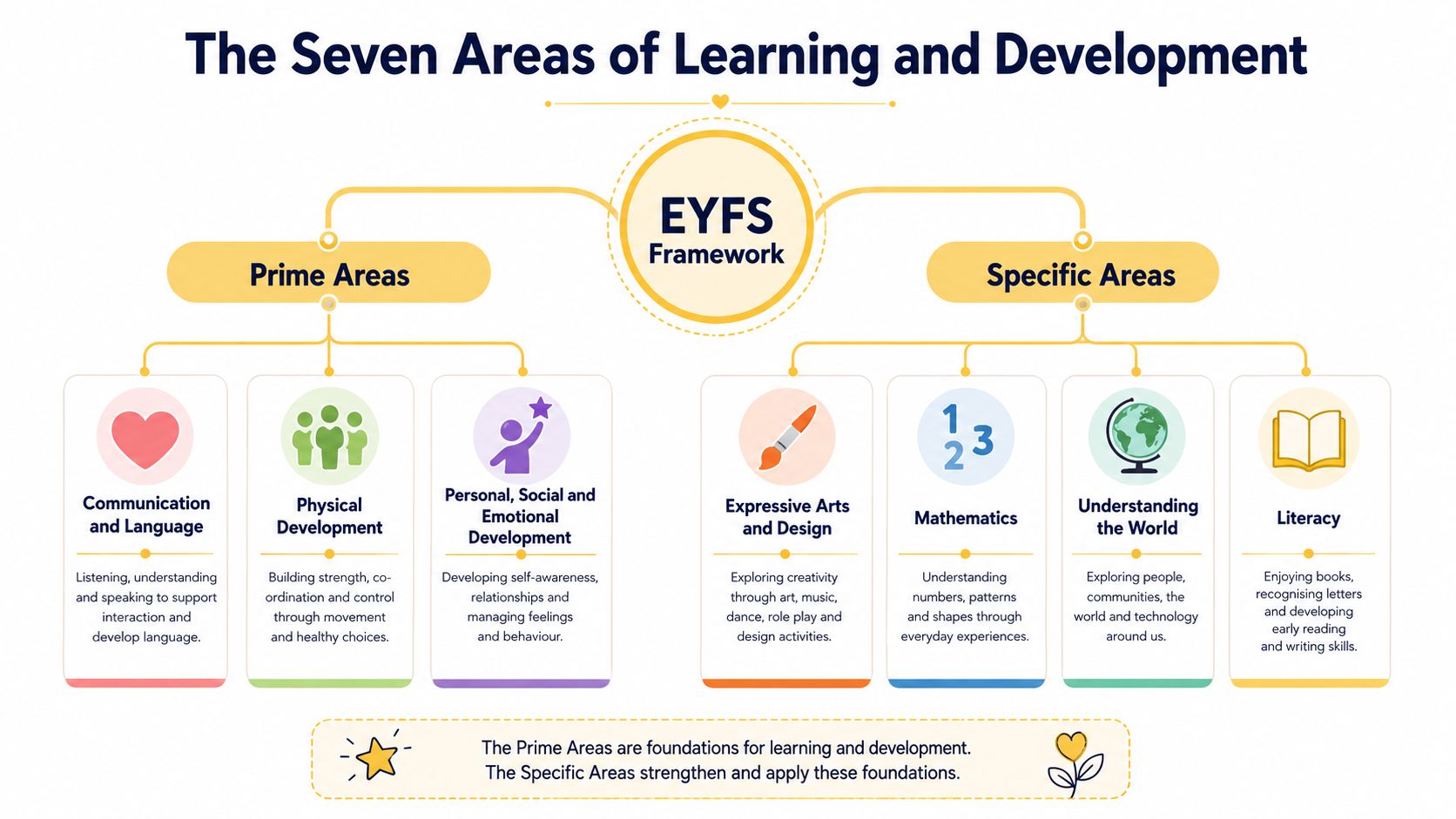
The EYFS curriculum is organised around seven areas of learning and development and 17 early learning goals. The areas aren't seven separate lessons. Practitioners weave them through play, conversations, routines, physical activity, creative work and relationships.
The three prime areas
The prime areas support the foundations children need for later learning:
- Communication and language covers listening, attention, understanding and speaking. A practitioner might narrate a child's construction play, introduce new words such as “stable” or “balance”, and give the child time to respond.
- Personal, social and emotional development includes relationships, emotional regulation and confidence. Waiting for a turn, recovering after frustration or asking an adult for help are all meaningful examples.
- Physical development includes movement, coordination, health and self-care. Climbing outdoors, using scissors, washing hands and putting on a coat can all contribute.
These areas matter particularly in the earliest years because children rely on communication, secure relationships and physical capability to explore their surroundings. A child who can express a need, manage a transition and move confidently is better placed to engage with wider experiences.
The four specific areas
The specific areas build on and extend those foundations:
- Literacy: Sharing stories, recognising print, developing early writing and responding to sounds.
- Mathematics: Comparing quantities, noticing patterns, using number language and exploring shape or measure.
- Understanding the world: Investigating nature, talking about people and communities, and using technology or materials purposefully.
- Expressive arts and design: Singing, dancing, painting, role play, music and designing with different resources.
A child making a pretend café, for example, might practise language with friends, count cups, write a shopping list, explore social roles and design a menu. That single experience can involve several areas without feeling like a formal lesson.
The EYFS Profile handbook explains how the 17 early learning goals provide a consistent endpoint for assessment. During a visit, ask how practitioners balance all seven areas. A setting that talks only about letters and numbers may not be showing the full EYFS picture.
Here's a short video that offers another accessible introduction to the framework:
Statutory Ratios and What They Mean for Your Child
Ratios affect how much attention adults can give children, how quickly staff can respond and how safely routines can be managed. The EYFS sets minimum adult-to-child ratios, although a setting may choose to deploy more adults when children's needs, activities or circumstances call for it.
| Age Group | Minimum Ratio | Setting Type |
|---|---|---|
| Under-twos | 1 adult to 3 children | EYFS group and school-based providers |
| Two-year-olds | 1 adult to 5 children | EYFS group and school-based providers |
| Three and over | 1 adult to 13 children | Maintained nursery schools and nursery classes in maintained schools |
These statutory figures come from the EYFS framework for group and school-based providers from September 2026. The exact staffing picture can still vary between rooms and throughout the day. Ask whether the advertised ratio includes the manager, apprentices, students or staff who are completing non-contact tasks. You'll want to know who is available to work directly with children.
Childminder numbers work differently
Childminders have a separate maximum-care rule. They may care for no more than six children under eight at any one time, with a maximum of three young children, and there should only be one child under one. The EYFS framework for childminders explains how these requirements apply.
Exceptional adjustments are possible only when the provider maintains children's quality, safety and security. That shouldn't be treated as permission to stretch staffing routinely. On a visit, ask what happens when a member of staff is ill, a child needs one-to-one support or the group moves between indoor and outdoor spaces.
Practical rule: Treat the ratio as a legal minimum, then ask how the setting makes sure children receive attentive care when real-life pressures arise.
How EYFS Assessment and the Profile Work
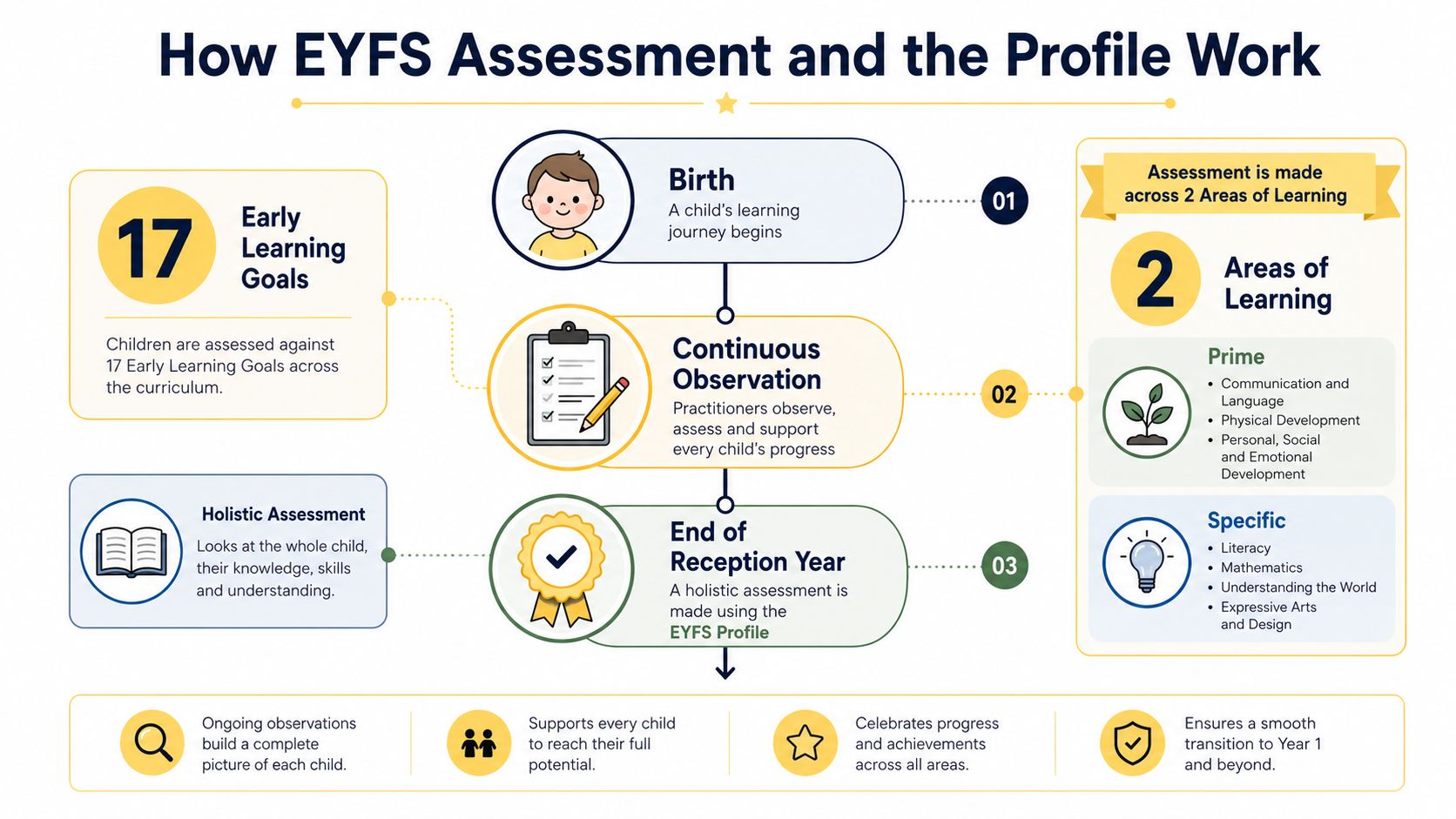
EYFS assessment isn't designed as a series of formal tests for young children. Practitioners observe children during everyday experiences, record significant knowledge about what they can do and use that information to decide what support or challenge may help next.
Those observations can include a child explaining an idea, joining a group game, balancing on equipment, recognising a quantity or retelling part of a familiar story. A single moment doesn't define a child's development. Practitioners build a picture over time and consider the child's interests, communication, background and individual needs.
What the EYFS Profile measures
The EYFS Profile is completed at the end of the reception year. It draws on the 17 early learning goals across seven areas of learning, creating a consistent national picture of children's outcomes at that stage. The profile isn't a league table for individual children, and it shouldn't be used to label a child's future ability.
The latest national release, covering 2024 to 2025, reported that 68.3% of children achieved a good level of development, compared with 65.2% in 2021 to 2022, an increase of 3.1 percentage points. The same release reported that 66.9% reached the expected level across all early learning goals, compared with 63.4% in 2021 to 2022, an increase of 3.5 percentage points. These figures are published in the official EYFS Profile results for 2024 to 2025.
The profile provides a benchmark, not a target that every child must meet at the same time. Practitioners use assessment information to identify children who may need additional support and to share useful information as children move into Year 1. Parents should expect conversations about strengths, emerging skills and practical next steps, not just a final label.
Safeguarding and Workforce Compliance Beyond the Curriculum
Many explanations of EYFS concentrate on play, language and early mathematics. Those areas matter, but the framework also operates as a safeguarding and workforce compliance structure. A setting can offer imaginative activities and still fall short if it doesn't recruit safely, train staff properly or protect children during everyday care routines.
The 2025 regulations and explanatory memorandum covered changes relating to safer recruitment references, staff absences and emergency contacts, safeguarding training, childcare student ratios, whistleblowing, safer eating, toileting and privacy. Some provisions are phased, including one part with a 1 January 2027 commencement, as set out in the 2025 EYFS regulations.
What parents can look for
During a visit, safeguarding evidence may be less visually impressive than a new playroom, but it's more important. Ask:
- Staff suitability: How does the setting check references and manage safer recruitment?
- Training: How are staff kept up to date with safeguarding responsibilities? Providers may also find structured safeguarding children training useful when developing workforce knowledge.
- Absences: What happens when a familiar key person is off work, and how does the setting maintain safe supervision?
- Whistleblowing: Can staff raise concerns independently, and do managers explain that process clearly?
- Privacy and care: How does the setting protect children's dignity during toileting, changing, eating and personal care?
You can also read practical background guidance on safeguarding in early years, then use it to shape questions for your visit.
A good answer won't necessarily involve complicated language. Managers should be able to explain who is responsible, what staff do in practice and how they respond when something changes. Notice whether staff communicate calmly, know the children well and follow consistent routines. Those everyday details can reveal more about safeguarding culture than a framed policy.
Using a Directory to Compare Settings and Ofsted Evidence
Online research works best when you use it to create a shortlist, not to make the final decision without visiting. An independent directory such as Nursery Advice brings together provider details including Ofsted information, opening hours, fees guidance, photos and setting summaries. You can then check the original Ofsted evidence before deciding which places deserve your time.
A practical comparison process
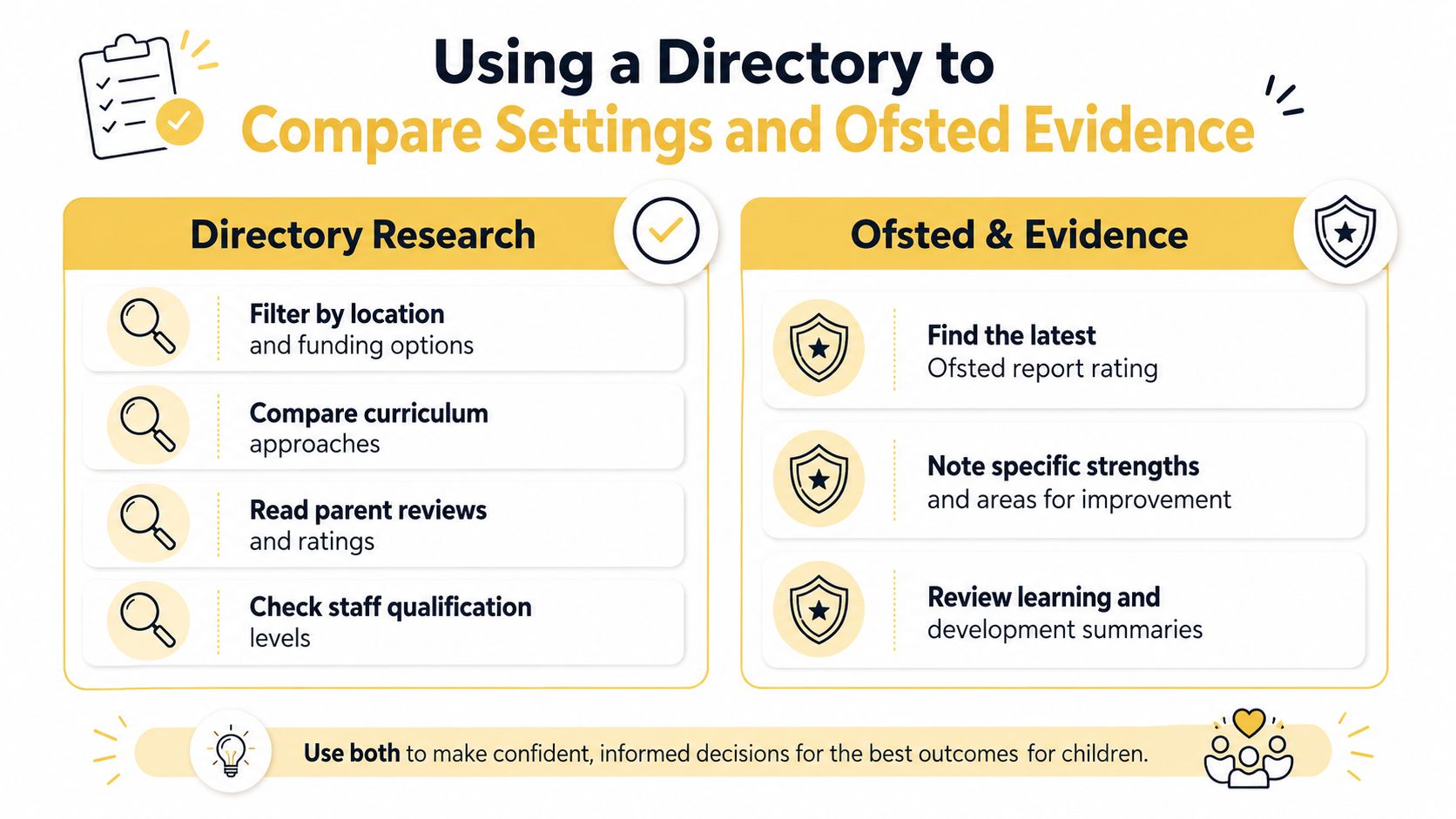
Start with location and suitability. Use a postcode search, then filter by Ofsted rating, age range, distance and inspection date where those details are available. If you're checking funded provision, SEND support or garden access, treat those flags as prompts for verification rather than replacements for a conversation with the provider.
Next, compare the information that affects daily life:
- Opening hours: Check whether the timetable works with commuting, school runs and holiday arrangements.
- Fees guidance: Use listed information to identify questions about deposits, meals, extra sessions and funded hours.
- Inspection evidence: Read the latest report and note the inspection date, strengths and areas for improvement.
- Childcare model: Compare nurseries, pre-schools and childminders according to the age range and type of care you need.
Some directories also provide side-by-side comparison, allowing parents to examine up to four settings on details such as grades, inspection history, opening hours and indicative fees. The Nursery Advice nursery search guide can help you approach a local search systematically.
Read reports, then test the evidence
Ofsted information tells you what inspectors found at a particular inspection. It doesn't tell you everything about how your child will settle, whether the journey is manageable or how staff will respond to your child's individual personality. Use the report to form questions, such as how the setting has addressed an identified improvement area.
On the visit, compare the written evidence with what you see. Do staff describe children's learning in specific terms? Can they explain their safeguarding arrangements? Do they answer ratio questions directly? A profile full of photos may look appealing, but clear answers and observable practice deserve more weight.
Key Takeaways and Next Steps for Parents
The answer to what is EYFS framework is broader than “the curriculum used in nursery”. It's England's statutory framework for learning, development, care and safeguarding from birth to the end of the EYFS age range. Every Ofsted-registered nursery, pre-school, childminder and reception class must meet its requirements.
Before choosing a setting:
- Search locally: Build a shortlist using postcode, age range, distance and practical opening hours.
- Check official evidence: Read the latest Ofsted report, inspection date and stated areas for improvement.
- Ask about staffing: Confirm the relevant ratio, who works directly with children and how absences are managed.
- Test safeguarding practice: Ask about recruitment, training, whistleblowing, eating, toileting and privacy.
- Discuss assessment: Find out how observations are shared and how practitioners support your child's next steps.
Use the Nursery Advice directory as one research option, then book visits and compare what providers say with what you observe. Bring a written list of questions, check how your child responds to the environment and use the Parent Hub for further guidance on funded hours, choosing childcare and other early years topics.
Choose two or three local settings today, read their Ofsted evidence, and arrange visits with questions about ratios, safeguarding and assessment ready to ask. A careful comparison now can help you select a setting that meets the statutory EYFS baseline and provides the secure, responsive care your child needs.