
Early Years Practitioner Qualifications: A UK Guide
Clear UK guide to early years practitioner qualifications — levels, routes, ratios and what parents should actually check when choosing a setting.
In England, the qualification a practitioner holds decides whether they count in EYFS staff-to-child ratios, with Level 2, Level 3 and Level 6 as the headline tiers. A person without a full and relevant qualification can work as an unqualified practitioner, but cannot be included in the qualified ratio.
You may be asking this while standing in a nursery doorway, watching a familiar face greet your child, or while comparing training courses and wondering whether a certificate will let you work in a room. The terminology can feel unnecessarily complicated because “qualified” doesn't always mean “counts for ratios”. A higher-level award may still need checking against the Department for Education's approved list.
The practical test is simple: what does the qualification allow the practitioner to do at the nursery door? In England, that means looking at EYFS rules, staff deployment and evidence of competence. Scotland, Wales and Northern Ireland have their own regulators and frameworks, so a qualification that works in one nation may not map neatly across the UK.
Table of Contents
- What an Early Years Practitioner Actually Does in a UK Nursery
- The Qualification Ladder from Level 2 to Level 6
- How Qualifications Connect to EYFS Staff-Child Ratios
- Routes Into the Workforce You Can Choose Between
- Additional Checks and Training Every Practitioner Needs
- England, Scotland, Wales and Northern Ireland Compared
- Why Qualifications Alone Don't Tell the Whole Story
- What Parents Should Check and How Nursery Advice Surfaces It
What an Early Years Practitioner Actually Does in a UK Nursery
At morning drop-off, a baby room can become busy within minutes. One practitioner is changing two six-month-olds, another is settling a nine-month-old who has missed sleep, and a parent is trying to leave while their child cries through separation. The team must keep children safe, respond warmly and maintain the room's staffing arrangement at the same time.
That work is far more than supervision. Practitioners plan experiences around the Early Years Foundation Stage, or an equivalent national curriculum framework, observe children's learning, record development and adapt activities when a child needs more support. They build key-person relationships, notice changes in behaviour, work with families and contribute to support for children with special educational needs and disabilities.
A practitioner may spend part of the morning helping a toddler communicate with visual prompts, then share a detailed observation with a parent at collection. In another room, they might adjust a story activity so a child with delayed language can join in. These decisions require knowledge of child development, safeguarding, communication and inclusive practice.
Why the role affects staffing
A nursery's manager also has to decide who can be deployed where. A practitioner may be experienced and trusted by families, but if their qualification isn't approved for the relevant ratio, the manager can't count them in the same way as a practitioner whose award is recognised under the applicable framework.
The Department for Education's early years qualification standards connect approved qualifications directly to ratio eligibility in England. The standards explain that someone without a full and relevant qualification can work as an unqualified practitioner, but cannot be included in the qualified ratio.
Practical rule: A qualification matters twice. It supports the quality of your work, and it may determine whether the setting can legally include you in its staffing calculation.
This is why early years practitioner qualifications exist as a professional framework rather than a simple list of courses. The next question is how each level maps to daily responsibilities, progression and ratio recognition across the four UK nations.
The Qualification Ladder from Level 2 to Level 6
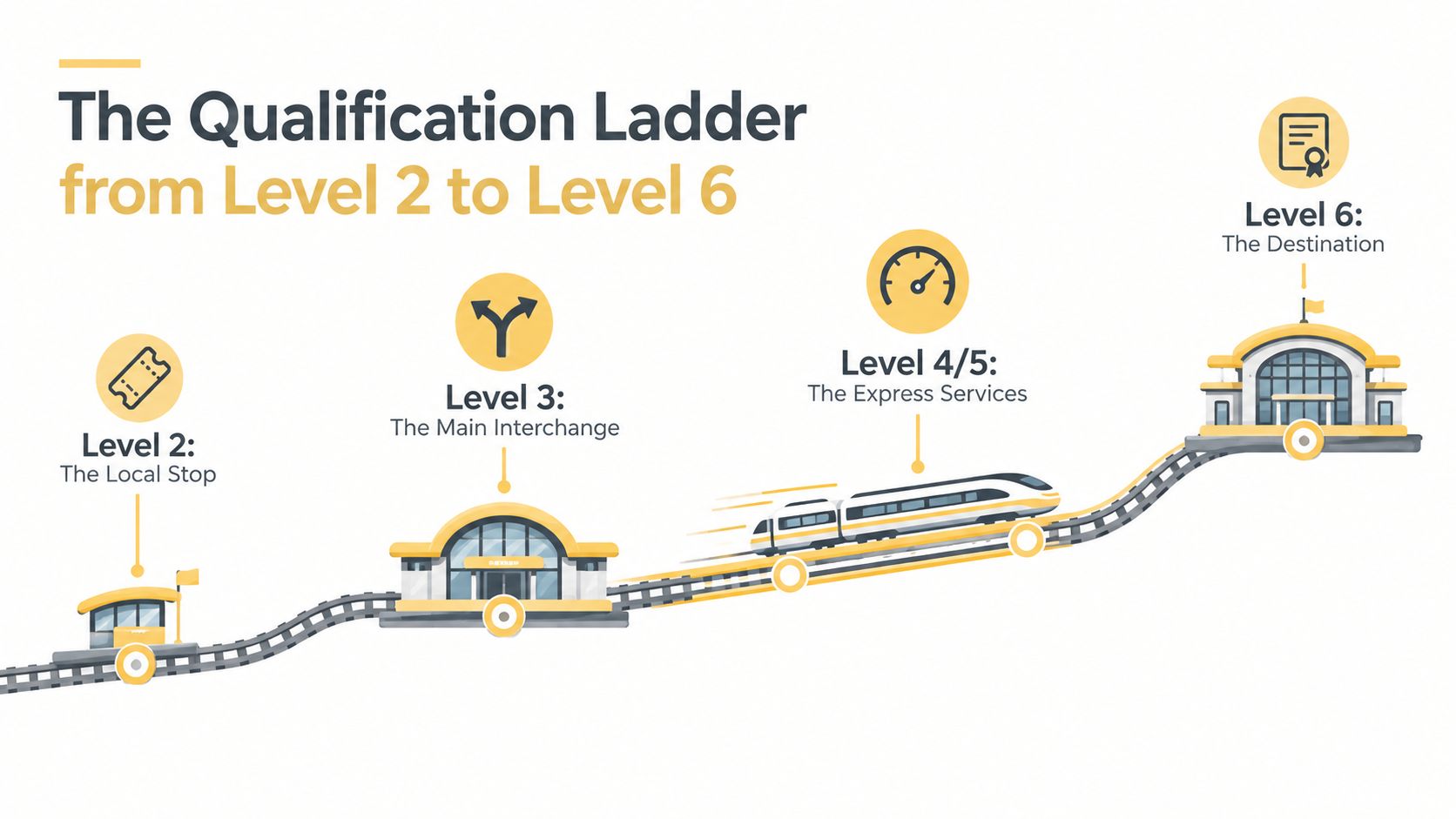
The qualification system is a series of tiers, each building on the last. At the nursery door, the level helps indicate what a practitioner has studied, which duties they may take on, and whether the setting can count them in the relevant staffing arrangements. The award still needs checking against the rules for the nation and age group involved.
Level 2, a supported starting point
A Level 2 early years qualification introduces the foundations of practice. It suits someone entering a nursery, learning how children develop, supporting play, following care routines and working under supervision.
The Skills England Level 2 Early Years Practitioner apprenticeship standard is approved for delivery and described as meeting the early years practitioner criteria. Apprentices must also complete English and maths requirements in line with apprenticeship funding rules.
In England, an approved, full and relevant Level 2 qualification may allow a practitioner to count in certain ratios. It does not make the holder the Level 3-qualified person required for some room arrangements. A parent checking a setting profile can therefore ask which staff hold Level 3, rather than treating every listed qualification as equivalent.
Level 3, the main practitioner route
Level 3 is the central route for many nursery practitioners. The Early Years Educator, commonly shortened to EYE, covers planning, observation, child development, safeguarding, partnership with families and support for individual needs.
In England, the DfE standards accept full and relevant qualifications across levels 3 to 8, alongside the experience-based route, provided the required English and paediatric first aid conditions are met. The recognised status of an award matters more than its title. GCSEs alone do not count as a full early years qualification, and a higher academic award does not automatically qualify someone for ratio purposes if it was not completed through an approved early-years pathway.
For a nursery manager, Level 3 is often the qualification that supports deployment as a qualified practitioner. For a parent, it is one useful detail to verify on the setting's staff information, alongside the person's role and experience.
Levels 4 and 5, deeper responsibility
Level 4 and Level 5 study can strengthen practice in leadership, management, pedagogy and additional needs. These routes often suit an experienced practitioner progressing towards room leader, deputy or manager responsibilities.
The qualification title and pathway still require checking. A Level 4 or Level 5 award outside an approved early-years route may not count for EYFS ratios, so an employer cannot assume that a higher level automatically carries ratio recognition.
Level 6, degree-level progression
Level 6 usually means a degree-level route, such as Early Childhood Studies or a related subject. It can support progression towards leadership, teaching or specialist roles, but the specific award and professional status still need checking at the nursery door.
Choose Level 2 to begin building practice, Level 3 for a core qualified practitioner route in England, Level 4 or 5 for leadership development, and Level 6 when graduate-level early years or teaching work is part of the plan. Scotland uses SCQF rather than England's RQF language. An Early Years Educator route is commonly compared with SCQF Level 7, subject to the relevant Scottish requirements. Wales and Northern Ireland have their own qualification arrangements, so an English level cannot be transferred without checking the local framework.
How Qualifications Connect to EYFS Staff-Child Ratios
At the nursery door, a qualification affects two practical questions: whether a practitioner can be counted in the room's staffing ratio, and whether the setting has the required qualified person present. In England, the headline EYFS ratios are 1:3 for children under two, 1:5 for two-year-olds, and 1:8 for children aged three and over in the relevant circumstances. A ratio of 1:13 may apply for three- and four-year-olds when a qualified teacher is present and the other conditions are met.
The qualification must be full and relevant to count in the approved way. The exact award, the practitioner's status and the room's age group all matter. A higher qualification title alone does not prove ratio eligibility.
A baby-room example
A baby room has six babies. Two practitioners each care for three children, while the manager provides oversight. One practitioner holds a full and relevant Level 3 qualification, and the other is working towards Level 3.
That arrangement may work only if the setting meets the EYFS conditions for trainees and for the qualified practitioner who must be present. The manager cannot treat every adult as interchangeable. Their training status determines how they may be counted.
A Level 2 practitioner can count in ratios where the rules allow and the qualification is approved, but cannot replace the qualified Level 3 member where the regulation requires one. Parents and trainees should ask the manager to explain that distinction plainly.
| Age Group | Minimum Ratio | Qualified Staff Required |
|---|---|---|
| Under two | 1:3 | At least one staff member must hold a full and relevant Level 3 qualification, with the room meeting the applicable EYFS conditions |
| Two-year-olds | 1:5 | At least one staff member must hold a full and relevant Level 3 qualification, subject to the applicable EYFS conditions |
| Three and over | 1:8, or 1:13 in specified qualified-teacher circumstances | Staff must meet the relevant Level 2 or Level 3 conditions; the 1:13 ratio also requires a qualified teacher and the other specified conditions |
For a broader explanation of how settings arrange cover, see this guide to nursery staff ratios. On a setting profile or during a visit, parents can check which practitioners are qualified, who is working towards a qualification, and how cover is maintained during breaks, absence and busy transitions.
Wales, Scotland and Northern Ireland have separate regulatory arrangements. Their ratios and qualification terms should not be inferred from this England table. A nursery should identify its nation's rules and explain how each listed qualification counts there.
Routes Into the Workforce You Can Choose Between
A trainee may need paid work straight away, while another learner may prefer college before entering a nursery. Both routes can lead to early years practice, but the qualification title, approval status and professional status determine how it counts at the nursery door.
Apprenticeship
A Level 2 or Level 3 apprenticeship combines paid employment with training in a nursery or early years setting. It suits learners who understand ideas best when they can apply them immediately. The employer must still provide the required off-the-job learning and support.
The Level 2 standard is formally recognised by Skills England as meeting the early years practitioner criteria. A Level 3 apprenticeship may lead directly to the qualification commonly used for qualified practitioner roles in England. Ask the provider to confirm the exact award, its approval status and how it affects ratio eligibility. This is the information a manager should be able to explain, and parents can ask about it on a setting visit.
Full-time college
College offers a planned timetable, tutor support and organised placement experience. Courses may include CACHE or NCFE CACHE diplomas, depending on the provider, as well as T Levels in Education and Childcare.
Assessment usually combines written or practical coursework with evidence from placement, although the balance varies. Check entry requirements, placement arrangements and whether the award is recognised as full and relevant before enrolling. A certificate name alone does not show whether it can count in a particular England ratio. The setting must verify that against the current rules.
Degree and teaching routes
A degree may suit someone seeking broader academic study or a future role in teaching. Routes can include Early Childhood Studies, primary teaching with Early Years Teacher Status, and Early Years Initial Teacher Training.
These qualifications can support progression beyond one nursery room, including teaching and leadership. However, a degree title alone does not decide whether someone counts for a particular England ratio. The employer must check the award and any professional status. On a setting profile, parents can ask which staff hold teaching status and which qualifications the nursery counts for each role.
Experience-based routes
Practical experience can support practitioners who developed their skills outside a traditional college route. England introduced an experience-based route for eligible practitioners in March 2025. From September 2025, people completing it can count towards Level 3 ratios without a full and relevant Level 3 qualification, subject to the EYFS changes.
The government guidance on the experience-based route explains the eligibility conditions. This route applies to England, so Scotland, Wales and Northern Ireland require separate checks rather than assumptions based on English terminology. Childminders are a separate case. The DfE removed the formal early years qualification requirement for childminders on the Early Years Register in 2024.
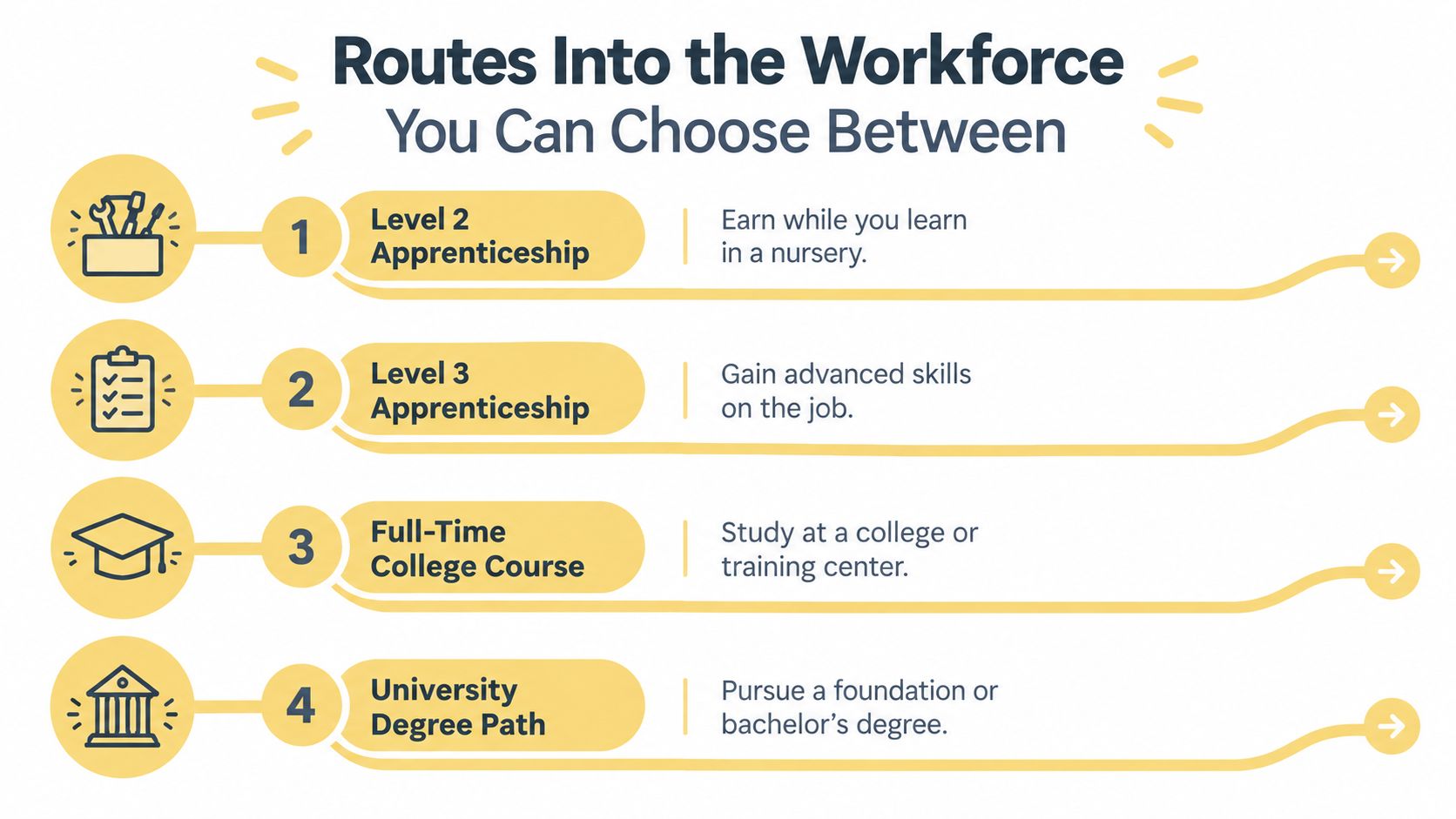
Choose an apprenticeship when earning while learning matters most, college when you need a clear study structure, and a degree route when teaching or long-term progression is your aim. Experience can strengthen any route, but the nursery must still check how the qualification or route counts under its nation's rules.
The following video provides a visual overview of the different training pathways into early years practice:
Additional Checks and Training Every Practitioner Needs
A qualification opens the nursery door, but it does not complete the safety checks. Before deciding how someone may work with children, managers confirm identity, suitability, first-aid cover, safeguarding knowledge and responsibilities linked to the role. These checks also help the setting explain what parents can verify on its staff or safeguarding information.
Suitability and first aid
An enhanced DBS check, including a children's barred-list check where appropriate, forms part of safer recruitment. It is one piece of the process, not a substitute for wider suitability checks. The setting should record the checks required for each person, including others who may have access to children.
Paediatric first aid affects daily staffing, not just a certificate folder. In England, the EYFS requires appropriate first-aid cover, so managers should know who is qualified in each room and how cover continues when that person is absent. Parents can ask whether the named first-aid arrangements apply throughout the day.
Safeguarding and inclusion
Safeguarding training should fit the practitioner's duties. A new starter needs a clear introduction and updates, while the designated safeguarding lead needs deeper knowledge and responsibility for local safeguarding partnership arrangements. Families can review a setting's safeguarding in early years information to see how concerns are reported and managed.
SENCO work also needs preparation beyond the main practitioner award. In group settings, new SENCOs face strengthened training expectations from September 2025, including Level 3 safeguarding and the new SENCO award, subject to the applicable arrangements. Ask who holds the role and what support is available for children with special educational needs or disabilities.
Food hygiene, Prevent awareness, FGM awareness, fire safety and manual handling may be required according to the role and setting. Childminders follow the training and suitability conditions attached to their registration route, so an answer that fits a nursery may not fit a childminding service.
| Check or Training | Who Needs It | Renewal / Frequency | Setting Type |
|---|---|---|---|
| Enhanced DBS and suitability checks | Staff and others who require clearance | Follow the setting's safer-recruitment and update arrangements | Nurseries, pre-schools and childminders |
| Paediatric first aid | Designated staff and anyone whose role requires it | Keep certificates current and maintain cover | Early years settings |
| Safeguarding | All practitioners, with enhanced training for the DSL | Refresh in line with local safeguarding expectations | All regulated settings |
| SENCO preparation | The setting's SENCO and relevant leaders | Maintain role knowledge and required awards | Group settings and other applicable provision |
| Food hygiene and Prevent awareness | Where the role or setting requires it | Follow employer or regulator guidance | Relevant settings |
Parents do not need confidential personnel records. They can ask how the setting checks suitability, maintains first-aid cover, trains staff and supports the SENCO role, then compare the answer with the setting profile and published policies.
England, Scotland, Wales and Northern Ireland Compared
A qualification may look familiar on paper yet count differently at the nursery door. The four UK nations set their own approval, registration and inspection rules, so parents and trainees should check the nation, regulator and setting type before comparing levels.
England
In England, the EYFS sets requirements for early years providers, with Ofsted inspecting registered settings. Approved Level 2 and Level 3 awards can count within staffing arrangements, provided the setting confirms that the qualification is full and relevant. The headline ratios include 1:3 for under-twos and 1:8 for children aged three and over, subject to the framework's conditions. A setting profile should make its registration and inspection information clear, while the manager can explain which qualifications count in each room.
Scotland
Scotland's childcare provision is regulated by the Care Inspectorate. Practitioners may also need registration with the Scottish Social Services Council, or SSSC, and must meet the qualification conditions linked to their role and registration category. Scotland uses the Scottish Credit and Qualifications Framework, or SCQF. An SCQF award should not be treated as a direct equivalent to an English level without checking the role requirements. The Care Inspectorate registration and the setting's staff information give parents a better starting point than a qualification title alone.
Wales
Wales has separate early years and childcare requirements, with Care Inspectorate Wales, or CIW, overseeing regulated provision. Qualification and staffing expectations connect with the Foundation Phase and Welsh setting rules. The Level 3 context associated with a 1:8 staff-to-pupil ratio is therefore a Welsh requirement, not an automatic extension of England's EYFS arrangements. Parents can check the provider's CIW status and ask how the setting applies its qualification rules in practice.
Northern Ireland
Northern Ireland follows Department of Education guidance, including DE Circular 2023 and the Early Years Standards. The minimum qualification expectation is commonly expressed at Level 2, but employers must apply the current Northern Ireland requirements. England's EYFS ratios and approval list cannot be directly imported. A setting profile, registration details and the manager's explanation should identify which standard governs the provision.
| Nation | Regulator / Framework | Minimum Qualification | Key Ratio |
|---|---|---|---|
| England | Ofsted and EYFS | Approved full and relevant qualification for the role | EYFS ratios, including 1:3 for under-twos and 1:8 in the relevant three-and-over arrangement |
| Scotland | Care Inspectorate, SSSC and Scottish frameworks | Qualification appropriate to the SSSC role and setting | Scottish requirements apply |
| Wales | CIW and Welsh early years frameworks | Relevant qualification under Welsh requirements | Foundation Phase and setting rules apply |
| Northern Ireland | Department of Education and Early Years Standards | Minimum Level 2 expectation under applicable standards | Northern Ireland requirements apply |
Childminders follow separate registration routes: Ofsted in England, the Care Inspectorate in Scotland, CIW in Wales, and Health and Social Care Trusts in Northern Ireland. Their training expectations come from the relevant nation, so nursery guidance may not apply to a childminding service.
Why Qualifications Alone Don't Tell the Whole Story
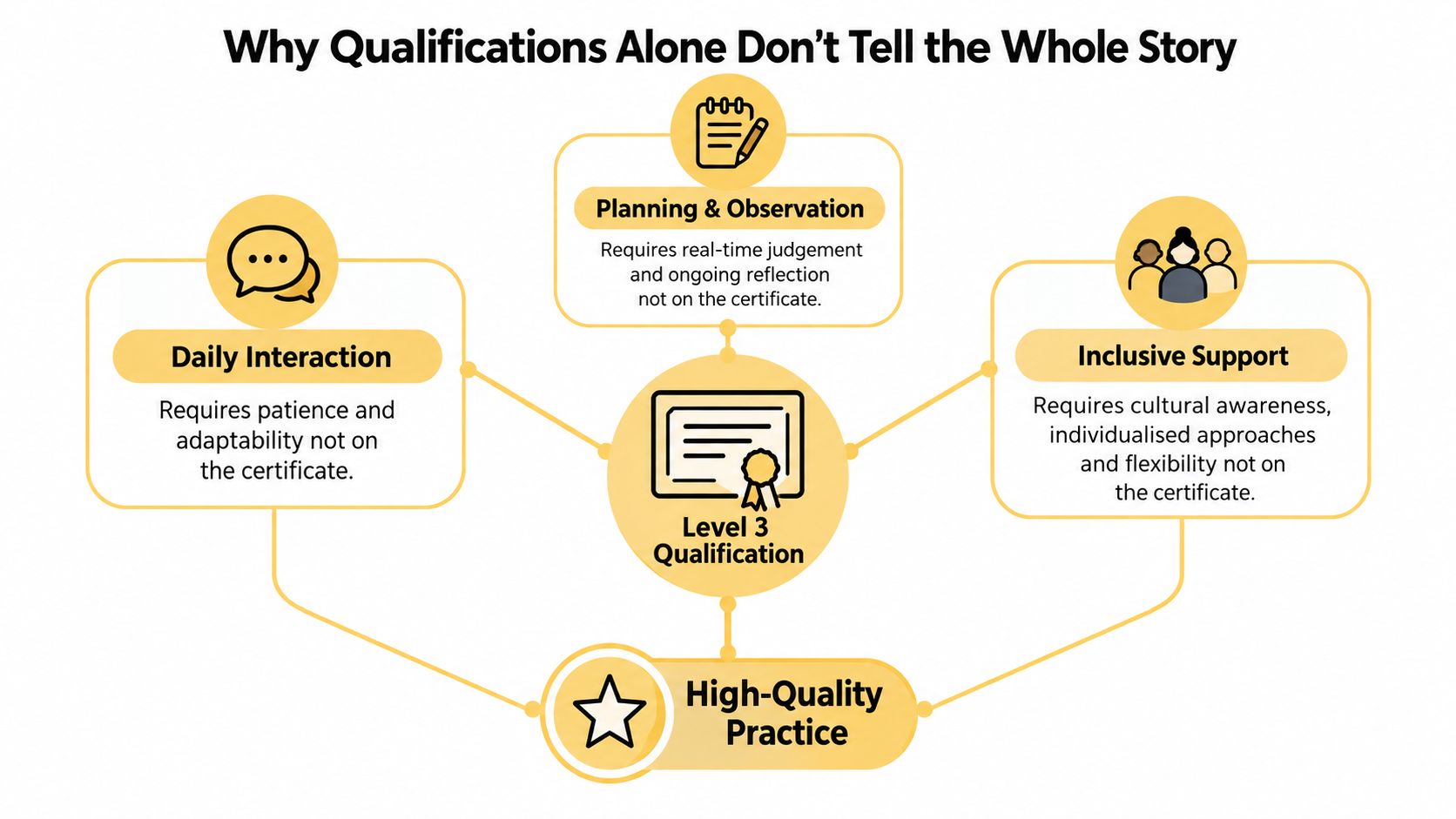
At the nursery door, a Level 3 certificate answers one question: has the practitioner completed an approved programme? It does not show how patiently they comfort a distressed child, notice a quiet developmental change or adapt an activity for a child with additional needs. Those skills become visible in the room, through interactions, routines and professional judgement.
Two practitioners may hold the same qualification yet contribute differently. One may be strong at sustained shared thinking but need help with observations. Another may organise routines confidently while developing communication with families. A manager therefore considers daily practice alongside the personnel file. Parents can ask how these strengths are supported, and how staff are deployed within the relevant ratios.
The 2026 NFER workforce evidence identifies a progression problem. Only about a quarter of the early years workforce holds a Level 4 or above qualification, and higher-qualified staff are less likely to see career progression opportunities than comparable workers in other sectors. It also identifies childminders as a distinct group, with 24% qualified to Level 2 or below, after the DfE removed the formal early years qualification requirement for childminders on the Early Years Register in 2024. These findings are discussed in the published early years workforce research.
What good settings add
A qualification provides the base. Strong settings build practice around it through:
- Mentoring: New practitioners observe skilled colleagues and receive feedback on interactions, planning and care routines.
- Reflective practice: Teams examine what happened, why it happened and how they might respond differently.
- Continuing professional development: Staff extend their knowledge of speech and language, SEND, safeguarding, behaviour, outdoor learning and leadership.
- Progression: Level 5 management routes, Early Years Teacher Status and the ECT pathway can help experienced staff shape practice across a team.
For parents, the useful question is not only whether a practitioner has Level 3. Ask whether the setting supports learning after qualification, records development appropriately, and keeps familiar adults with children. A setting profile may show qualifications and roles, while a manager can explain how training affects room cover, ratio decisions and support for individual children.
A qualification is the entry ticket and the floor. It is not the ceiling.
What Parents Should Check and How Nursery Advice Surfaces It
A nursery visit can answer questions that a qualification list cannot. Parents need to know who will care for their child, how qualifications affect staffing ratios, and how the setting supports practice after training.
Ask the manager:
- Qualification profile: How many practitioners hold Level 3 or above, and which qualifications count towards ratios in each room?
- Room cover: Who holds paediatric first aid, and who covers breaks, sickness or absence?
- Additional needs: Who is the SENCO, and how does the setting support children with SEND?
- Inspection evidence: What is the latest inspection outcome and date, and where can you read the report?
- Workforce stability: How does the nursery manage turnover and maintain familiar key-person relationships?
- Suitability checks: How does the manager complete DBS, prohibition and disqualification checks?
A clear answer should explain the process without sharing private staff documents. Ask how qualification status affects deployment, supervision and room cover. In England, the setting's profile and inspection information can help you check what is recorded. In Scotland, Wales and Northern Ireland, use the relevant national regulator's information as well, because registration, inspection and qualification expectations are not identical.
What to observe during a visit
Watch the adults, not only the toys and décor. Do practitioners come down to children's level, respond to communication attempts, comfort children respectfully and share useful information with families? Notice whether the room is organised so adults can supervise safely while giving children unhurried attention.
Ask to see the setting's policies and quality information. An inspection outcome gives context, but your own observations still matter. Listen to how staff describe children, their interests and any support they need.
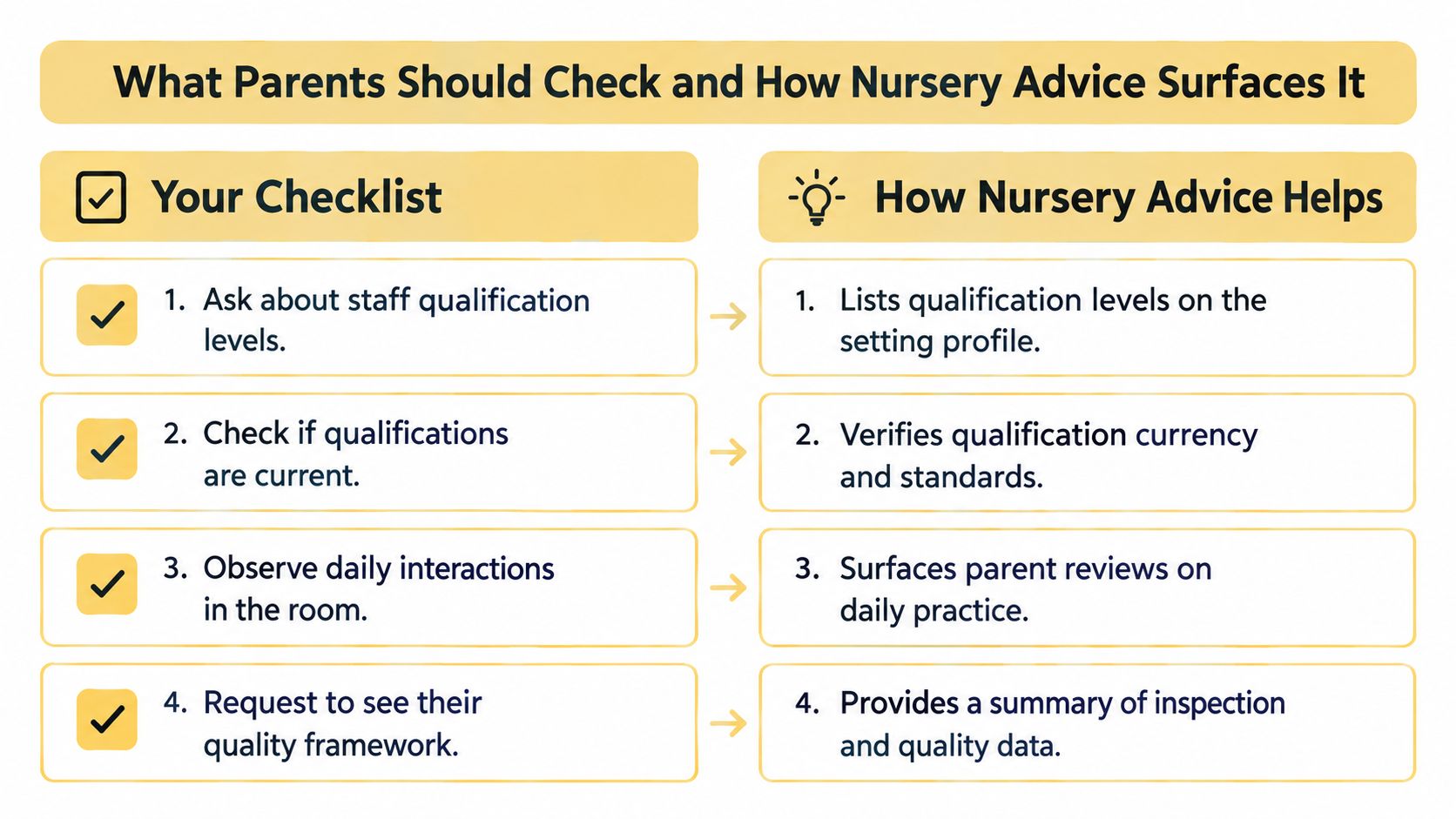
Nursery Advice brings together provider information, inspection evidence and parent-facing guidance. Profiles can include registration details, inspection information, opening hours, fees guidance and setting-supplied information, helping families create a shortlist before visiting. Treat a directory profile as a starting point, then confirm current details directly with the nursery.
Use qualification level as your first check, then ask how it affects ratios, supervision and progression. Compare current provider details on Nursery Advice before making a shortlist or applying for a role.