
Nursery Staff Ratios Explained for UK Parents and Settings
Understand nursery staff ratios in the UK, statutory requirements by age, how to calculate them and what to check when comparing settings near you.
You're halfway through a nursery tour when you notice the adults rather than the toys. One practitioner is settling a baby, another is helping with lunch, and a third is watching the wider room. The children look comfortable, but you're still wondering whether the staffing is legally sufficient, especially during naps, outdoor play or the busiest part of the day.
That question sits behind nursery staff ratios. Ratios aren't a matter of counting everyone employed by a setting. They concern the eligible adults present, the children they're caring for, their ages, relevant qualifications and how the nursery deploys staff across the provision.
The rules also vary according to the type of setting and the age of the children. England's early years framework provides the statutory baseline for group-based providers, while school-based nurseries have their own published arrangements. Scotland, Wales and Northern Ireland operate under different regulatory systems, so an England-based explanation shouldn't be treated as a UK-wide rulebook.
For parents, understanding the basics makes visits more useful. You can ask how cover works when someone takes a break, whether staff move between rooms, and what happens when attendance changes during the day. For managers, the same knowledge supports safer deployment and clearer explanations to families.
The practical issue is rarely just, “What's the ratio?” It's also, “What does staffing look like at 8am, at lunch, in the garden and when a colleague is absent?” The sections below unpack the legal minimums, show how calculations work, and explain where official evidence and directory information can help you compare settings calmly.
Table of Contents
- Introduction Why Nursery Staff Ratios Matter on Your First Visit
- What Nursery Staff Ratios Mean in Plain English
- Statutory Nursery Staff Ratios Across the UK Nations
- How to Calculate Nursery Staff Ratios With Worked Examples
- Why Ratios Affect Safety Quality and Everyday Care
- How Nursery Staff Ratios Appear in Ofsted Reports and Directory Listings
- Practical Tips for Checking and Comparing Nursery Staff Ratios
Introduction Why Nursery Staff Ratios Matter on Your First Visit
A first visit often gives you two kinds of information at once. You hear what the manager says about the nursery, and you observe how many adults are available to the children in front of you. The room may feel settled, but a calm moment doesn't tell you whether staffing remains resilient when children arrive together, someone needs changing or a practitioner steps away to support an individual child.
That's why ratios matter before you've chosen a place. They provide a common starting point for comparing settings, rather than leaving you to judge quality only by the size of the garden, the appearance of the room or how welcoming the tour feels.
The question behind the number
Suppose you visit a baby room and see several adults caring for a small group. You might ask whether every adult counts towards the ratio, whether someone is covering another room, and whether the arrangement you're seeing is typical or organised for visitors. Those are reasonable questions, not challenges to the staff.
The legal ratio is a minimum requirement, not a promise that every setting will operate at a lower number of children per adult throughout the day. A nursery may choose to deploy more staff at particular times, while attendance patterns, breaks, training and unexpected absences can alter the picture.
Practical rule: Ask what staffing looks like during the busiest parts of the day, not only during your appointment.
A guide for parents and settings
This guide uses England's rules where the statutory data applies, identifies school-based variations, and keeps the language practical. You'll find worked calculations, a simple way to check staffing during a visit, and guidance on reading inspection information without treating a published ratio as the whole quality picture.
The aim is fairness. A large group-based nursery, a maintained nursery class and a childminder aren't organised in the same way, so comparing them requires care. Understanding the framework helps you compare like with like and notice the questions that a brochure can't answer.
What Nursery Staff Ratios Mean in Plain English
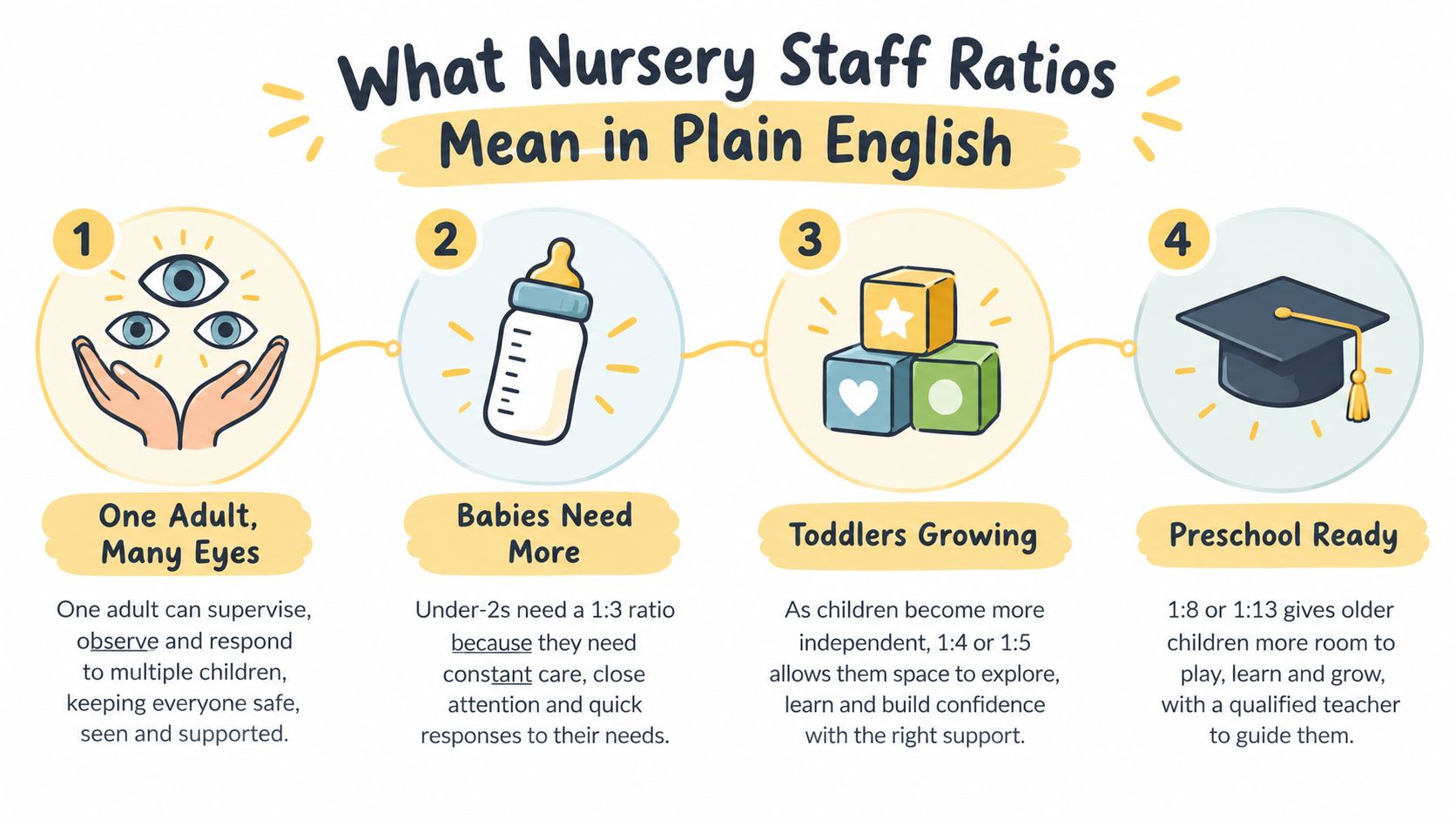
A staff:child ratio tells you how many children one eligible member of staff can be responsible for under the relevant rules. A ratio of 1:3 means one member of staff for up to three children. It doesn't mean one adult must remain physically attached to exactly three children every second, but the provision must organise staffing so the required level of supervision is maintained.
Think of an adult as a pair of hands and eyes. A baby may need help with feeding, settling, changing or comfort while another child needs close attention. Younger children generally need more immediate physical care, so the framework requires more adults in proportion to the group.
Minimum does not mean ideal
The statutory ratio is the floor. It sets the minimum staffing level a provider must meet, but it doesn't describe every aspect of good practice, including how experienced the team is, how well staff communicate with children or how effectively leaders respond when the day changes.
The Department for Education's guidance on early years qualifications and ratios sets out the rules for England's early years providers. The framework applies to providers working with children from birth to five years old and forms part of the Early Years Foundation Stage regulatory system.
Who counts as staff
Not every adult in the building can automatically be counted. Staff included in the ratio must generally be at least 17 years old, with limited exceptions for apprentices, as explained by the Department for Education's plain-English explanation of how staff-to-child ratios work.
That distinction matters during a nursery visit. A manager, trainee or visitor may be present, but their eligibility and role determine whether they can be included in the calculation. For group care across all age groups, at least one member of staff must hold a full and relevant Level 3 qualification.
Ratios also support learning, not just physical safety. When staffing is organised well, adults have more opportunity to notice children's interests, respond to communication and help children take part in play. The number alone can't prove that those things happen, but very stretched deployment can make them harder to sustain.
Statutory Nursery Staff Ratios Across the UK Nations
A nursery may look fully staffed at the start of a visit, then operate differently when children move outdoors, a practitioner takes a break or several children need help at once. Ratios are therefore a practical staffing rule, not a figure attached to one room.
The clearest statutory figures in the available official material relate to England's group-based nursery settings. They are organised around children's ages because babies, toddlers and older preschool children need different levels of supervision.
| Age group | Minimum ratio | Condition |
|---|---|---|
| Children under age 2 | 1:3 | One eligible member of staff for up to three children |
| Two-year-olds | 1:4 | The optional 1:5 arrangement may apply where the setting meets the relevant conditions |
| Children aged 3 and over | 1:8 | The ratio can be 1:13 where a qualified teacher or another suitable Level 6 professional works directly with the children |
The 1:3, 1:4 and 1:8 framework, including the qualified-teacher exception for children aged three and over, is set out in the official England qualifications and ratios guidance. The same guidance records the optional change for two-year-olds introduced in September 2023, allowing 1:5 where the stated conditions are met.
The qualification condition matters
The higher 1:13 ratio is not available merely because an experienced practitioner is on shift. A qualified teacher, or someone with QTS, EYPS, EYTS or another suitable Level 6 qualification, must work directly with the children.
Group care must also include at least one member of staff with a full and relevant Level 3 qualification. Parents can ask which practitioners are being counted, who holds the qualification and how staff are deployed when children move between areas.
The EYFS framework places ratios alongside wider requirements for care, learning and safeguarding. A ratio can show whether the staffing calculation meets the rule, but it cannot by itself show how well adults respond to children.
Whole provision, not automatically one room
Ofsted explains that ratios are calculated across the whole provision rather than room by room. In a larger nursery, children and staff may move between rooms, shared spaces and outdoor areas. The calculation must still reflect the ages being cared for and the staff eligible to count.
School-based provision can follow a different arrangement. For children aged three and over in maintained nursery schools and nursery classes in maintained schools, the rule is 1:13 when a teacher is present. If children attend beyond the school day or during holidays without a teacher, 1:8 can apply when at least one staff member holds a full and relevant Level 3 qualification and at least half of the remaining staff hold a full and relevant Level 2 qualification, as outlined in this maintained nursery staffing guidance.
That is why directory listings and Ofsted reports need context. The word “nursery” can describe different operating models, and a published ratio may not explain who covers breaks, outdoor play or busy drop-off periods. Ask the setting how its staffing works across the whole day, not only in the room you first see.
How to Calculate Nursery Staff Ratios With Worked Examples
The basic calculation is straightforward:
Children ÷ permitted ratio = staff needed
If the result isn't a whole number, round up. A fraction of a practitioner isn't a staffing solution, so a group that falls between two staffing levels needs the next complete member of staff.
Three simple examples
Baby room: A group has six children under age two. At 1:3, divide six by three. The result is two staff members.
Two-year-old group: A group has eight two-year-olds. At the standard 1:4 ratio, divide eight by four. The result is two staff members. If the setting is using the optional 1:5 arrangement, it must still satisfy the conditions attached to that arrangement, rather than treating 1:5 as an automatic entitlement.
Preschool group: A group has sixteen children aged three and over. At 1:8, divide sixteen by eight. The result is two staff members. Where the qualified-teacher condition applies, the 1:13 calculation may produce a different staffing requirement, but the professional must be working directly with the children.
The examples use whole groups because mixed-age attendance needs more careful judgement. A setting shouldn't apply the oldest child's ratio to every child. Managers need to consider the ages represented, the relevant conditions and how staff are deployed across the provision.
Why the whole provision matters
The Ofsted explanation of ratios states that calculations are made across the whole provision, not automatically room by room. That can allow a manager to deploy staff flexibly, but flexibility doesn't remove the need for supervision. Staff counted in the calculation must generally be at least 17, subject to limited apprentice exceptions, and group care must include the required Level 3 qualification.
For parents, a quick visit check is useful but limited. Count the adults and children you can see, then ask whether anyone is moving between spaces, covering breaks or excluded from the ratio. For managers, the practical test is to review deployment before predictable pressure points, such as lunch, outdoor play and collection time.
The image gives a visual summary. A short video can provide another way to think through the calculation:
Why Ratios Affect Safety Quality and Everyday Care
A ratio becomes meaningful when you connect it to what adults can do during the day. One practitioner may need to supervise a group, respond to a child who is upset, help with a practical task and maintain awareness of what is happening elsewhere. When more adults are available, the team has greater capacity to divide those responsibilities.
That doesn't mean a lower ratio automatically proves higher quality. Staff experience, consistency, room organisation and leadership also matter. Ratios create the conditions for attentive care, but people still need to use those conditions well.
What the current provider picture shows
England's 2025 Childcare and Early Years Provider Survey found that 97% of private group-based providers and 95% of voluntary group-based providers said they were operating at or below the under-two ratio of 1:3. The same survey reported a mean of 6.7 children aged three to four per staff member in group-based providers and 8.1 in school-based providers. These figures come from the official 2025 provider survey.
The figures help answer a question that statutory tables leave open: what staffing looks like in practice. They also show why setting type matters. A school-based provision and a private group-based nursery may serve similar ages while organising adults differently.
The busy-period test
Staffing can feel different as the day changes. A nursery might have a full team at the start of a session, then need to coordinate breaks, nappy changes, sleep routines, outdoor play and arrivals. A child who becomes unwell or needs individual support can also alter what the team must do, even when the planned attendance hasn't changed.
Ask how the setting protects supervision during those moments. The answer should describe who covers breaks, how leaders respond to absence and how staff know which children they're responsible for when groups combine.
Ratios protect the minimum number of adult eyes available. Good practice also protects continuity, attention and calm decision-making.
The most useful observation is therefore not a single headcount. Notice whether adults communicate clearly, whether children can reach help, and whether staff remain aware of the whole group while supporting individuals.
How Nursery Staff Ratios Appear in Ofsted Reports and Directory Listings
A directory figure or an Ofsted report gives you a useful starting point, not a live view of the nursery floor. Ofsted reports may describe leadership, supervision and how the setting meets requirements, but they record an inspection rather than each day's staffing rota.
Read the report beside what you see and hear on a visit. Look for comments about how leaders deploy staff, how practitioners support children and whether the setting has addressed earlier weaknesses. A positive overall judgement does not explain who covers lunch, sickness, nappy changes or other busy periods.
Compare the setting type as well as the number
The same ratio can mean different things in different provisions. Maintained nursery schools and nursery classes may organise staff differently from group-based day nurseries. For children aged three and over, a teacher-led arrangement can support a 1:13 ratio, while 1:8 may apply outside that arrangement when the stated qualification conditions are met.
The practical question is what the published figure covers. If a directory lists a ratio, or a manager gives you one, ask whether it applies to the whole provision, one age group, a school session or extended care.
Staffing can change as groups combine or children move between indoor and outdoor areas. Ask who remains responsible for each group and how the setting checks that qualified staff are in place.
Use listings as a starting point
A directory such as Nursery Advice lets you shortlist settings by Ofsted grade and inspection date before you visit, so you can verify staffing in person.
Use a listing to compare basic information, then contact each provider directly. Inspection evidence can help you decide which settings to visit, while a conversation reveals how the team handles ordinary disruption.
Keep the same questions for every nursery:
- Which adults count in the ratio?
- Who covers breaks, sickness and training?
- Does the published figure apply across the whole provision?
- Which qualifications do staff working directly with children hold?
- What changes during outdoor play or combined-group periods?
During a visit, compare the answer with the room itself. Adults should know which children they are watching, communicate when responsibilities change and maintain supervision when someone needs individual help. That comparison shows how a ratio works in practice, rather than how it appears in a listing.
Practical Tips for Checking and Comparing Nursery Staff Ratios
Parents don't need to audit a nursery like an inspector. You do need enough information to understand whether the setting's explanation matches what you see and whether the team has a plan for ordinary disruption.
A visit-day checklist
-
Observe the room. Count the children and adults during the visit, then ask whether the staffing is typical.
-
Ask about cover. Find out who covers breaks, lunch, sickness and training. A clear answer is more useful than a general assurance that the nursery is “fully staffed”.
-
Check qualifications. Ask which adults count in the ratio and who holds the relevant Level 3 qualification. If the setting refers to a higher ratio for older children, ask which qualification condition supports it.
-
Look for operational clarity. Ask how ratios are checked when rooms combine, children go outside or attendance changes. Managers should be able to explain their deployment process.
-
Compare consistently. Use the same questions at every visit. If you're weighing a childminder against a nursery, the practical differences are set out in this guide to childminder versus nursery care.
For managers, the same checklist becomes a compliance routine. Review staffing before known pressure points, confirm eligibility and qualification coverage, and keep daily records that show how deployment met the required arrangements. A workforce-management resource such as this Australian workforce management guide offers broader operational ideas, but England's statutory requirements remain the authority for English early years provision.
For parents: The minimum ratio is a starting point for questions, not the only measure of a nursery's quality.
You can use a directory shortlist, saved comparisons and parent information resources to revisit your decision after the emotion of a first visit has settled. Choose the setting that can explain its staffing clearly, shows consistent adult presence and demonstrates how it protects children's care when the day becomes busy.
Before booking your next nursery visit, write down the five questions above and ask each setting the same things. Use the official England guidance to check the legal baseline, compare inspection information carefully, and request a clear explanation of staffing during breaks, outdoor play and absence.