
Nursery Sickness Policy How to Write a Compliant Guide
Build a compliant nursery sickness policy for UK settings with exclusion periods, templates and outbreak steps. Includes NHS and GOV.UK guidance.
A parent arrives at 8.05am with a cheerful toddler, a packed bag and a confident explanation: “The vomiting stopped yesterday morning, so she's fine now.” The manager checks the illness log, asks when the last episode occurred and explains that the child can't return yet. The parent is frustrated. The manager doesn't want an argument at the door, but the decision has to protect the rest of the room, the staff team and the child herself.
That exchange is exactly why a nursery sickness policy needs to be written, specific and easy to apply. It gives staff a consistent response when symptoms appear, gives parents a fair explanation and turns public-health guidance into an ordinary nursery routine rather than a personal judgement made under pressure.
A useful policy also separates two questions. First, has the relevant exclusion period passed? Secondly, is the child well enough to take part in the nursery day? UK children's settings guidance supports both conditions, requiring people with infectious symptoms or diagnoses to stay away for the minimum recommended period and until they're well enough to return. UKHSA guidance on managing outbreaks and incidents provides the operational model.
The sections below focus on what works at the door and in the office, including exclusion wording, illness handling, records, outbreak notifications and copy-ready messages for families. The aim isn't to create a document that sits in a policy folder. It's to build a working infection-control tool that staff can use confidently on a busy morning.
Table of Contents
- Introduction Why Your Nursery Needs a Clear Sickness Policy
- Essential Components Every UK Nursery Sickness Policy Must Include
- Exclusion Periods and When Children and Staff Can Return
- Handling Illness Medication and Recordkeeping Day to Day
- Outbreak Management Notifications and Parent Communication Templates
- Putting Your Policy Into Practice With a Ready to Use Template
Introduction Why Your Nursery Needs a Clear Sickness Policy
A child arrives pale after vomiting overnight. At the door, the parent says they seem fine now, while the practitioner is deciding whether they can manage breakfast, play and the full nursery day. Without an agreed process, staff can make different decisions, parents receive conflicting messages and managers repeatedly face the same difficult conversation.
A nursery sickness policy gives the team a consistent response when a child develops a cough, rash, diarrhoea or unusual tiredness. It explains what happens when symptoms appear, how families are contacted and who records the decision. Exclusion is a health and attendance decision, not a punishment.
The policy should separate two checks. Has the relevant exclusion period ended? Is the child well enough to take part in ordinary activities without one-to-one comfort, regular observation or a quiet place to sleep? Both answers need to support return. A child may look cheerful but still be within an infection-specific exclusion window. Another may have no confirmed infectious illness but be too unwell to manage the day safely.
Practical rule: Staff should refer to the symptom, the applicable exclusion period and the child's ability to participate. They should not diagnose an illness at the entrance.
England's health-protection guidance applies to nurseries and other children's settings. Its public-health exclusion table lists diarrhoea and vomiting as requiring 48 hours after symptoms stop away from the setting. For chickenpox, it lists 5 days after the rash first appears. The GOV.UK public-health exclusion table provides the reference managers can use when explaining an attendance decision. The separate UKHSA guidance on managing outbreaks and incidents also sets out the operational approach for responding to concerns and possible clusters.
Parents should know how quickly the nursery will contact them, what information will be shared and whether collection may be needed during the day. Staff need the same clarity about reporting their own symptoms, return decisions and cover arrangements. These details reduce hurried choices when the room is busy.
Consistency at the door
A calm, repeatable script keeps the discussion focused:
“Our policy follows the public-health exclusion period for this illness. We recorded the last symptom as yesterday morning, so the full exclusion window must pass before return. We'll check the child's wellbeing before the next attendance.”
This avoids an argument about whether the child “looks better” and makes clear that the nursery has not diagnosed anything. The policy provides the decision framework.
Keep the document available to staff and families, in plain English, and review it when official guidance changes. It should connect with safeguarding, medication, health and safety, infection-control and emergency procedures. A manager can then show how the setting makes decisions at the door, records them in the office and communicates them consistently.
Essential Components Every UK Nursery Sickness Policy Must Include
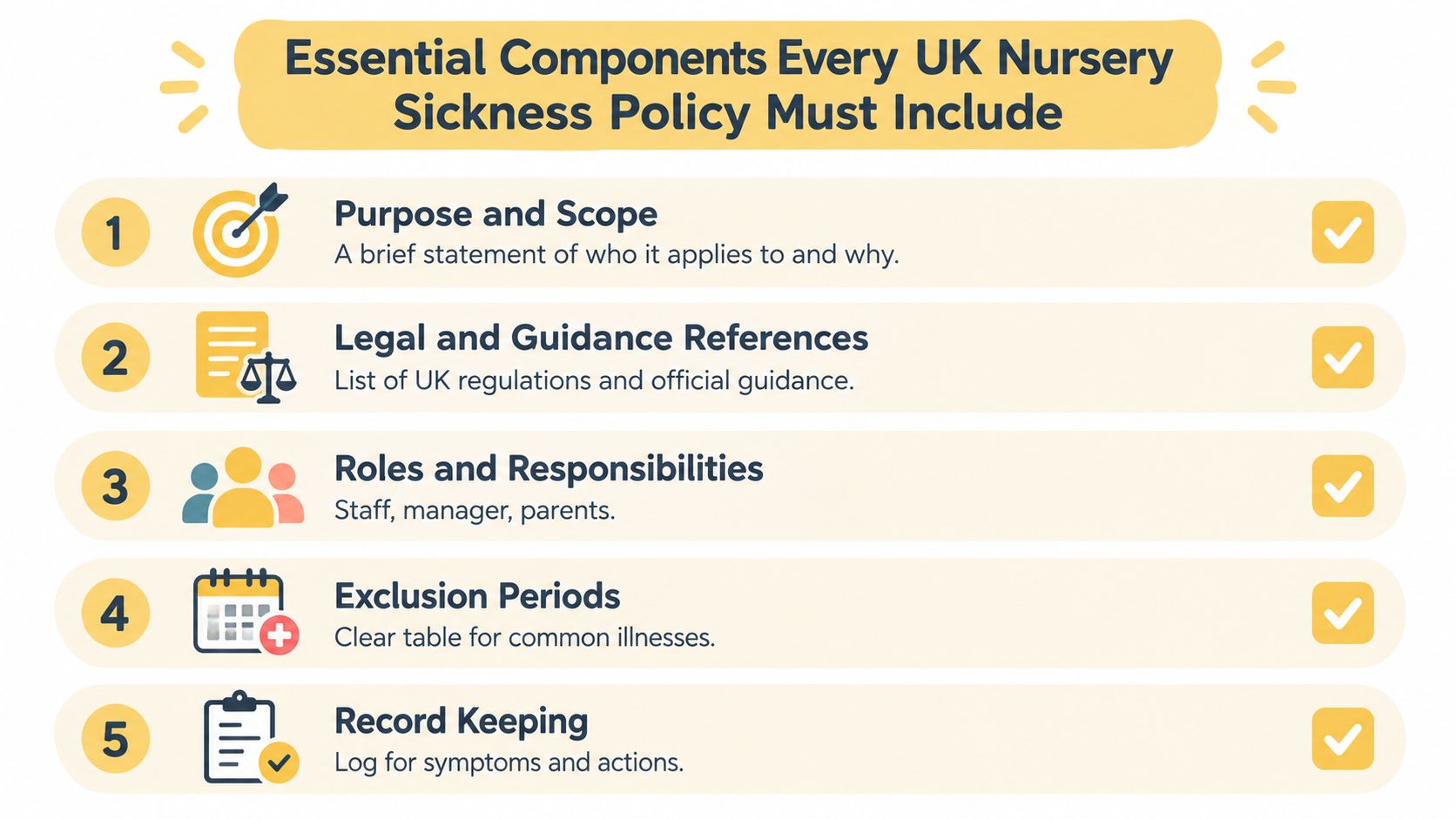
Start with a structure that a new member of staff can follow without needing a private explanation from the manager. The policy should state who it covers, what decisions it controls and where the setting obtains health-protection advice. Avoid vague phrases such as “children should stay home when unwell”. Define the practical test instead.
Start with purpose and scope
Open with a short statement covering children, staff, agency workers, students, visitors where relevant and parents' reporting duties. Explain that the policy supports infection prevention, safe care and appropriate attendance decisions. Include a review owner, approval date and next review date, but don't rely on dates alone. Staff should know where the live version is stored.
Your policy should cross-reference the setting's approach to the EYFS framework and its welfare requirements, particularly where illness affects supervision, medication, safeguarding or a child's ability to access activities.
Identify the authority behind decisions
Link to current GOV.UK health-protection guidance and NHS advice for parents. The national framework was first published on GOV.UK in 2017 and remains a maintained guidance set, bringing exclusion tables and outbreak-management advice into one national system. The dedicated GOV.UK framework for schools and childcare facilities shows that decisions should be differentiated by condition rather than based on one blanket rule.
Don't add unsupported local rules to the same table without labelling them as setting requirements. If your nursery asks for extra information, such as a medication update or a healthcare professional's advice, say why and identify who makes the final decision.
Allocate responsibility clearly
Use names or job titles rather than “the nursery” as an abstract decision-maker.
- Parents and carers: Report symptoms, diagnoses, treatment and relevant professional advice before attendance.
- Room practitioners: Observe, comfort, supervise and record changes, then alert the designated senior person.
- The manager or deputy: Decide on collection, exclusion, readmission and escalation.
- All staff: Follow hygiene, confidentiality, medication and reporting procedures, including their own sickness requirements.
Define illness in practical terms
Distinguish a mild symptom from a child who cannot comfortably participate. A runny nose alone shouldn't automatically produce a blanket exclusion rule, but a child who is unusually drowsy, needs constant adult attention or can't manage normal routines may need to go home. Avoid diagnosing conditions. Staff can describe observations and follow the relevant public-health table.
Build the supporting records
Include an illness notification form, room observation record, medication form, collection record, staff absence log and outbreak monitoring sheet. Record facts, not speculation. Note what was seen, when it happened, who was contacted, what advice was given and what action followed.
The policy should also point staff to medication, safeguarding, health and safety, accident and incident, confidentiality and business-continuity procedures. That prevents one document from carrying instructions it can't safely manage.
Exclusion Periods and When Children and Staff Can Return
At 8.30am, a parent may say that a child vomited once overnight but seems ready for nursery. The manager needs more than a general impression to make that decision. The policy should set out the relevant exclusion window, then apply a fit-to-attend check before agreeing a return.
Keep the exclusion table available in the office, staff handbook and parent information. State that it reflects current public-health guidance and must be checked for updates. The return decision has two parts: the minimum exclusion period must have passed, and the child or staff member must be well enough to take part in ordinary activities. Completing the time period alone does not make attendance appropriate.
Use condition-specific rules
The GOV.UK table gives different instructions for different conditions. Some require no exclusion, while others use a fixed period or symptoms as the deciding factor. Athlete's foot and cold sores require no exclusion. Cryptosporidiosis requires absence until 2 days after diarrhoea and vomiting stop. COVID-19 advice is symptom-based rather than expressed as a fixed day count. Check The official exclusion periods table during policy reviews and whenever a reported case may match an entry.
| Infection or condition | Exclusion period | Return condition |
|---|---|---|
| Diarrhoea and vomiting | Until 48 hours after symptoms stop | The exclusion window has passed and the child is well enough to participate |
| Chickenpox | Until 5 days after the rash first appears | The required period has passed and the child is well enough to attend |
| Cryptosporidiosis | Until 2 days after diarrhoea and vomiting stop | The condition-specific period has passed and the child is fit to attend |
| Athlete's foot | No exclusion | The child is well enough to participate |
| Cold sores | No exclusion | The child is well enough to participate, with sensible hygiene controls |
| COVID-19 | Symptom-based guidance, not a fixed day count | Follow current advice and assess whether the child is well enough to attend |
Use the table to make an attendance decision, not to diagnose a child. If a parent reports a named infection, record the information and apply the relevant entry. If the diagnosis is uncertain, ask the family to follow NHS or healthcare professional advice and speak with the manager before the child returns.
Handle the “mild symptoms” question properly
Parents may ask whether the 48-hour rule applies when vomiting or diarrhoea has a non-infectious explanation. Staff should not investigate or diagnose the cause at the door. Explain that the nursery applies its published policy to reported symptoms. A family with a specific medical explanation can share advice from a healthcare professional for the manager to consider.
Healthcare professionals should tell families how long a child with an infectious condition needs to stay away and when they can return. Add a policy instruction asking parents to pass that advice to the manager, preferably before the proposed return date. This gives the nursery a clear record and avoids a rushed decision at drop-off.
Apply the same infection-control approach to staff. A practitioner should report symptoms through the stated route and must not feel pressured to attend because the rota is difficult. The manager has to maintain safe staffing while keeping exclusion decisions consistent. If several people develop related symptoms, or an unusual illness appears, follow the outbreak process and seek local health-protection advice rather than creating a new rule at the door.
Handling Illness Medication and Recordkeeping Day to Day
A good policy becomes real during lunch, outdoor play and sleep periods, not during a policy review meeting. Staff need a short sequence that protects the child's dignity while keeping supervision safe.
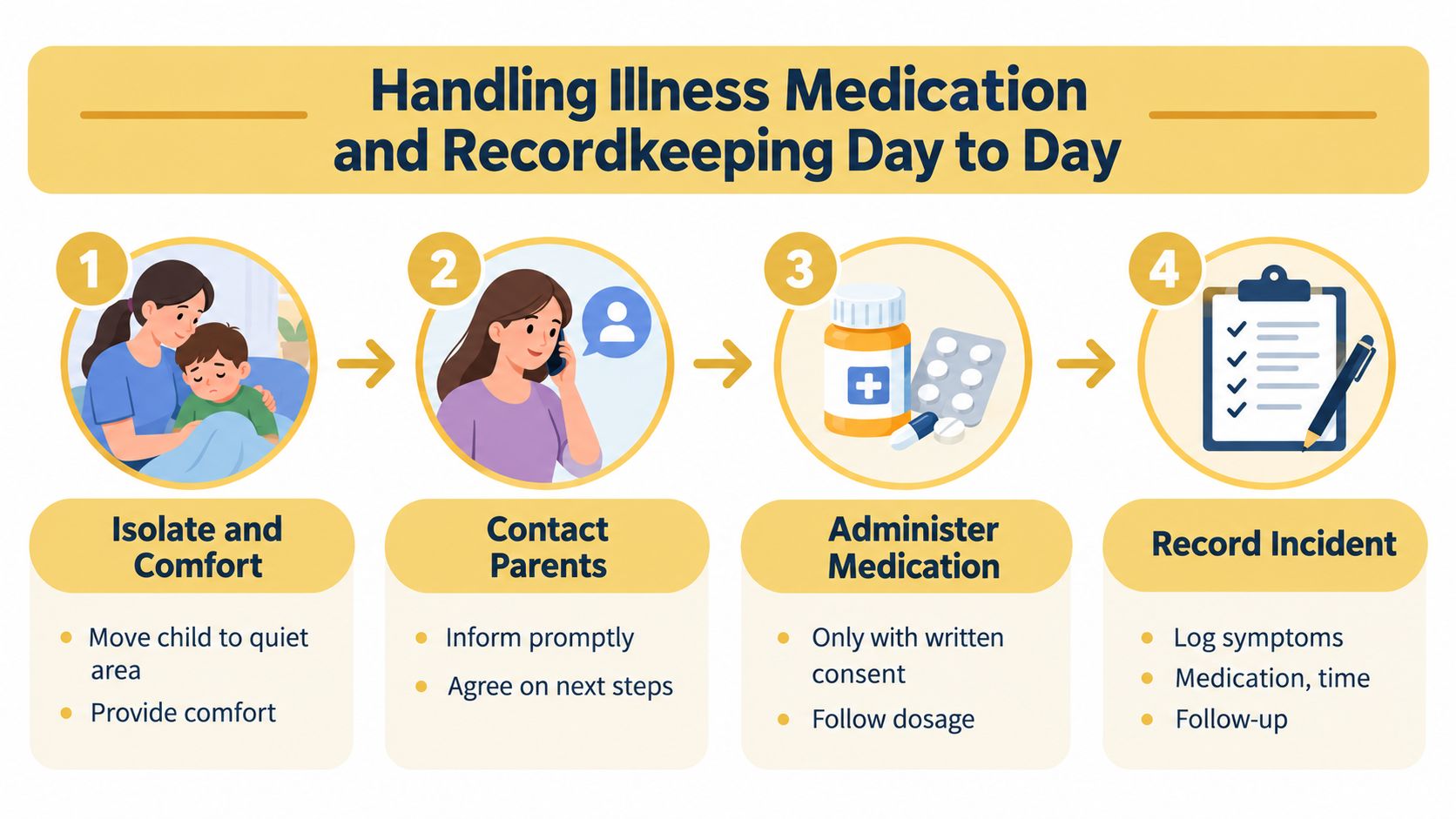
If a child vomits at lunch, move them away from the group to a quiet, supervised area. Comfort them, observe their condition, use the setting's cleaning and hygiene procedure, and contact the parent promptly. Don't leave the child isolated or make them feel responsible for the disruption. The senior person should decide whether collection is needed and record the decision.
Make the routine repeatable
- Observe and comfort: Note symptoms, presentation, temperature where your procedure permits it, fluid intake and ability to participate. Keep the child supervised.
- Contact the parent or carer: Give factual information, explain the next step and confirm collection arrangements. Escalate urgently where the child's condition appears serious.
- Administer medication safely: Only give medication under the setting's written-consent procedure, with the correct child, medicine, dose, timing and recording. Never rely on a verbal instruction that hasn't been authorised through your policy.
- Close the record: Log symptoms, times, action taken, contact attempts, medication and follow-up. File the record securely and share it only with people who need the information.
Medication records should show what was given, who administered it, who checked it where your procedure requires a second check, and whether any dose was refused or returned. If a child's condition changes, record the new observation rather than overwriting the earlier entry.
A staff member diagnosed with cryptosporidiosis, for example, should report the diagnosis through the agreed manager route and remain away for the condition-specific period. The manager records the absence, considers staffing and hygiene implications, and seeks public-health advice if other linked cases appear.
Confidentiality matters. Keep health records secure, avoid discussing a child's condition in shared areas and tell families only what they need to know about wider infection risks. For practical emergency preparation, managers may also direct staff to relevant first-aid training resources, including ways to find first aid courses in Australia when supporting colleagues who work across jurisdictions or maintain broader professional training records.
Your illness process should connect with safeguarding in early years. A sudden change in presentation, repeated unexplained illness or concerns about collection arrangements may require safeguarding consideration, not just an attendance decision.
Outbreak Management Notifications and Parent Communication Templates
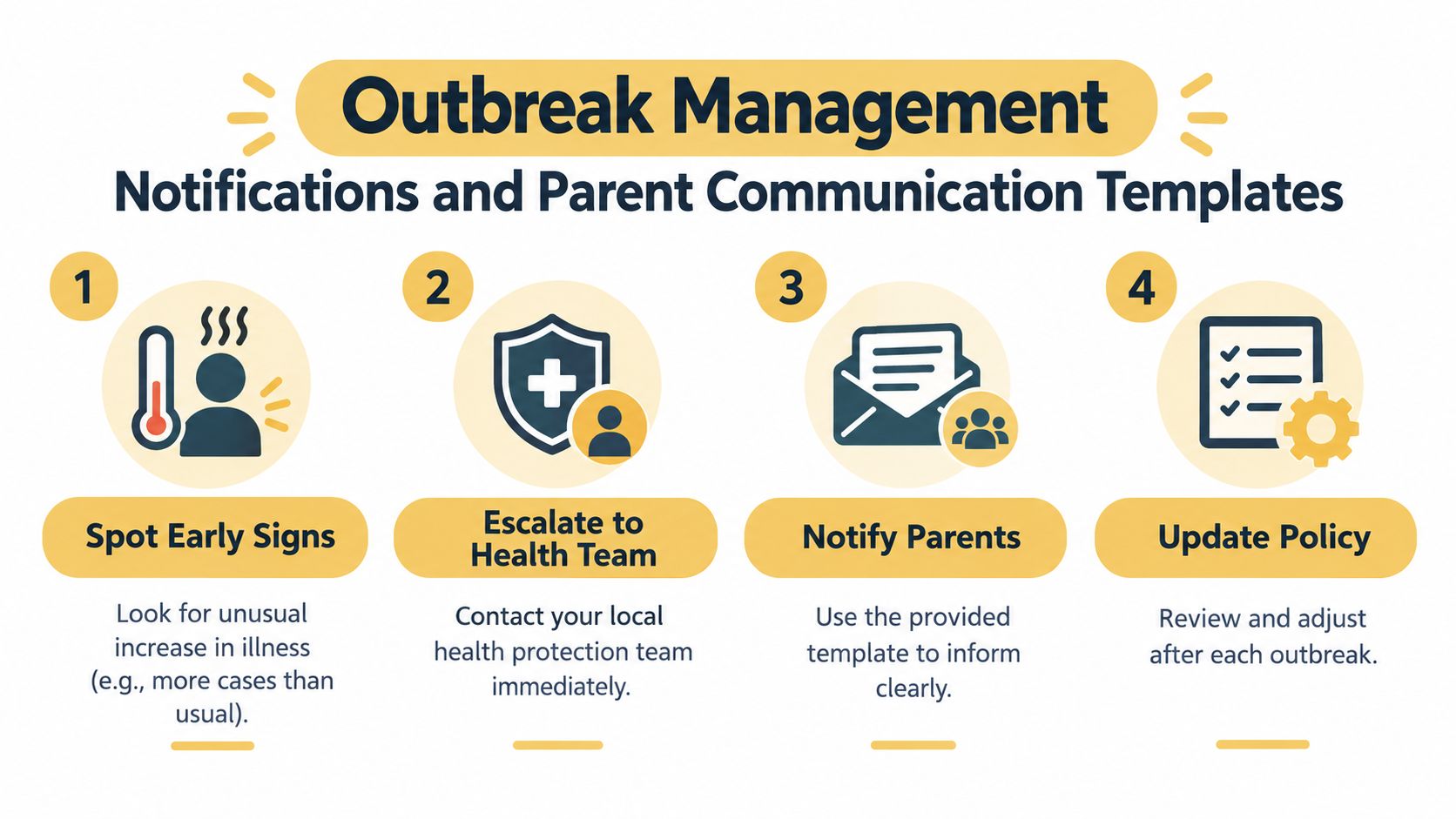
A child vomiting at breakfast may be an isolated incident. Several children in one room becoming unwell over a short period needs a different response. The manager should compare absence records, symptom descriptions, dates, rooms and staff links, then decide whether to contact the local health protection team. The GOV.UK outbreak and incident management guidance sets out the escalation approach and the need to follow local health-protection advice.
Record first, then communicate
Open an outbreak log as soon as a pattern becomes possible. Record the affected child or staff group, symptoms observed, absence dates, room location, cleaning or staffing actions, advice requested and advice received. Keep the working record factual. Do not label an illness as a diagnosis unless that diagnosis has been confirmed.
A general parent message must protect confidentiality while giving families something practical to do:
Parent update: “We're contacting families because we've received reports of similar illness within the setting. Please tell us promptly if your child develops symptoms and follow the exclusion period in our sickness policy. We're increasing cleaning and monitoring absences, and we'll follow advice from the local health protection team.”
Send the same wording through the agreed channel, then record when it was issued. Parents need enough information to recognise symptoms and report them, not details that identify another family.
Staff need instructions they can apply at the door and in the room:
Staff message: “Record symptoms and absence times accurately, report new linked cases to the manager and follow the room hygiene procedure. Don't speculate about diagnoses or discuss individual cases with families.”
Keep entrance wording brief:
“Please report vomiting, diarrhoea, rashes and diagnosed infectious conditions before attendance. The manager may ask for collection or a period away in line with current public-health guidance.”
A clear message recognises the disruption without weakening the exclusion rule. Families may need work cover, while the nursery may need to adjust staffing, rooms or activities. Consistent wording also reduces repeated calls and prevents different explanations being given at collection.
For managers shaping the wider plan, the VirusFAQ.com risk communication guide provides principles for clarity, reassurance and avoiding unnecessary alarm. Keep every nursery update tied to observed facts and current official advice.
Putting Your Policy Into Practice With a Ready to Use Template
A policy only works if staff can find it, understand it and use the same wording. After approval, brief the whole team using realistic scenarios: a child who vomits during lunch, a parent disputing the return date and a staff member reporting an infectious diagnosis. Ask practitioners to explain what they'd record and who they'd contact.
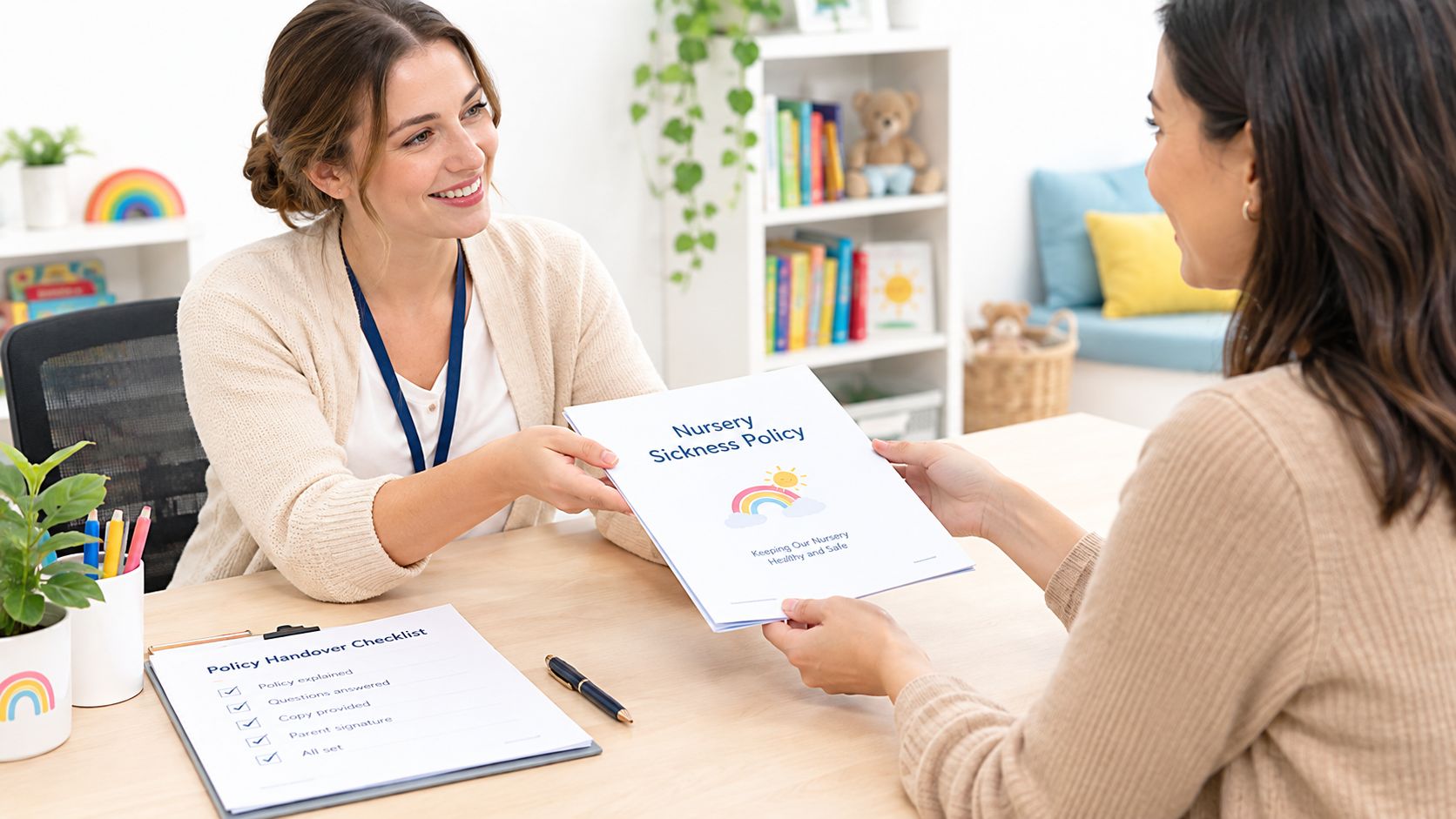
Share the parent version during induction, include it in the welcome information and place it somewhere families can access easily. If your setting uses an app, keep the current version there, but retain a controlled office copy so staff know which document is live.
Copy-ready policy wording
“The nursery follows current UK public-health exclusion guidance. A child or staff member must remain away for the minimum period specified for the relevant infection or symptom. Return also depends on the person being well enough to participate safely in the normal day. The manager will consider healthcare professional advice, current guidance and the information available before confirming readmission.”
Add your setting's collection procedure, emergency contacts, medication arrangements, record locations and local health-protection contact route. Don't copy a generic table without checking that its linked guidance remains current.
For a practical first-month rollout, complete these actions:
- Confirm ownership: Name the manager responsible for updates and decisions.
- Brief staff: Test the process through role-play and check that records are completed consistently.
- Share with parents: Explain the policy before the first attendance and repeat key rules when needed.
- Audit records: Check whether symptom times, contacts and actions are clear enough for another manager to understand.
- Review after incidents: Record what caused confusion and amend the wording, not just the staff reminder.
Review the policy whenever official guidance changes and after any significant illness event. Resources discussing why compliant schools stay unprepared are a useful reminder that having a document isn't the same as having a tested response.
A directory such as Nursery Advice can also be used by families comparing UK settings, where provider profiles may include practical policy notes such as sickness-related attendance and charging information. Keep your own policy specific to your setting, publish the current version and invite parents to contact the manager before bringing back a child after an exclusion period.
Download or create your policy today, then test it with your team before the next busy drop-off. Put the exclusion table, illness record and parent templates where staff can reach them quickly, brief every practitioner on the same return test and schedule a review against current GOV.UK guidance so your nursery is ready to act calmly when illness arrives.