
Nursery Teacher Qualifications: UK Guide 2026
Understand nursery teacher qualifications in the UK. Learn about EYTS, QTS, Level 2/3 routes, Ofsted ratios, mandatory checks and training options for 2026.
In England's 2025/26 school workforce collection, 494,200 of 512,000 teachers held a Level 4 or higher qualification, meaning at least 96.5% had a post-A-level qualification according to the Department for Education's school workforce statistics. Nursery staff work within a different part of the education system, but the comparison highlights an important point: qualifications shape professional expectations, staffing decisions and progression.
For nursery managers, nursery teacher qualifications aren't just entries on a CV. They affect who can count towards EYFS ratios, whether a preschool room can operate with a larger group, and how confidently a setting can plan its leadership structure. For career-changers, the qualification ladder determines the route from entry-level support to graduate-level early years teaching. For parents, it provides useful questions to ask when comparing settings.
The terminology can feel confusing because Level 2, Level 3, EYTS, QTS and EYPS don't mean the same thing. The practical distinction is straightforward once you connect each qualification to the work a person can do and the legal staffing framework around it.
Table of Contents
- Why Nursery Teacher Qualifications Matter in 2026
- Understanding Qualification Levels from Entry to Graduate
- EYTS vs QTS vs EYPS Explained
- How Qualifications Determine Legal Staff Ratios
- Mandatory Checks and Short Courses Beyond Qualifications
- The Workforce Gap Between Expansion and Qualification Depth
- Next Steps for Aspiring Nursery Teachers and Overseas Applicants
Why Nursery Teacher Qualifications Matter in 2026
A nursery may be fully registered and compliant while still having a workforce with very different levels of qualification. NFER's 2026 England early years workforce report says only about a quarter of the overall early years workforce holds a Level 4 or higher early years or teaching-related qualification. It also reports that 20% of staff in group-based providers and 24% of childminders are qualified to Level 2 or below.
That doesn't mean Level 2 staff have no value. Experienced assistants can build strong relationships, support routines and contribute greatly to children's learning. The point is that qualification depth and staffing entitlement are separate questions. A setting might have capable practitioners, but only specific qualifications count at Level 6 for EYFS ratio purposes.
Qualifications affect room planning
The most important operational connection appears in preschool provision. Under the current EYFS framework, a ratio of one member of staff to 13 children aged three and over can apply when a person with QTS, EYTS or EYPS is working directly with the children. Without that qualified teacher-level practitioner working directly in the room, the ratio becomes one member of staff to eight children. The detailed rule is set out in the current EYFS group and school-based framework.
That difference influences more than the rota. It can affect whether a manager combines groups, how many practitioners are needed on a particular day, and whether planned places can be offered safely within the legal framework. A graduate-level member of staff who is only listed on the payroll but not working directly with children won't automatically create the staffing arrangement needed for the larger ratio.
Practical rule: Check the qualification, the age of the children, the person's role and whether they're working directly with the group. Those details must align.
Why this matters to different readers
A career-changer needs to know whether a course leads to a recognised early years role or provides a stepping stone towards higher training. A nursery manager needs a qualification matrix that can be checked against the EYFS framework before publishing room capacity or accepting bookings. A parent should understand that “qualified staff” can describe several levels, not just a graduate teacher.
If you're exploring higher education after school or a different career, an Access Courses Online early years diploma may help you investigate an academic route into early years education. Always confirm how a specific course connects to the entry requirements of the next qualification, particularly if your long-term aim is EYTS.
Understanding Qualification Levels from Entry to Graduate
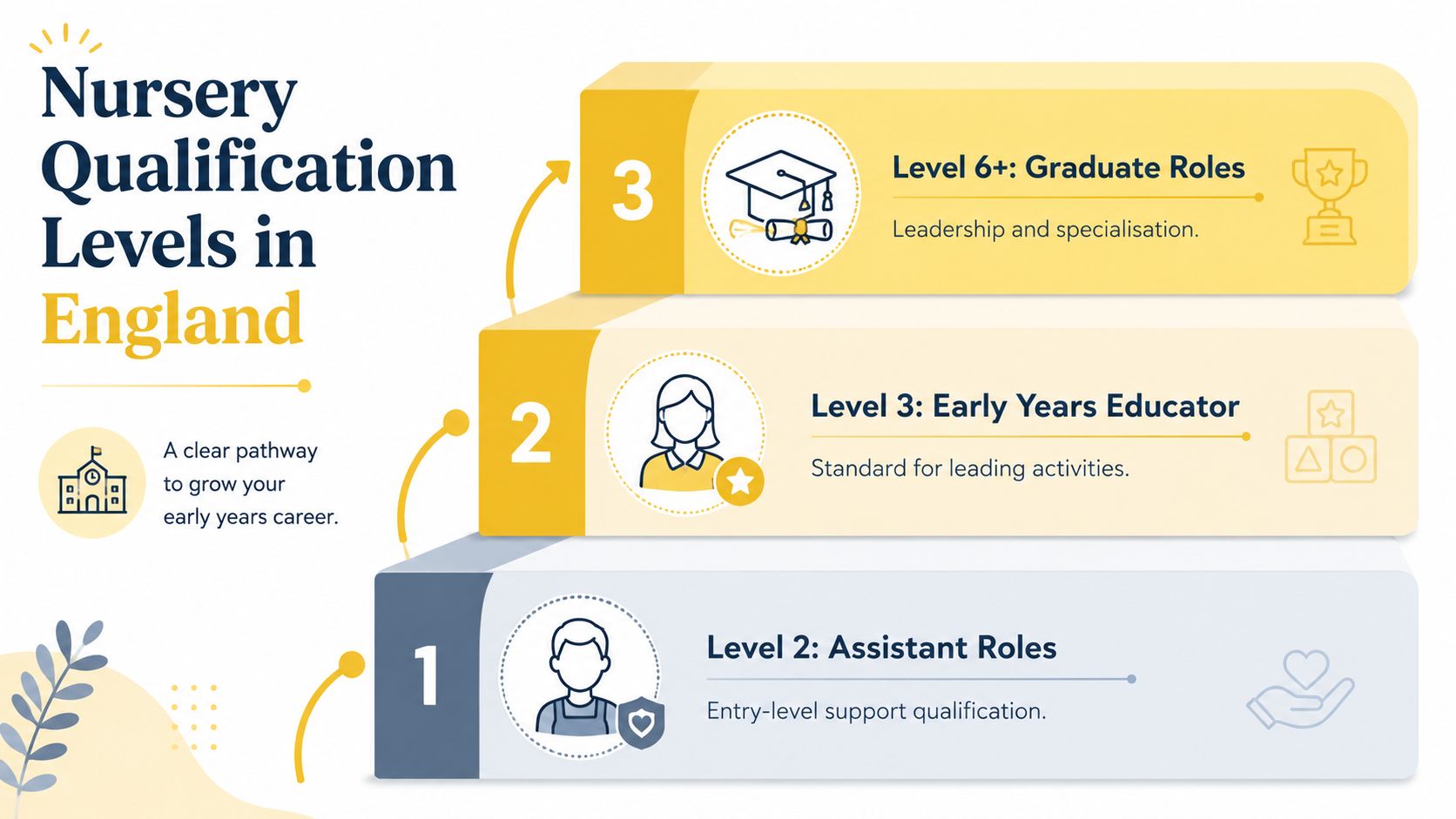
The easiest way to understand nursery teacher qualifications is to view them as a progression rather than a list of unrelated certificates. Level 2 usually supports entry-level work, Level 3 represents the standard qualified practitioner route, and Level 6 covers graduate-level status and leadership.
Level 2 and assistant roles
A Level 2 early years qualification can provide a foundation for nursery support work. In practice, a person at this stage may help with activities, mealtimes, personal care, observations and the daily routines that make a room function. Their responsibilities still depend on the setting's policies, supervision arrangements and the EYFS requirements applying to the children they work with.
Level 2 shouldn't be confused with the standard qualification for leading practice across an early years room. Managers should check the exact qualification and its status against the current government framework rather than relying on a course title alone.
Level 3 and the qualified practitioner route
The Early Years Educator at Level 3 is the central practitioner qualification for staff supporting children from birth to age five. The government's Level 3 Early Years Educator criteria define the minimum knowledge, understanding and practice needed to be considered qualified for that work in the EYFS.
That includes child development, safeguarding, supporting learning, working with families and meeting children's care needs. A Level 3 practitioner can take a substantial role in planning and delivering activities, observing children and contributing to assessment, although the precise position may be described differently by each employer.
The government's pathway guidance also states that staff count towards EYFS ratios at Level 3 or Level 6 where they hold the relevant recognised qualification. Staff with QTS, EYTS or EYPS don't need separate Level 2 literacy and numeracy qualifications to count in those ratios, provided the other requirements are met.
Level 6 and graduate-level responsibility
Level 6 is the graduate-level category relevant to the most important ratio distinction in preschool rooms. It includes QTS, EYTS and EYPS for EYFS staff-to-child ratio purposes. A Level 6 practitioner may take responsibility for leading practice, mentoring colleagues, supporting curriculum development and helping a setting strengthen its educational quality.
A Level 3 qualification can be an excellent professional destination, but it isn't the same as EYTS or QTS. If your aim is to become the graduate teacher-level practitioner who can support a setting's Level 6 staffing model, you'll need to examine the requirements for an approved Level 6 route.
For learners comparing academic pathways, Next Level Online College early years offers a route to explore higher education preparation. Before enrolling, check progression arrangements, entry criteria and whether the course fits your intended early years initial teacher training pathway.
EYTS vs QTS vs EYPS Explained
The three terms most likely to cause confusion are Early Years Teacher Status, Qualified Teacher Status and Early Years Professional Status. They can all appear in discussions about Level 6 staffing, but they have different histories and different professional uses.
EYTS is the modern qualification route for nursery teachers in England. The Get Into Teaching guidance on early years teachers explains that EYTS is the award allowing a person to teach in a nursery or early years setting. It replaced EYPS in September 2014, establishing the current early years teacher route.
QTS is the recognised teacher status associated with teaching in maintained schools. It also counts as Level 6 for EYFS staff-to-child ratios, so a teacher with QTS can support the qualified teacher-level staffing arrangement in an eligible early years room.
EYPS is different because it's a historical status rather than an active route. It's no longer awarded, but existing holders retain recognition as Level 6 staff for ratio purposes.
The entry point for EYTS
Applicants for EYTS normally need GCSE grade 4/C in maths, English and science, according to current GOV.UK guidance. Graduate entrants must also hold a first degree from a UK higher education institution or an equivalent qualification. Providers and routes may apply further selection criteria, so meeting the basic requirements doesn't guarantee admission.
Early years initial teacher training, or EYITT, provides the training route towards EYTS. The Department for Education continues to allocate EYITT places, which means EYTS remains an active national pathway rather than a legacy award.
Comparison table
| Qualification | Valid in | EYFS ratio level | Still awarded |
|---|---|---|---|
| EYTS | Nursery and early years settings in England | Level 6 | Yes |
| QTS | Maintained schools, and recognised for relevant EYFS ratio purposes | Level 6 | Yes |
| EYPS | Existing early years professional status holders | Level 6 | No, it was superseded by EYTS |
The distinction matters when recruiting. A job advert seeking an “early years teacher” should state whether the setting needs EYTS, accepts QTS, or is referring to a different Level 3 practitioner role. Candidates should ask the employer how the qualification will be used, particularly if the position is linked to room leadership or ratios.
A qualification from overseas may be academically strong but still require formal recognition before it can be treated as QTS or EYTS for the relevant staffing purpose. Managers should verify status rather than assuming that a teaching title transfers automatically.
How Qualifications Determine Legal Staff Ratios
The staffing calculation for older preschool children can change depending on one person's qualification and whether that person is directly working with the children. The current EYFS rule permits one staff member for every 13 children aged three and over when a person with QTS, EYTS or EYPS is working directly with them. If no such qualified teacher-level practitioner is working directly with the group, the ratio tightens to one staff member for every eight children.
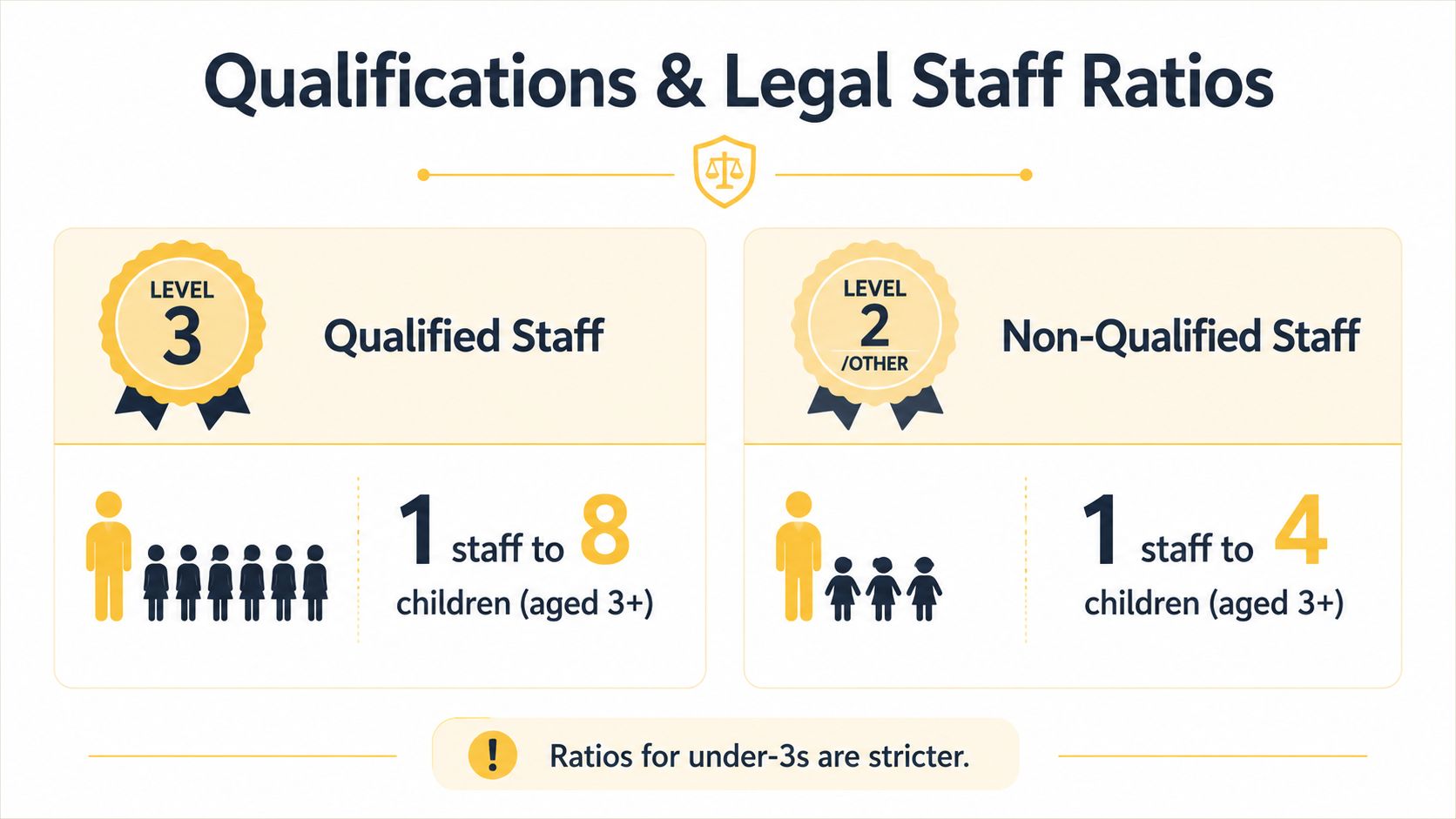
The supplied visual uses different labels from the statutory rule, so managers should rely on the current EYFS wording and the qualification status of the person working with children. A Level 3 practitioner is qualified for the relevant practitioner role, but the larger preschool ratio depends on the presence of QTS, EYTS or EYPS working directly with the group.
What “working directly” means
A graduate teacher-level practitioner cannot be designated as the ratio person while spending the session in an office, attending a meeting, or working elsewhere in the building. The person must be working directly with the children in the circumstances described by the framework.
That affects rota design. A manager should identify which sessions have the required Level 6 practitioner present, record who is working in each room, and review the arrangement when staff are absent, deployed to another group or covering non-contact time.
Room capacity follows the rota, not just the establishment list.
The practical consequences can include additional recruitment, changes to session planning or a decision to keep a group smaller than the maximum that might otherwise be possible. Managers should also consider supervision, safeguarding and children's individual needs rather than treating the ratio as a target to reach.
Overseas qualifications need verification
Overseas teaching qualifications don't count as Level 6 for these purposes until the staff member obtains QTS or EYTS. This can surprise managers and applicants, especially where a practitioner has extensive teaching experience in another country.
The individual may still bring valuable knowledge and experience, but the nursery must distinguish between professional capability and the formal status recognised by the EYFS ratio framework. Build time into recruitment for document checks, equivalence decisions and any required training route.
For a plain-English explanation of the wider statutory framework, see this guide to what the EYFS framework means.
Mandatory Checks and Short Courses Beyond Qualifications
A formal qualification is only one part of being ready to work in an English nursery. Managers must also confirm that staff are suitable to work with children, understand safeguarding responsibilities and can respond to common emergencies.
Recruitment and suitability checks
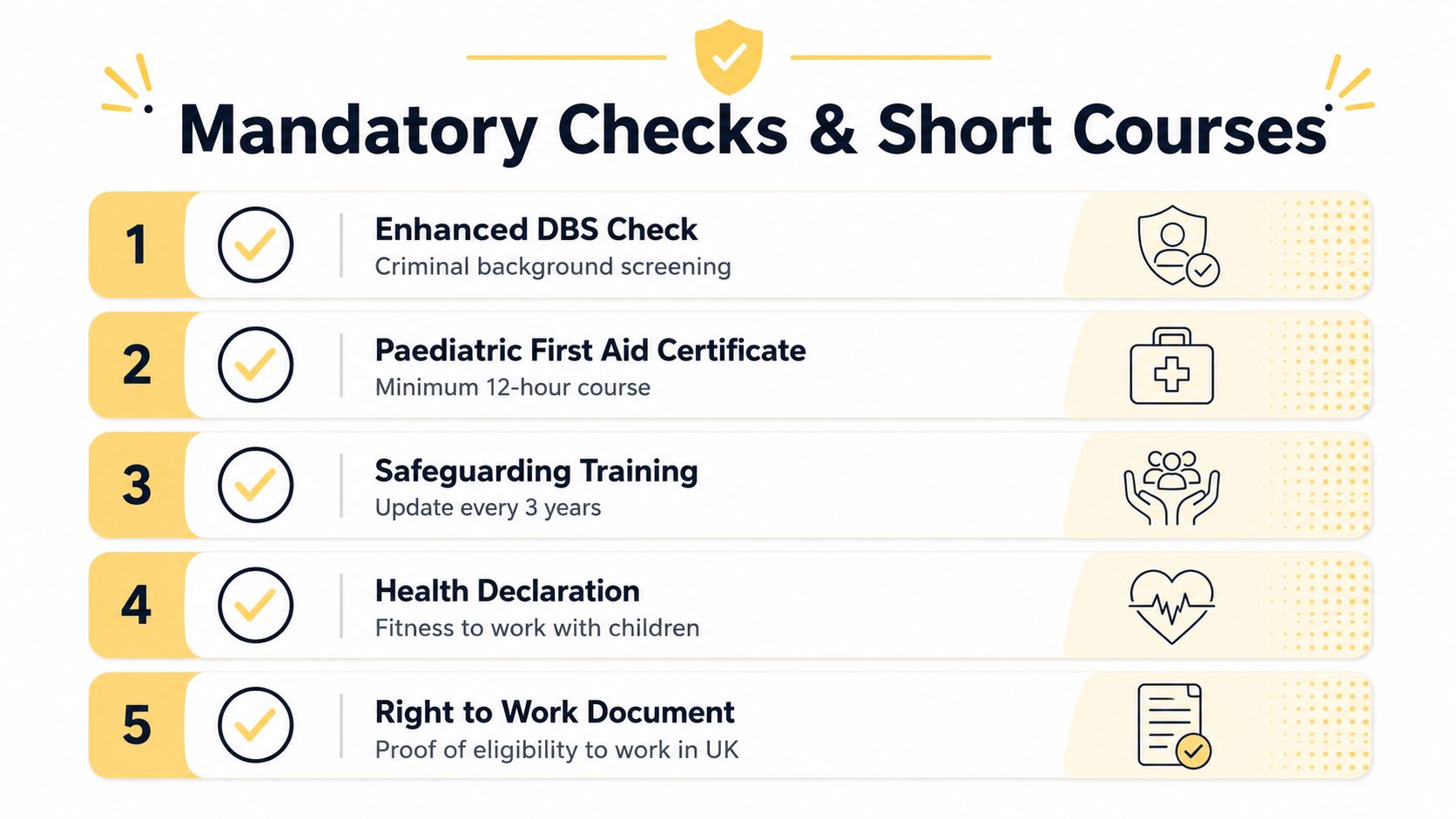
An enhanced DBS check is a central part of safer recruitment. It doesn't replace references, identity checks or a considered suitability process. The manager should keep a clear record of what was checked, when it was completed and whether any issue requires further assessment.
A health declaration helps the provider consider whether the person is fit to work with children and whether reasonable adjustments or additional support may be needed. Right-to-work documentation is a separate employment requirement and should be checked before the person begins work.
A qualification certificate also needs scrutiny. Keep copies or verified records, check the awarding body and confirm whether the award appears on the relevant early years qualification list where that applies.
First aid, safeguarding and role-specific learning
Paediatric first aid is essential practical preparation. The EYFS framework requires appropriate first-aid arrangements, including a person with a full paediatric first aid certificate on the premises when children are present. Managers should check certificate validity, course content and whether staff understand the setting's emergency procedures.
Safeguarding training must be part of induction and ongoing professional development. Staff should know how to identify concerns, record information accurately, report through the setting's procedure and respond appropriately to allegations or disclosures. The safeguarding in early years guidance provides a useful reference point for reviewing those arrangements.
Food hygiene training may be needed for staff who prepare or handle children's meals. Other short courses can support specific responsibilities, such as allergy awareness, medication administration, SEND practice or behaviour support.
A manager's compliance checklist
- DBS and identity: Confirm enhanced DBS clearance and the person's identity documentation.
- References and suitability: Check employment history, references and any gaps that need explanation.
- First aid: Verify the appropriate paediatric first aid certificate and on-site cover.
- Safeguarding: Record induction training and planned refreshers.
- Qualification status: Confirm the exact award, level and ratio recognition.
- Ongoing development: Link CPD to observations, supervision, children's needs and inspection evidence.
Ofsted won't judge a nursery solely by how many certificates sit in a personnel file. Inspectors will want to see that staff apply their knowledge, managers understand their responsibilities and professional development improves everyday practice.
The Workforce Gap Between Expansion and Qualification Depth
Expansion creates a staffing problem that qualification guides often overlook. More places require more practitioners, but a larger workforce does not automatically create a stronger qualification mix. For a nursery manager, the issue is similar to expanding a building without increasing the number of appropriately trained people who can run each room safely and within the rules.
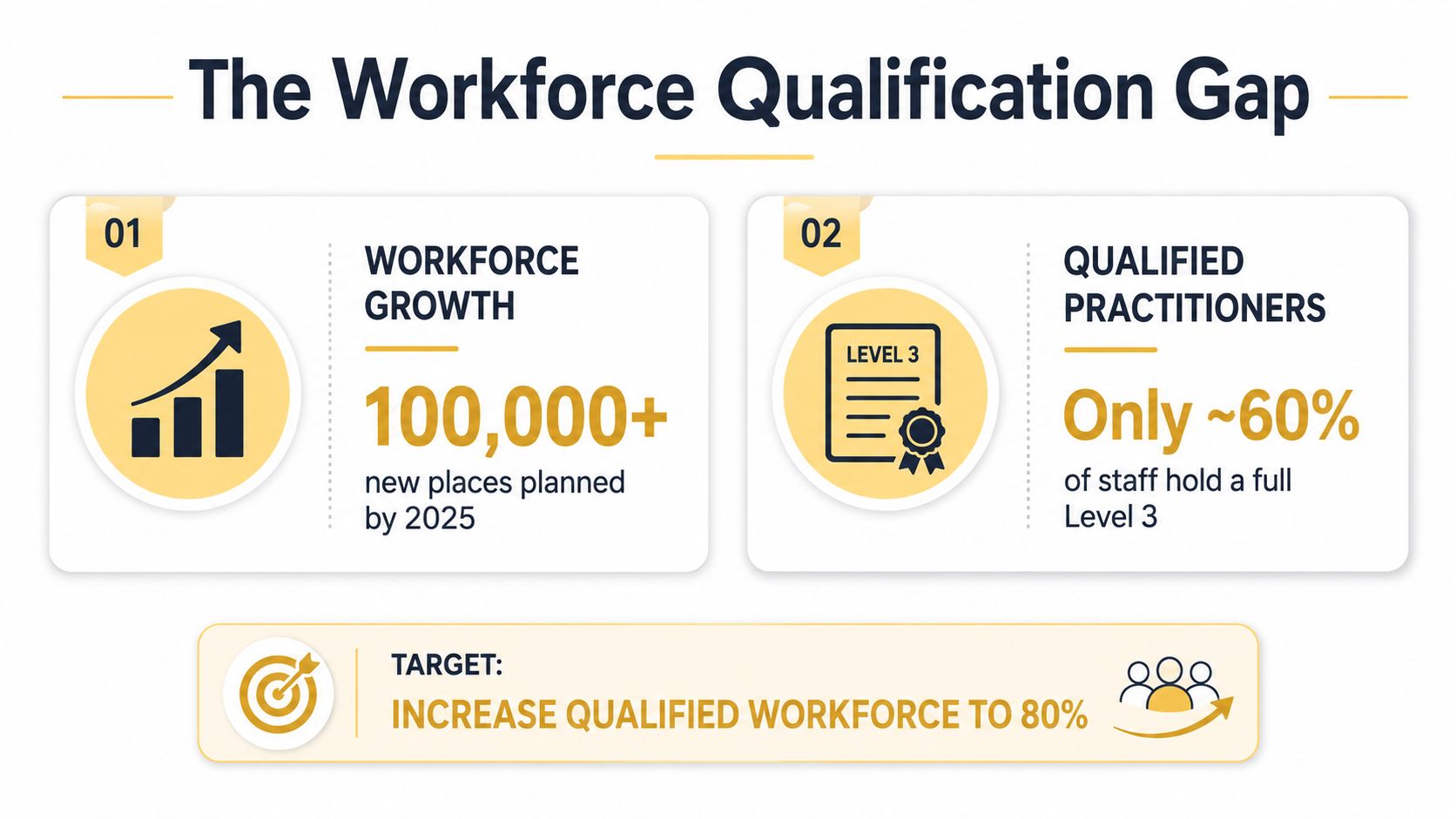
NFER's 2026 workforce analysis for England reports that only about a quarter of the overall early years workforce holds a Level 4 or higher early years or teaching-related qualification. It also identifies a lower-qualified group, with 20% of staff in group-based providers and 24% of childminders qualified to Level 2 or below.
Expansion puts pressure on recruitment
The Department for Education estimated that the expanded funded-hours rollout would require about 40,000 additional staff from September 2025, as recorded in the NFER report. Providers therefore need to fill vacancies while also increasing the qualification depth of their teams.
Recruitment pressure can make immediate availability seem like the answer. It may keep rooms open, but progression becomes harder when new staff lack protected study time, financial support or experienced mentoring. Qualification depth affects more than professional development. It can influence who may work unsupervised, which ratios apply and how many children a room can legally accommodate.
Parents should look beyond a general “qualified team” statement. Ask who leads the room, which practitioners hold Level 3 or Level 6 status, how qualifications are recognised for ratios and what support staff receive to develop. A setting may meet its legal requirements while having relatively few higher-qualified practitioners.
Funding shapes progression
Historical evidence shows how strongly qualification upgrades depend on sustained support. During the Graduate Leader Fund period, the number of early years workers with a bachelor's degree or equivalent rose by 76%, from 16,500 to 29,100, according to Department for Education employer guidance on EYITT. After ring-fenced funding ended, qualification growth stalled.
For managers, encouragement alone is insufficient. A workable workforce plan should identify potential Level 3 and Level 6 candidates, explain available funding and mentoring, and protect learning time where possible. It should also connect each person's qualification route with the rooms and responsibilities they may legally support.
Next Steps for Aspiring Nursery Teachers and Overseas Applicants
Start by deciding which role you want, rather than choosing the first course with “early years” in its title.
- For entry-level applicants: Explore a recognised Level 2 route if you're new to nursery work, then consider progression towards the Level 3 Early Years Educator standard.
- For aspiring practitioners: Compare college courses and apprenticeships carefully, checking that the qualification meets the current EYFS criteria.
- For graduate-level applicants: Review EYITT providers and the EYTS entry requirements, including GCSE grade 4/C in maths, English and science and the first-degree requirement for graduate entrants.
- For overseas teachers: Ask the relevant UK authorities and training providers to assess your existing qualifications. Don't assume an overseas teaching award will count at Level 6 until you've obtained QTS or EYTS.
- For nursery managers: Map every staff member's qualification, expiry-sensitive training and progression goal against the rooms they work in. Use DfE guidance and GOV.UK as the primary checks before changing staffing models.
Career planning also involves practical coordination. If family responsibilities make study, childcare and school commitments difficult to organise, resources about managing therapy and school schedules may help you plan the workload around training.
Before accepting a place, speak directly with the course provider about placements, assessment, funding and progression. Before appointing someone, verify the qualification and ratio status in writing. Those two checks prevent many expensive misunderstandings.
If you're comparing nurseries for your family, use Nursery Advice to review Ofsted information, inspection dates, opening hours, fees guidance and setting details in one place. Shortlist suitable providers, compare them side by side, then contact each nursery to ask who holds Level 3 and Level 6 qualifications in your child's room and how those practitioners support the daily programme.