
Ofsted Inspection Reports: A Parent's Guide
Learn how to read Ofsted inspection reports as a UK parent. Understand school ratings, key findings, and what the grades mean for your child's education.
You've got three nursery tabs open, a cup of tea going cold and a decision that suddenly feels much bigger than it should. One setting has an old Outstanding grade in large type. Another has a colour-coded report card with no obvious overall grade. The third has a PDF from 2019 that praises a manager who no longer works there.
Then the wording starts to wobble. Safeguarding is marked “met” in one report and “not met” in another. One nursery is described as “inadequate” in a particular area but still has a positive overall outcome. A newer report gives you several coloured blocks, but no single word to compare with the other two settings.
That confusion isn't your fault. Ofsted inspection reports are accountability documents, not shopping guides. They record what inspectors found at a particular time, under a particular framework, using language designed to support regulation. Parents need to turn that evidence into a practical decision. That requires more than hunting for the brightest colour or the most impressive grade.
Table of Contents
- When an Ofsted Report Feels Harder to Read Than It Should
- What an Ofsted Inspection Report Actually Is
- Legacy Grades and New Colour-Coded Report Cards
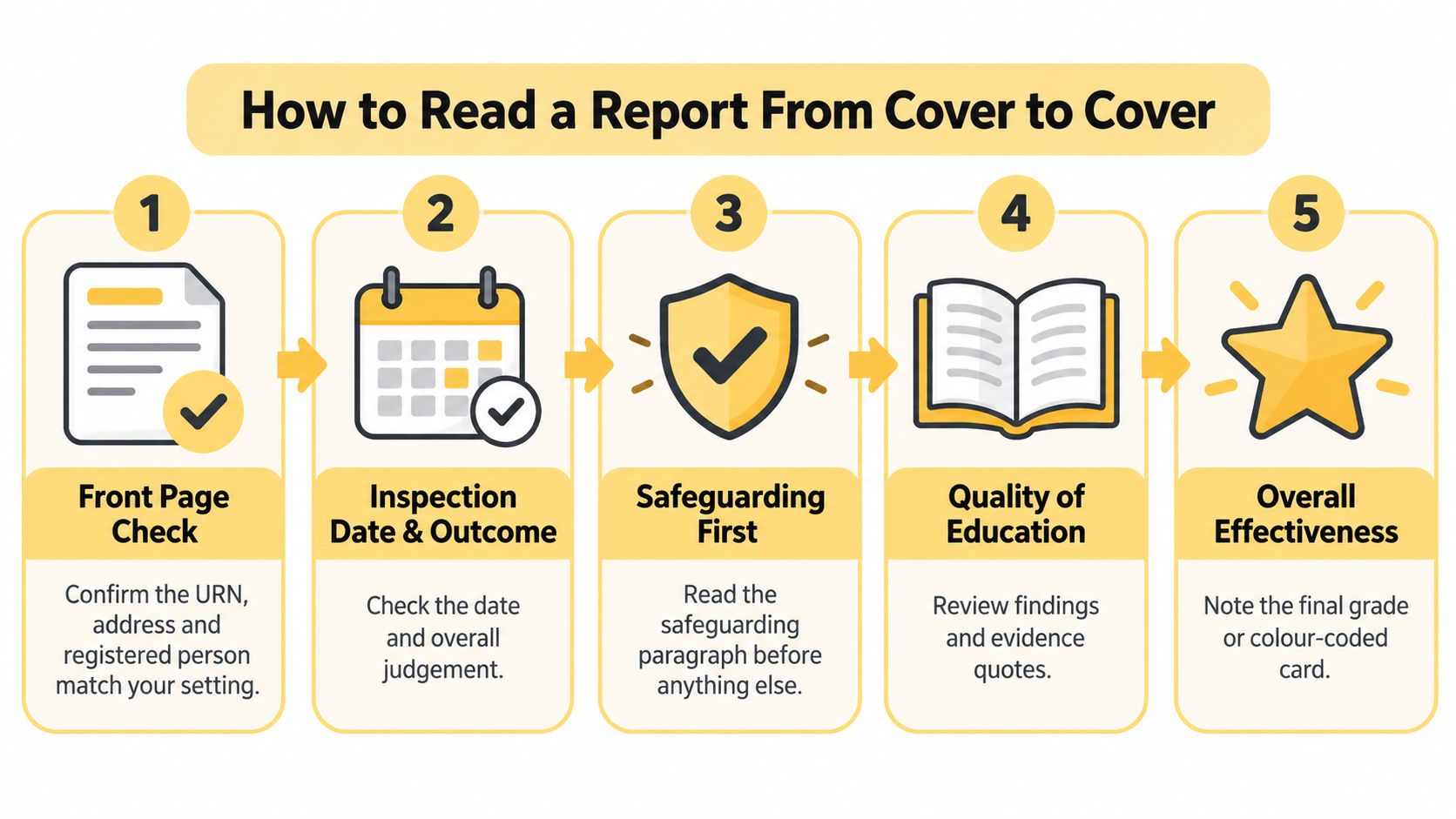
- How to Read a Report From Cover to Cover
- What the 2024-25 Inspection Numbers Really Tell You
- Common Misinterpretations Parents Should Avoid
- Where to Find Reports and How a Directory Keeps Them Fresh
- Your Practical Ofsted Reading Checklist
When an Ofsted Report Feels Harder to Read Than It Should
The parent at the kitchen table usually starts with a simple question: which nursery is safest and most suitable for my child? Within minutes, that question has become a comparison of inspection dates, report formats and phrases that seem designed for professionals.
The first report says Outstanding. It feels reassuring, until you notice the inspection took place years ago. The report describes a manager who has since left, refers to staff who may no longer be at the setting and reflects children, routines and leadership from a different period.
The second report looks newer, but its layout is unfamiliar. A coloured block appears beside quality of education, another beside leadership and management, and safeguarding is listed separately. There isn't one headline word to put into your notes. You find yourself wondering whether a middle colour means the same thing as Good, or whether it signals a serious concern.
The third report uses phrases that sound more alarming than the rest of the document. It says one area is inadequate, yet the overall outcome appears more positive. Elsewhere, the inspector says requirements were met, but recommends improvement. Which sentence should carry the most weight?
The report is a snapshot of a setting, not a guarantee about every day your child will spend there.
The problem is that parents often have to do the interpretation themselves. A report can tell you what inspectors evaluated and what evidence informed their judgements, but it won't tell you whether your child will settle quickly, whether the nursery's meals suit your family or whether the manager will communicate well with you.
You need a reading method that separates safeguarding, education, leadership, inspection timing and current context. Without one, an old positive grade can look more useful than a recent but more detailed report, and a single weak phrase can overshadow evidence that needs a closer reading.
What an Ofsted Inspection Report Actually Is
An Ofsted report is an official record of an inspection of an early years provider in England. For providers on the Early Years Register, inspectors evaluate the setting against the requirements of the Early Years Foundation Stage statutory framework, then publish their findings and judgements.
The document normally gives you the provider's identity, location, inspection date, inspection type and the registered person's details. It also sets out the inspector's findings, the evaluation areas considered, the evidence gathered and any actions the provider must take. The report isn't a collection of parent reviews, and it isn't written to provide a complete description of daily life at the nursery.
Ofsted's official childcare inspection findings explain that inspectors make judgements about quality of education, behaviour and attitudes, personal development, and leadership and management. Those areas sit alongside the statutory requirements that protect children's safety, welfare and development.
The evidence behind the judgement
Inspectors don't write a verbatim transcript of everything they see. The operating guidance requires an evaluative evidence base that explains how findings and provisional judgements were reached. In practice, that means the sentences beneath a grade matter. They show which routines, interactions, records or leadership decisions led to the conclusion.
Ofsted uses a secure fit approach. Inspectors first consider whether the expected standards have been met, then assess whether the evidence supports a stronger or exceptional evaluation. A statutory failure isn't automatically meaningful in isolation. Inspectors must consider its effect on children's learning, development, safety and welfare, but a failure can still lead to action or affect the judgement.
For registered early years settings, full inspections operate under sections 49 and 50 of the Childcare Act 2006. The early years inspection operating guide explains that judgements made at the end of the visit are provisional until Ofsted completes moderation, quality assurance and consistency checks. Ofsted says the final report card is completed in most cases within 18 working days of the inspection ending.
Don't confuse the documents
Search results and provider pages can present several types of information together. A full inspection report contains the inspector's findings and evaluation. An outcome summary is a shorter account of the result. A parent view summary reflects feedback gathered from parents and should not be treated as the inspector's evidence.
The official report is the document to read when you need to understand why Ofsted reached its conclusion. Use shorter summaries to locate the setting and identify the relevant inspection, then open the full report before deciding.
Legacy Grades and New Colour-Coded Report Cards
You may be comparing a nursery with an old Good grade against another with a new colour-coded report card. Treat those documents as evidence from different inspection systems, then judge the setting in front of you.
Reports issued under the previous system used four overall-effectiveness grades: Outstanding, Good, Requires Improvement and Inadequate. They also covered the main evaluation areas, allowing parents to see whether education, behaviour, personal development and leadership broadly matched or pointed to different strengths and weaknesses.
From 10 November 2025, Ofsted replaced the previous single overall-effectiveness judgement for registered childcare providers, including nurseries and childminders, with a report card. The new scale has five grades: urgent improvement, needs attention, expected standard, strong standard and exceptional. Safeguarding is assessed separately as met or not met, under the regulations introducing the new childcare inspection approach.
The two formats cannot be ranked as though they were league-table scores. An older report records a judgement within the framework used at that inspection. A newer report separates its evaluations under the report-card model. Read the comments, evidence and inspection date before deciding which setting looks stronger.
A practical crosswalk
| Legacy grade, pre-November 2025 | New colour-coded report card | What it means for parents | Typical Ofsted action |
|---|---|---|---|
| Outstanding | Exceptional | Evidence indicates provision well beyond the expected standard in the relevant area. Check whether the evidence applies across the setting. | Continued inspection and any actions identified in the report. |
| Good | Strong standard or expected standard | The new report may distinguish between solid expected provision and practice that is stronger. Neither is a direct translation of Good. | Follow the report's findings and any stated next steps. |
| Requires improvement | Needs attention | Inspectors have identified weaknesses that need addressing. Read which area is affected and what children experience as a result. | Improvement action may be required, depending on the findings. |
| Inadequate | Urgent improvement | The provision has serious weaknesses under the relevant evaluation. | Serious regulatory or improvement action may follow the inspection findings. |
| No direct equivalent | Safeguarding met or not met | Safeguarding is assessed separately from educational quality. Read the explanation and the stated response. | A safeguarding judgement of not met requires attention to the stated regulatory response. |
The table provides approximate equivalences only. Inadequate under the old system is not the same label as urgent improvement under the new system, because the frameworks and reporting structures differ. Older grades will remain in circulation alongside newer report cards during the transition, so parents need to recognise which system produced each document.
For a plain-English explanation, read Nursery Advice's guide to the new Ofsted grading system. Use the colour as a prompt, then read the statements beneath it. A setting may show strong educational practice alongside weaker leadership, or positive findings in several areas alongside a safeguarding judgement that demands immediate attention. Also check when the inspection took place, because a report describes provision at that point in time. Changes in managers, staff, premises or routines may make an older result less useful for your decision.
How to Read a Report From Cover to Cover
Read the report in a fixed order. That stops a large Outstanding label or an attractive colour from deciding what you think before you've looked at the details.
Start with identity and timing
Check the setting's name, URN, address and registered person. Make sure the report belongs to the nursery you are considering, particularly if the provider has changed ownership, moved premises or operates several sites.
Next, note the inspection date and inspection type. A report from an inspection without children on roll may not tell you the same thing as a full inspection of an operating nursery. The report should make its scope clear, so don't skip that line.
Read the safeguarding section before the praise. Look for direct findings about recruitment, supervision, reporting concerns, attendance, risk management and child protection. “Safeguarding is effective” is useful, but the supporting explanation tells you whether inspectors tested the systems that matter.
Test the education claims
In quality of education, don't settle for “children learn well”. Look for evidence about what children are expected to learn, how staff build knowledge over time, how language is supported and how practitioners notice what children understand.
Then read behaviour and attitudes and personal development separately. A calm room doesn't prove that children receive effective teaching. A warm account of relationships doesn't answer whether the curriculum meets the needs of children with different starting points.
Leadership and management deserves its own judgement. Inspectors may praise the curriculum while identifying weaknesses in oversight, staff development or the way leaders check the quality of provision. Under a report card, treat each coloured block as an evidence box, not as part of an average score.
Read the next steps as carefully as the compliments. They show what the inspector thinks the provider must do next.
Finish with the previous inspection and the provider's response to earlier weaknesses. A report that says leaders have addressed a previous concern gives you a useful improvement story. A repeated weakness deserves a direct question on your visit.
Use this short video as an additional orientation, not as a replacement for the report itself.
What the 2024-25 Inspection Numbers Really Tell You
National figures are useful for context, but they don't choose a nursery for your child. Ofsted carried out approximately 12,300 inspections of early years and childcare providers in the 2024-25 inspection year, including about 9,540 full inspections of providers registered on the Early Years Register, according to the Ofsted annual report for 2024-25.
Among those full inspections, 90% resulted in an overall-effectiveness judgement of Good or Outstanding. The corresponding figures were 91% for quality of education, 91% for behaviour and attitudes, 90% for personal development, and 90% for leadership and management, under the previous system.
That high proportion changes how you should read the word Outstanding. It isn't useless, but it may distinguish less sharply between settings than parents assume. The report's examples and weaknesses become more valuable than the headline.
The denominator matters
Ofsted reported that the remaining 1,640 inspections involved out-of-school settings or providers with no children on roll at the time of inspection. Those inspections aren't necessarily comparable with full inspections of a nursery currently caring for children.
By 31 August 2025, more than three-quarters of providers on the Early Years Register had received a full inspection, while 98% of providers' most recent inspections were judged Good or Outstanding. The 31 August 2025 childcare statistics make the distinction clear. A latest-outcome figure and a full-inspection figure answer different questions.
| Outcome band | Legacy grades, pre-September 2025 | Report card, post-November 2025 | Approximate share |
|---|---|---|---|
| Good or Outstanding | 90% of full inspections in 2024-25 | No directly equivalent verified share | 90% of full inspections |
| Good or Outstanding at latest inspection | 98% of providers' most recent inspections by 31 August 2025 | No directly equivalent verified share | 98% of latest inspections |
| Report-card outcome | Not applicable | Five area grades, with safeguarding separate | No verified national share supplied |
Don't use the national pattern to excuse a local weakness. Use it to resist the idea that a headline grade tells you everything, then return to the specific report, its date and its inspection scope.
Common Misinterpretations Parents Should Avoid
An old Outstanding grade is not a permanent certificate. Staff change, leaders leave, ownership can change and a nursery's routines can shift. The date is the first piece of context, not a footnote.
A new colour isn't a complete verdict either. It summarises a particular evaluation area, and the statements underneath explain what inspectors saw. If leadership is weaker than education, ask how leaders monitor practice. If personal development is less strong, ask what that means for children's independence, relationships and wider experiences.
What the report cannot prove
A missing report doesn't automatically mean poor quality. A newly registered provider may not yet have an inspection record, and the absence of a recent report isn't proof that a setting is unsafe. Treat it as a reason to ask more questions, not as a grade you can invent.
Nor does a Good report mean perfection. Inspectors can identify areas for improvement inside a broadly positive inspection. Read those areas, then ask the manager what has changed since the visit.
Don't assume an inspection near the start or end of term was less rigorous. Focus instead on the inspection type, whether children were present and what evidence the inspector recorded. An unannounced visit may reveal different aspects of practice from a planned interaction, but neither date alone proves that a report is more or less reliable.
Parent testimonials and provider marketing have a place, but they're separate evidence. Parents can tell you about communication, settling-in and day-to-day experience. They can't replace an inspector's evaluation of statutory compliance or educational practice.
Use the report to identify questions for your visit, not to avoid visiting.
Where to Find Reports and How a Directory Keeps Them Fresh
Start with the official Ofsted reports portal. Search by provider name, URN or postcode, then open the setting's page and check that the address matches. From there, you can view the summary information and download the full report where available.
The official route gives you the source record, inspection date, provider details and historical reports. It also helps you avoid relying on a screenshot copied onto a nursery's website. Save the full report for any setting that reaches your shortlist.
The portal can be awkward for comparison. Filtering several settings side by side isn't straightforward, older reports can sit beneath newer information and the change from grades to report cards makes quick visual comparisons harder. That is where an independent directory can be useful, provided it makes the official source easy to verify.
What a responsible directory should show
Look for four things:
- Source links: The profile should link back to the relevant GOV.UK or Ofsted record.
- Inspection dates: It should show when the judgement was made, not just the current label.
- Format clarity: It should distinguish a legacy grade from a newer colour-coded report card.
- Refresh information: It should explain how often its data is checked and updated.
Nursery Advice is one UK directory option. It presents Ofsted-registered settings with inspection dates, report extracts and links to the full report, and says its Ofsted data is refreshed weekly. That can make shortlisting and comparison easier, but the official report remains the authority. A reputable directory shouldn't rewrite Ofsted's wording, hide an uninspected setting or create a rating where none exists.
Your Practical Ofsted Reading Checklist
After reading any report, write down the answers rather than trusting your first impression. The same checklist works for a legacy report and a new report card.
- Confirm the setting: Check the nursery name, URN, address and registered person. Make sure you're not reading about a predecessor or different branch.
- Record the date: Note when the inspection took place and how long the judgement has been available.
- Identify the inspection scope: Check whether it was a full inspection or another type of inspection, including whether children were on roll.
- Read safeguarding first: Find the child protection and safeguarding findings before the headline grade or colour.
- Compare the areas: Set the overall outcome beside quality of education, behaviour and attitudes, personal development, and leadership and management.
- Mark the weak points: Flag any Requires Improvement judgement, Needs Attention colour or stated improvement action, even if the headline looks positive.
- Check the history: Open earlier reports on the official portal and look for repeated concerns, completed actions or a clear improvement pattern.
The practical advice in this guide to choosing a nursery is useful alongside the report, particularly when you turn written findings into questions for a visit. Ask the manager to explain anything you can't connect to what you see on the day.
An Ofsted report should leave you better informed, not falsely reassured. Choose the setting whose current practice, safeguarding answers, leadership and approach to your child's needs make sense together, then arrange a visit and test that impression in person.
Download the latest reports for your shortlisted nurseries, complete the seven checks above and take your questions to each manager. Don't choose on the brightest grade alone. Choose the setting that can explain its evidence, address its weak points and show you how it keeps children safe and learning well now.