
Nursery Open Day: Your Complete UK Guide for Parents 2026
Everything UK parents need to know about nursery open days: timeline, questions, red flags, and how to use Nursery Advice to shortlist settings before you
UK parents typically book 2-3 nursery visits over a 4-6 week period, with each visit lasting 30-45 minutes, and the most successful parents use a structured checklist rather than winging it. That approach matters when every setting looks polished online but feels very different once you step through the door.
You may be comparing childcare while working, pregnant, returning from parental leave, or trying to secure a place before your preferred start date disappears. A nursery open day can help, but only if you use it to verify the details that affect daily life, not just admire the toys and freshly painted rooms.
The practical rule is simple: check facts on paper before you visit, then use the visit to test whether the advertised experience matches reality. Pay particular attention to safeguarding, staff behaviour, communication, inclusion, settling-in arrangements and the exact funding terms.
Table of Contents
- The Realistic Open Day Timeline for UK Parents
- How to Book and Prepare for Nursery Visits
- What to Verify In Person versus On Paper
- Red Flags and Green Flags to Watch For
- Using Nursery Advice Tools Before and After Visits
- Next Steps After Your Open Day Visits
The Realistic Open Day Timeline for UK Parents
Most parents start too late. They search when childcare is urgently needed, book the first available tour and then try to make a major decision while distracted by work, pregnancy, a tired baby or a looming return-to-work date. That's how important details get missed.
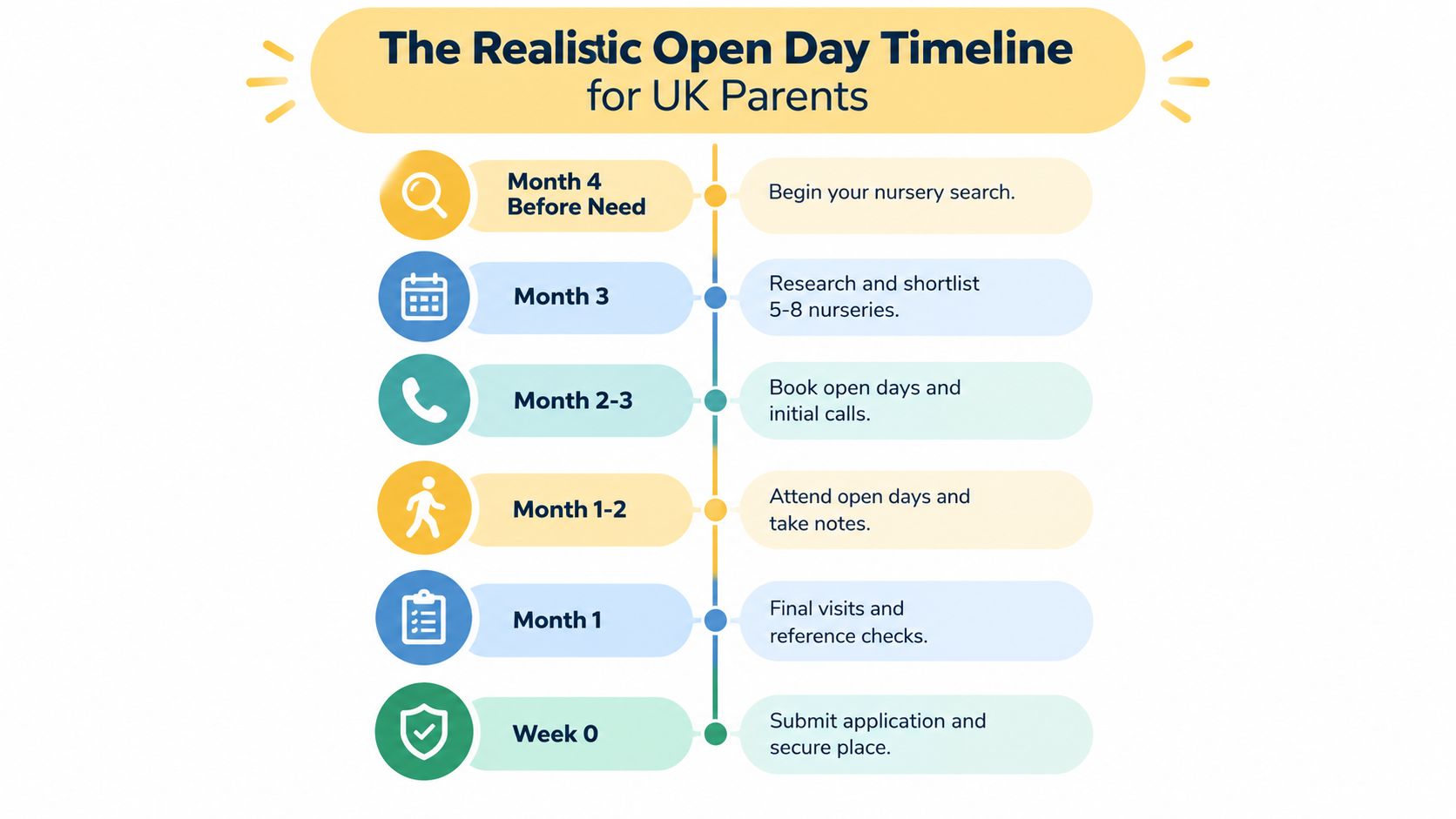
Start your search roughly 3-4 months before you need childcare. Use published information to build a broad shortlist, then reduce it before booking visits. Include the types of provision that might suit your family, such as day nurseries, pre-schools and childminders. A day nursery may offer long, consistent opening hours, while another setting may suit a child who needs a smaller environment or a different routine.
The BCP Council day nursery directory describes day nurseries as usually operating Monday to Friday throughout the year, with possible opening hours between 6am and 8pm. It also describes provision for children from 6 weeks to 5 years. Treat those figures as an operational benchmark, not a promise from every nursery. Your shortlisted setting must confirm its own hours, age range and session pattern.
Spread visits instead of rushing them
Book visits roughly 2-3 weeks apart where possible. That gives you time to read the information from one setting, compare it with the next and notice which questions remain unanswered. Booking several tours in the same week may feel efficient, but it often produces a blur of rooms, names and promises.
A workable calendar looks like this:
| Timing | Action |
|---|---|
| Month 4 before childcare is needed | Search local provision and record hours, age range, inspection information and funding details |
| Month 3 | Shortlist settings that appear workable for travel, sessions and budget |
| Month 2 to 3 | Book visits and ask for written fees, funded-hours terms and closure dates |
| Month 1 to 2 | Attend visits, observe practice and arrange a follow-up where needed |
| Month 1 | Check references, registration steps, settling-in visits and availability |
| Week 0 | Submit the application and confirm the place in writing |
Prioritise settings that accept the funding arrangement your family needs, but don't choose solely on that basis. A place that technically accepts funded hours may still impose session patterns, meal charges, consumable fees or holiday rules that don't work for you.
Practical rule: A nursery open day is only one part of your evidence. Leave enough time for a settling-in visit, a second conversation and a written review of the terms before registration.
If you're also organising pregnancy-related testing and want a separate resource for understanding at-home NIPT testing, keep that research separate from your childcare checklist. Mixing unrelated decisions on the same busy day makes it easier to overlook the questions that affect your child's care.
How to Book and Prepare for Nursery Visits
Don't click “book” on the first available appointment. Contact the nursery and ask for a visit when children are following their normal routine. You want to see arrival, play, meals, outdoor access or rest periods in an ordinary working day, not a carefully staged presentation.
Avoid turning up during the busiest handover period unless that's the only time you can attend. Ask whether you can bring your child, whether a second visit is possible and whether you'll meet the manager or the practitioner likely to become your child's key person. If you work shifts, say so early and ask whether the nursery can offer an appointment outside its usual tour schedule.
Before booking, check the setting's published inspection information, opening hours, fees and age range. Read the guide to choosing a nursery for a broader checklist, then write down the questions specific to your family.
Prepare questions that force useful answers
Broad questions produce rehearsed answers. Ask for operational detail instead:
- Who will comfort my child if they're upset, and how will you tell me what happened?
- How are allergies recorded, communicated and checked during meals?
- What happens if my child needs additional support or a SEND assessment?
- How do you handle naps, bottle feeding, toileting and changes in routine?
- Can I speak with the key person before registration?
- What does settling in involve, and can the plan be adjusted?
- Which hours are funded, which charges remain, and how are holidays handled?
- What happens if I need to change sessions or pause attendance?
The UK Government's childcare policy confirms that, from September 2025, eligible working parents can receive up to 30 hours of funded childcare for 38 weeks a year from the term after a child turns 9 months until school age. It also confirms 15 hours for all 3- and 4-year-olds and 15 hours for eligible 2-year-olds in low-income households. Ask the nursery to explain how those entitlements work in its own sessions, rather than assuming the headline offer equals free attendance. The details are set out in the government childcare policy.
| Task | Where to Find It | Why It Matters |
|---|---|---|
| Check inspection information | Ofsted or the setting's published profile | Establishes the available inspection evidence before you form an impression |
| Read the fee schedule | Nursery website or written fee pack | Reveals deposits, meals, registration fees and payment deadlines |
| Confirm funded-hours terms | Nursery manager and written funding policy | Shows which sessions are covered and which charges remain |
| Record opening hours and closures | Provider profile, handbook and manager | Tests whether care fits work, commuting and holiday arrangements |
| Prepare non-negotiable questions | Your own notes | Stops a friendly tour from distracting you from essential checks |
| Ask about settling in | Manager or key person | Shows how the nursery supports separation and transition |
Take notes immediately after each visit. Record what you saw, not just how you felt. “Warm staff” is useful, but “practitioner noticed a child becoming distressed, crouched beside them and explained the next step” is evidence you can compare.
What to Verify In Person versus On Paper
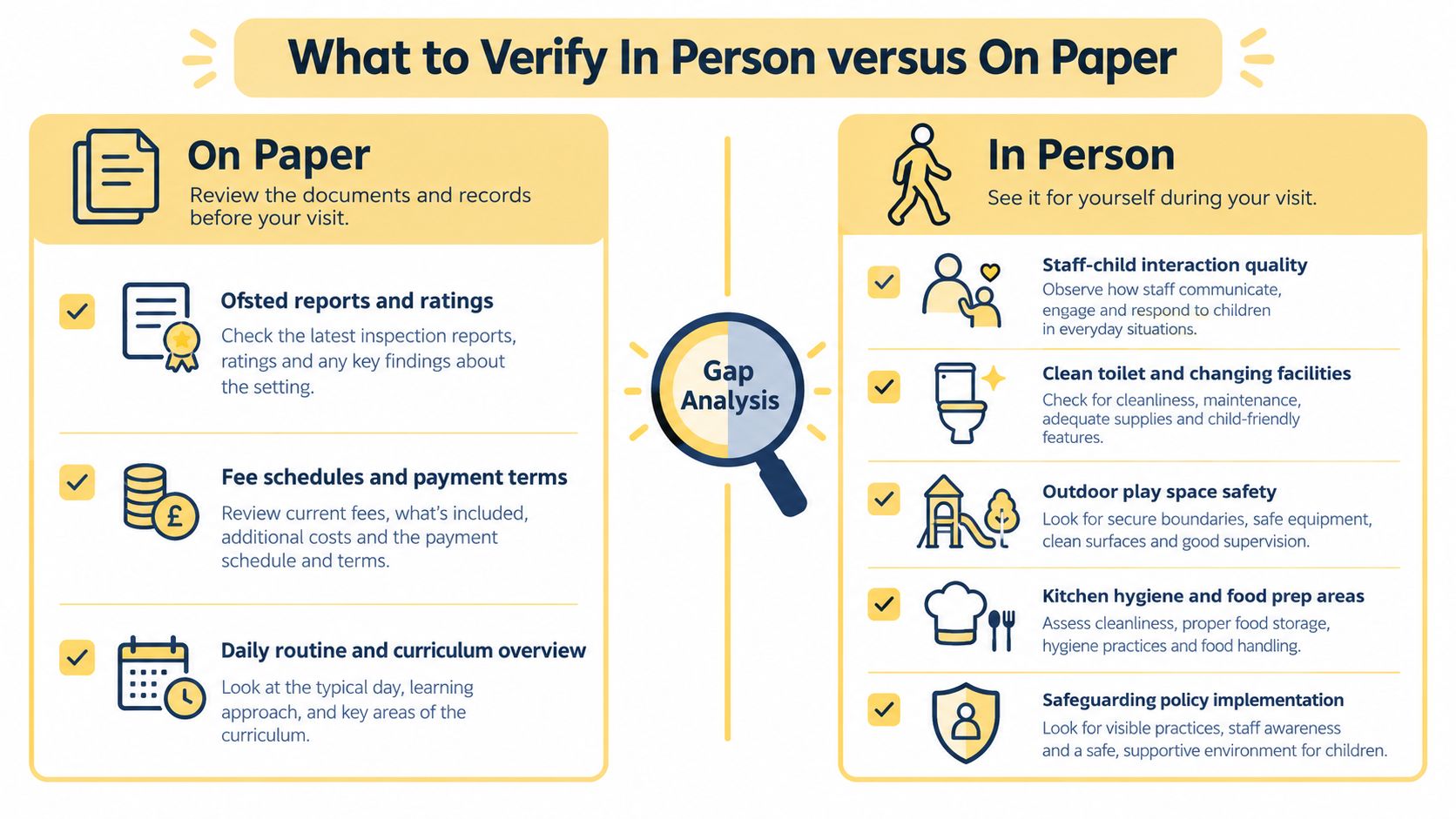
Published information is excellent for narrowing your search. It's much less useful for judging whether adults respond patiently to children, whether the room feels calm or whether the nursery's safeguarding procedures operate in practice.
Check fees, opening hours, funded-hours arrangements, inspection reports and age ranges before the visit. These details shouldn't consume most of your time on site because you can request them in writing and compare them across settings. Leicester County Council advises parents to check opening hours, funded hours, whether the entitlement is stretched across the year and which hours are funded. Its guidance describes many nurseries as operating around 7:30am to 6:30pm and being open for 51 weeks of the year, but your provider must confirm its own model. Read the choosing a childcare provider guidance before you visit.
On paper
You can establish the basic fit without travelling:
- Inspection evidence: Read the report, inspection date and current report format. Don't treat a rating as a substitute for visiting.
- Fees and payment terms: Request a full schedule, including registration charges, deposits, meals, nappies, late collection and holiday payments.
- Hours and sessions: Check earliest drop-off, latest collection, minimum sessions, closures and availability.
- Funding mechanics: Ask how funded hours are allocated, whether charges remain and whether sessions can be split.
- Routine overview: Read the setting's description of meals, naps, outdoor play, key-person arrangements and learning.
Devon County Council explains that funded childcare can be used across 7 days a week between 6am and 8pm, with a maximum of 10 hours claimed in one day. It also says funding can be split between providers, although a child can't be funded at more than two providers in one day. That's exactly the sort of detail to verify before a visit, especially if you're combining nursery care with another arrangement. The full mechanics appear in Devon's early years funding guidance.
In person
The visit tests the gap between description and daily reality. Watch what happens when a child cries, refuses an activity, spills a drink or moves away from the group. Look at whether practitioners notice those moments without being prompted.
Inspect the less glamorous areas. Check toilets, changing spaces, handwashing, outdoor gates, sleeping areas and food preparation arrangements. Ask to see safeguarding and emergency procedures, then listen for a clear explanation rather than vague reassurance. If you want a separate reference, this daycare cleaning guide can help you understand the practical hygiene details worth observing.
Staffing deserves direct questions. Ask about the team's qualifications, continuity and cover for absence, then observe whether adults know the children well. The nursery staff ratios guidance can help you prepare, but the visit should show whether staff are attentive, available and able to respond to individual children.
A website tells you what the nursery wants families to know. A visit shows you what children experience when nobody is presenting the setting.
Red Flags and Green Flags to Watch For
A parent once described leaving a nursery feeling impressed by the manager's presentation but uneasy about the room itself. During the tour, two practitioners spoke to the visitors while a child played alone nearby. Nobody was rude, and nothing dramatic happened. The problem was that the adults seemed more focused on selling the setting than noticing the children.
That's the kind of detail you should trust. A nursery open day isn't an audition where you need to be agreeable. You're watching how adults behave when they're busy, how they speak about children and whether the setting welcomes scrutiny.
Read the room, not the sales pitch
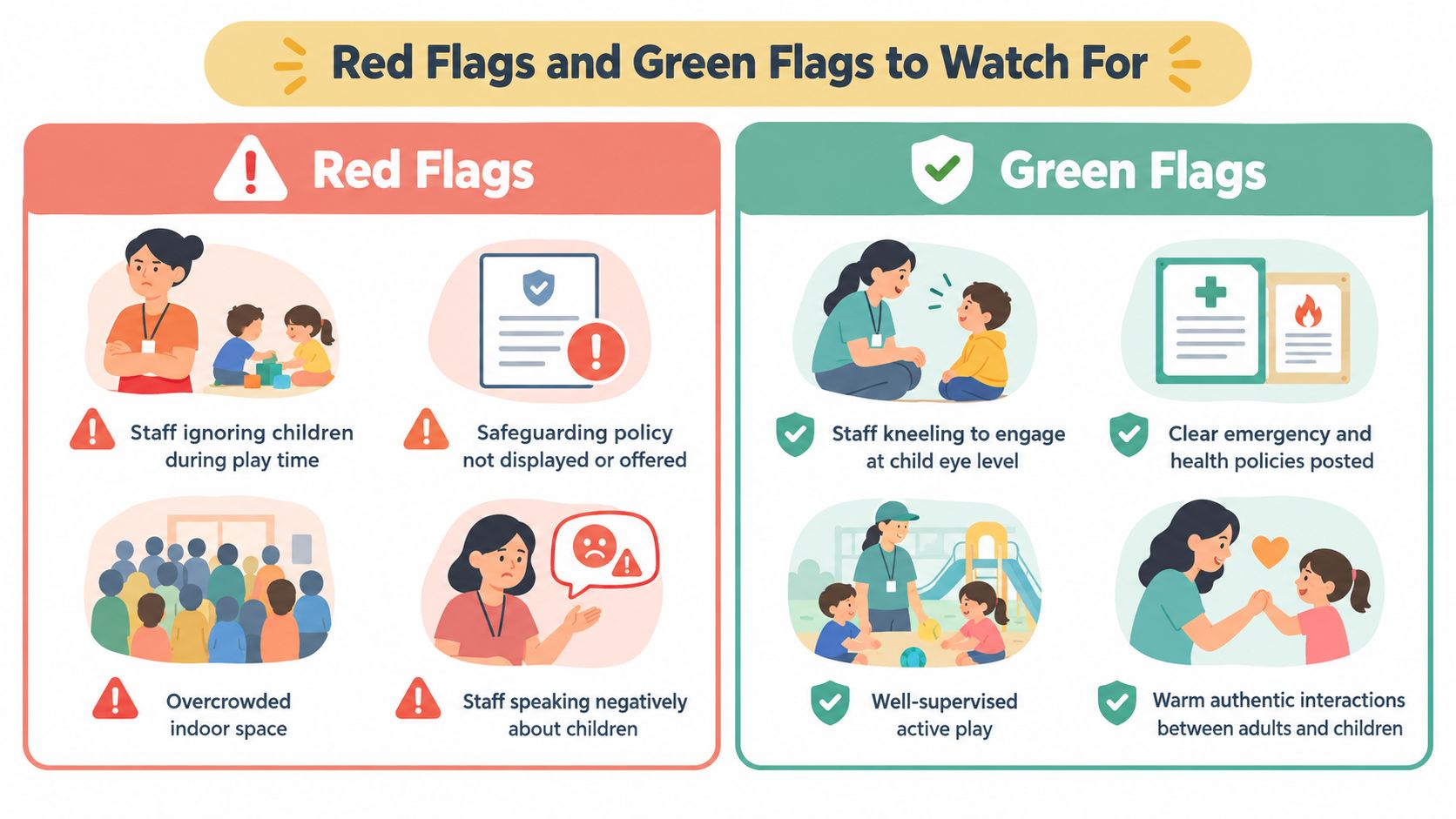
Red flags include:
- Detached adults: Staff ignore children during play, remain physically distant or speak across the room instead of engaging.
- Unclear safeguarding: The manager can't explain visitor control, collection arrangements, allegations procedures or who holds safeguarding responsibility.
- Crowded spaces: Rooms feel cramped, children struggle to move freely and staff can't explain how supervision works.
- Negative language: Adults describe children as difficult, naughty or troublesome, particularly in front of families or other children.
- Pressure to commit: You're pushed to pay a deposit or accept a place before receiving clear written terms or having time to ask questions.
Green flags are quieter but more meaningful. A practitioner notices a child's mood, lowers themselves to eye level and responds without making a performance of it. Staff explain what children are doing, invite questions and admit when they need to check an answer. The manager discusses fees plainly, including charges that may not be covered by funding.
Look for evidence of partnership, particularly if your child has allergies, SEND, a medical need or difficulty separating. The UK guidance on working with parents and carers emphasises communication and collaboration. Ask how information moves between home and the setting, who records concerns and how transitions are supported.
| Look For | Good Sign | Concern |
|---|---|---|
| Adult response to distress | Staff notice, comfort and explain what they're doing | Child remains upset while adults carry on |
| Conversation about behaviour | Respectful, specific language about needs and development | Labels, blame or dismissive comments |
| Safeguarding | Policies are available and explained clearly | Answers are vague or defensive |
| Outdoor play | Children use a safe, supervised space | Outdoor access is promised but rarely used |
| Food and allergies | Staff describe recording, checking and communication | Responsibility is passed between staff |
| Questions from parents | The team welcomes follow-up and gives written answers | You're hurried towards registration |
Watch the video only as supplementary preparation. Your own observations matter more because they relate to the particular room, staff team and child you're considering.
Using Nursery Advice Tools Before and After Visits
Use a directory as a screening tool, not as a replacement for seeing the nursery. Start with the practical filters: location, age range, opening hours, funded-hours availability, SEND support and inspection date. Remove settings that fail an essential requirement before you spend time arranging a tour.
Ofsted's early years inspection framework changed on 10 November 2025. The new system moves settings to inspections every 4 years rather than every 6, replaces the single overall-effectiveness judgement with a report card and introduces a five-point grading scale. The official Ofsted reform announcement explains the change. Read the report card for findings and context. Don't reduce it to a colour or label without understanding what inspectors observed.
Build a shortlist you can defend
Record each setting against the same fields:
- Practical fit: Distance, opening hours, session pattern and holiday closures.
- Financial fit: Published fees, funded-hours deductions, deposits and additional charges.
- Evidence quality: Inspection date, report findings and whether the profile is current.
- Child fit: Outdoor space, routines, sleep arrangements, food and likely key-person approach.
- Family fit: Communication, SEND support, settling in and flexibility for work patterns.
After visiting, compare your notes with the directory information. If the profile says the nursery offers garden access but the visit shows restricted use, ask why. If the published fee guidance is incomplete, request the full terms in writing before you treat the setting as viable.
Nursery Advice can be used as one option for filtering UK early-years settings, checking profile information and comparing shortlisted providers. It also provides a saved list and side-by-side comparison, which is useful when two nurseries appear similar but differ in hours, inspection evidence or fees guidance.
Don't let childcare costs remain an unexplained source of stress. Once you know the likely fee structure, use separate practical budgeting and investing tools to organise household planning. That won't answer whether a nursery is suitable, but it can help you evaluate the wider financial commitment clearly.
Next Steps After Your Open Day Visits
Don't choose in the car park. Wait until you've written down what you saw, what remains uncertain and how each setting meets your actual requirements. Memory favours the nursery with the nicest room or most confident manager, even when another setting offered better communication and a more workable routine.
Create a simple decision matrix and score only evidence you can explain:
| Decision area | Setting A | Setting B | Setting C |
|---|---|---|---|
| Hours and travel fit | |||
| Written fee clarity | |||
| Funding arrangement | |||
| Staff interaction | |||
| Safeguarding confidence | |||
| SEND and allergy support | |||
| Settling-in flexibility |
Use notes rather than arbitrary scores if numbers make the decision feel false. Mark each point as confirmed, unclear or concerning. Any “unclear” item should trigger an email or second visit, not an optimistic assumption.
Confirm the place properly
Ask about availability, waiting lists, registration forms, deposits, notice periods and the date by which you must accept. Request the parent contract and fee schedule before paying anything. Check whether a deposit is refundable, when it becomes part of your account and what happens if your start date changes.
If you're relying on funded hours, apply through the relevant government process in good time and ask the nursery what evidence it needs. Funding rules affect session timing, daily limits and provider arrangements, so keep written confirmation rather than relying on a verbal explanation.
A second visit is justified when the first one was staged, rushed or missing the person who would manage your child's daily care. Bring your child where possible and observe whether staff engage naturally, whether your child relaxes and whether the nursery responds to your questions without pressure.
Choose the setting whose ordinary practice you can understand, verify and afford. A polished open day matters less than dependable care on an ordinary Tuesday.
The next action is straightforward. Shortlist the settings that meet your essentials, request written fees and funding terms, book visits at ordinary operating times and take the completed observation guide with you. Then contact your preferred nursery within a few days of visiting to confirm availability, arrange a follow-up and secure the place before your childcare plans become urgent.